
.jpg)
What is serpentine?
Serpentine-group minerals have approximate composition Mg₃Si₂O₅(OH)₄ with substitutions including iron and other elements. Major forms include antigorite, lizardite, and chrysotile; visual appearance alone may not establish which is present.
What does serpentine look like?
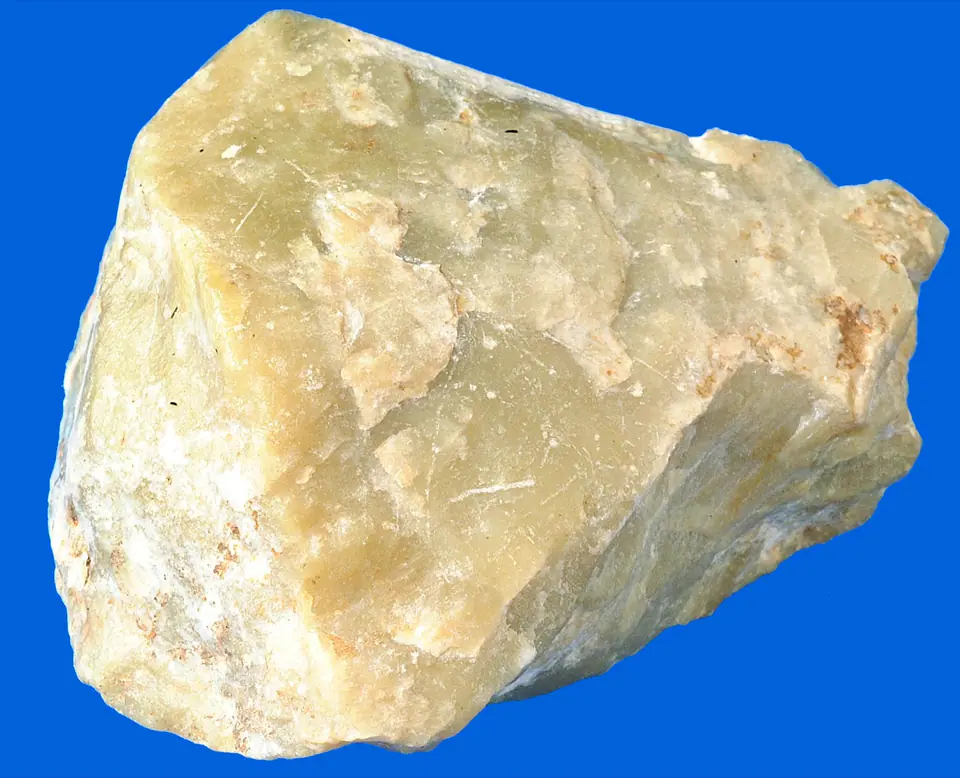
Serpentine occurs as platy, massive, scaly, mesh-textured, vein-filling, silky, or fibrous material. Colors range from pale yellow-green to dark green, gray, white, brown, or mottled patterns.
Massive serpentine can resemble jade, soapstone, green carbonate minerals, or altered volcanic rock. Fibers can be microscopic even where the hand sample does not look obviously fibrous.
Identification tests
Begin with observation and use the least destructive test first. Results can change with weathering, mixtures, coatings, and grain size. Review the step-by-step field-test methods before altering an unfamiliar specimen.
Hardness
Variable, commonly about 2.5 to 4Most varieties are scratched by steel; some are scratched by a fingernail.
Luster and feel
Waxy, greasy, silky, or smoothSupports serpentine but overlaps talc and other soft minerals.
Acid response
Generally no strong broad fizzStrong reaction suggests carbonate mixed with or replacing serpentine.
Certainty limit
Species and fiber type may require microscopy or diffractionDo not handle or disturb uncertain fibrous material.
Useful procedures: Mohs hardness test · Acid reaction test
Common lookalikes
How does it form?
Serpentine minerals form when water alters magnesium-rich ultramafic rocks such as peridotite and dunite, a process called serpentinization.
They occur in serpentinite bodies, fault zones, oceanic-rock assemblages, and hydrothermal systems, commonly with magnetite, talc, carbonate, chlorite, or brucite.
Geologic setting and occurrence
Serpentine minerals occur in ultramafic belts, ophiolites, mélanges, and faulted mountain regions, including parts of California, Oregon, Washington, Alaska, and the Appalachians.
Occurrence does not mean all material is asbestos, but uncertain fibrous serpentinite should be treated conservatively.
Uses and significance
Attractive massive serpentine has been used as decorative and carving stone. Chrysotile was historically mined as asbestos; disturbance and exposure are now regulated because inhaled asbestos fibers cause serious disease.
Field notes
- Never scrape, saw, crush, or collect visibly fibrous material.
- Do not bring uncertain fibrous specimens into living spaces.
- Professional asbestos identification requires appropriate sampling and laboratory methods.
This guide supports preliminary field identification, not a laboratory determination, appraisal, hazard assessment, or statement of ownership or collecting permission. Verify land status and local rules before handling or collecting material.
Authoritative sources
LithoMap wrote this guide in original language using the scientific concepts and physical-property standards supported by these sources.
- Minerals and their physical properties U.S. National Park Service
- Mohs Hardness Scale U.S. National Park Service
- Natural Gemstones: Mineral Gemstones U.S. Geological Survey
Editorial review: September 17, 2026.