
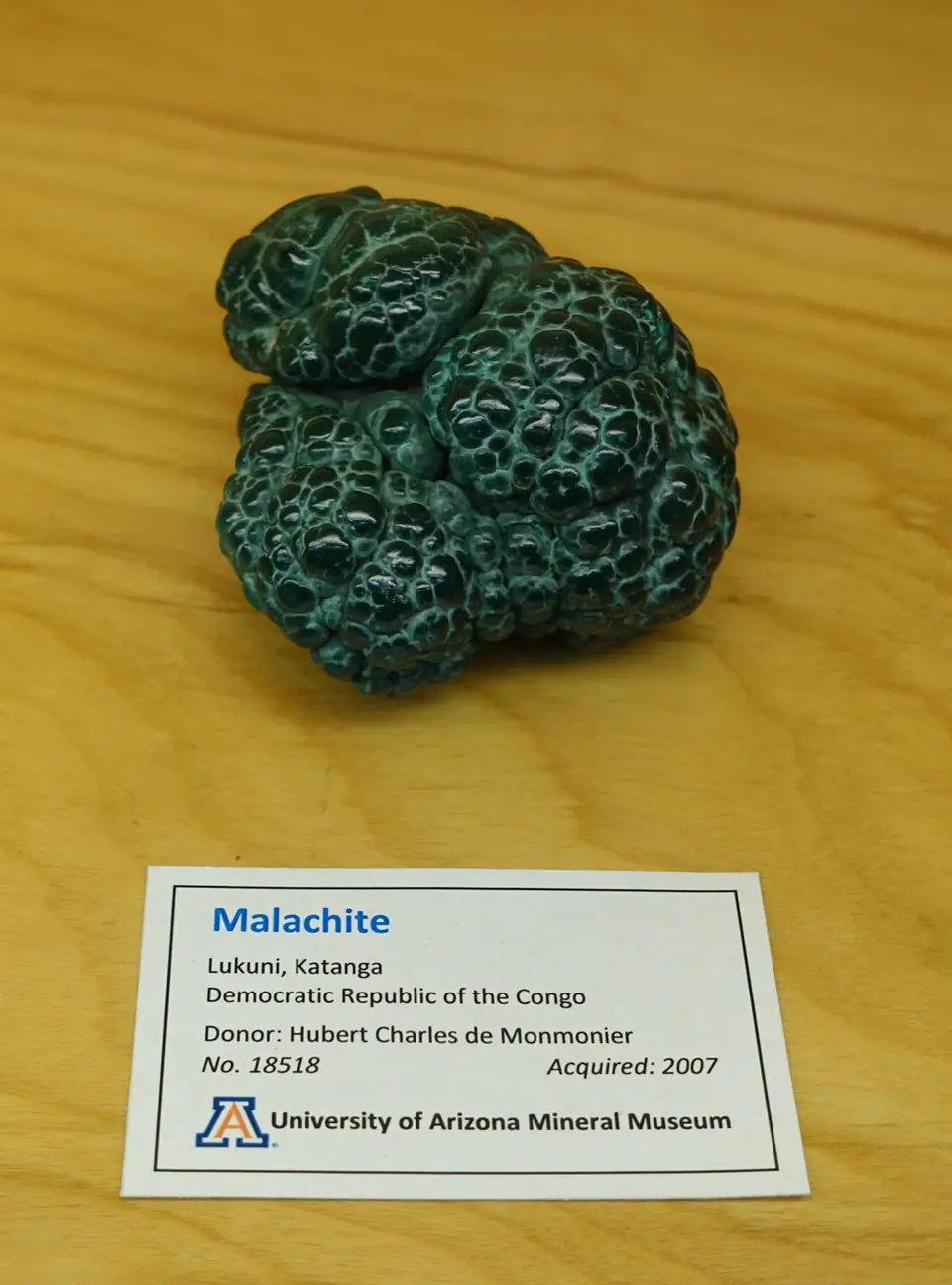

What is malachite?
Malachite contains copper, carbonate, and hydroxide. It commonly grows with azurite, chrysocolla, cuprite, limonite, and remnants of primary copper sulfides. Color intensity does not measure copper grade or specimen safety.
What does malachite look like?
Malachite forms rounded botryoidal surfaces, concentric bands, fibrous crusts, stalactitic shapes, earthy coatings, and uncommon crystals. Polished material displays distinctive light and dark green banding.
Thin films and stains can coat unrelated rock. A green surface alone is insufficient without streak, texture, and geological context.
Identification tests
Begin with observation and use the least destructive test first. Results can change with weathering, mixtures, coatings, and grain size. Review the step-by-step field-test methods before altering an unfamiliar specimen.
Hardness
About 3.5 to 4Scratched by steel but generally resists a fingernail.
Streak
GreenA major clue that distinguishes many green silicates and stains.
Acid response
Reacts with acidConsistent with a carbonate but destructive and capable of mobilizing copper; avoid casual testing.
Habit
Banded, botryoidal, fibrous, or earthyConcentric green structure strongly supports malachite.
Useful procedures: Mohs hardness test · Mineral streak test · Acid reaction test
Common lookalikes
Azurite
Deep blue with a blue streak; the minerals commonly occur together or replace one another.
Chrysocolla
Usually blue-green, softer or variable, and lacks malachite’s consistent green streak and banding.
Green staining or paint
May coat surfaces without mineral structure and can occur near human activity.
How does it form?
Malachite forms near the surface when oxygenated, carbonate-bearing water alters primary copper minerals in the oxidation zone of a deposit.
It can fill fractures and cavities or replace earlier minerals. Changes in fluid chemistry may produce intergrowths or partial replacements with azurite.
Geologic setting and occurrence
Malachite is widespread in the weathered upper parts of copper deposits and may indicate copper mineralization beneath or nearby.
A showy surface coating does not establish deposit size, depth, grade, ownership, or collecting permission.
Uses and significance
Malachite has served as a copper ore, pigment, ornamental stone, carving material, and collectible mineral. Dust from cutting or polishing copper minerals requires proper controls.
Field notes
- Do not lick, grind, or dry-polish malachite; avoid copper-bearing dust.
- Wash hands after handling earthy or powdery specimens.
- Historic mine workings and waste rock may be unstable, claimed, and chemically contaminated.
This guide supports preliminary field identification, not a laboratory determination, appraisal, hazard assessment, or statement of ownership or collecting permission. Verify land status and local rules before handling or collecting material.
Authoritative sources
LithoMap wrote this guide in original language using the scientific concepts and physical-property standards supported by these sources.
- Assessment of Selected Copper Minerals in Mine Wastes U.S. Geological Survey
- Copper Statistics and Information U.S. Geological Survey
- Minerals and their physical properties U.S. National Park Service
- Mohs Hardness Scale U.S. National Park Service
- Natural Gemstones: Mineral Gemstones U.S. Geological Survey
Editorial review: September 17, 2026.