
.jpg)
What is copper?
Native copper is elemental Cu, although natural material can contain small amounts of silver, arsenic, iron, or other elements. Green coatings may be secondary copper minerals, but a green stain alone does not prove that native copper is present beneath it.
What does copper look like?
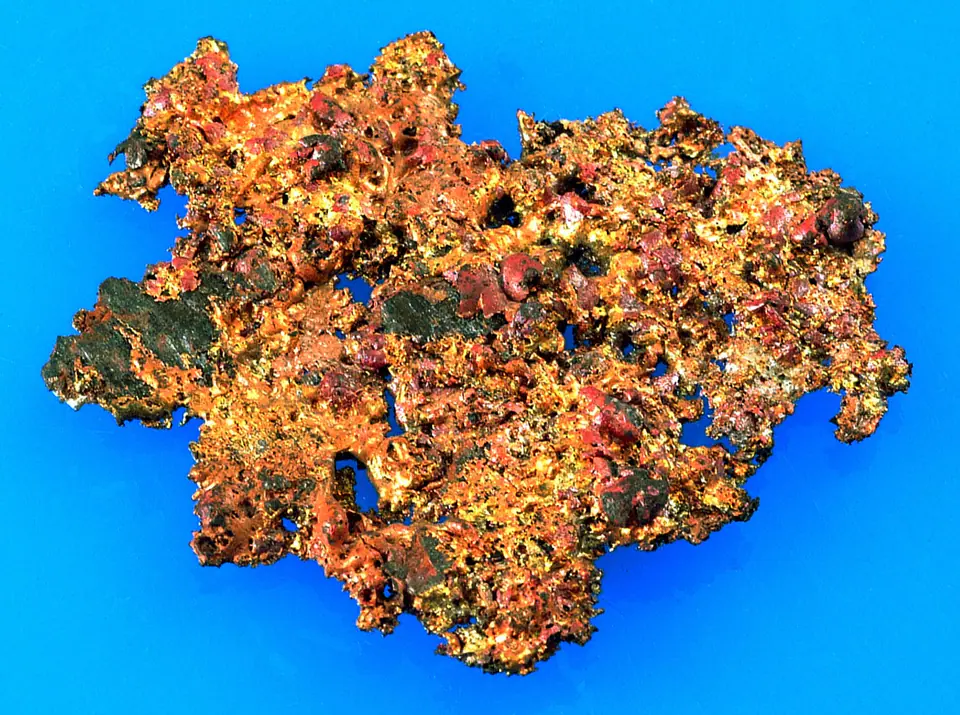
Native copper occurs as irregular masses, sheets, wires, branching dendrites, grains, and uncommon crystals. Fresh metal is pinkish copper-red rather than brass-yellow.
Oxidation may hide the metal under dark oxides or green carbonate minerals. A carefully observed existing break can reveal the diagnostic interior without damaging an intact specimen.
Identification tests
Begin with observation and use the least destructive test first. Results can change with weathering, mixtures, coatings, and grain size. Review the step-by-step field-test methods before altering an unfamiliar specimen.
Hardness
2.5 to 3Scratched by steel and similar in hardness to gold, but color differs.
Streak
Copper-redA fresh streak differs from the dark streak of most copper sulfides.
Tenacity
Malleable, ductile, and sectileA loose expendable grain bends or flattens instead of shattering.
Density
High; specific gravity about 8.9Feels heavy compared with common rock, though far less dense than gold.
Useful procedures: Mohs hardness test · Mineral streak test · Specific gravity and density test
Common lookalikes
Gold
Richer yellow, much denser, and yellow-streaked rather than copper-red.
Chalcopyrite
Brass-yellow, brittle, and greenish-black-streaked rather than malleable.
Manufactured copper
Wire, fragments, slag, and industrial debris require context; regular form or nearby infrastructure may indicate a human source.
How does it form?
Native copper forms where geological processes reduce copper-bearing fluids or minerals to elemental metal. Important settings include basalt-hosted deposits, hydrothermal veins, and oxidation or enrichment zones above some copper sulfide deposits.
It can occur with calcite, quartz, zeolites, silver, cuprite, malachite, and other copper minerals. Association supports context but does not establish purity or value.
Geologic setting and occurrence
Native copper is much less common than copper-bearing sulfides and oxides. In the United States, the Lake Superior region is famous for basalt-hosted native copper, but occurrences exist in several other geological settings.
A metallic fragment near a road, mine, building, or utility corridor may be manufactured copper. Geological context and attached matrix matter.
Uses and significance
Most modern copper comes from ore minerals rather than native metal. Copper is essential in electrical wiring, electronics, construction, plumbing, transportation, alloys, and renewable-energy systems.
Field notes
- Do not scrape valuable specimens merely to expose fresh metal.
- Treat mine dumps and underground workings as potentially unstable and contaminated.
- Confirm land ownership and collecting rules before removing material.
This guide supports preliminary field identification, not a laboratory determination, appraisal, hazard assessment, or statement of ownership or collecting permission. Verify land status and local rules before handling or collecting material.
Authoritative sources
LithoMap wrote this guide in original language using the scientific concepts and physical-property standards supported by these sources.
- Copper Statistics and Information U.S. Geological Survey
- Minerals and their physical properties U.S. National Park Service
- Mohs Hardness Scale U.S. National Park Service
- Natural Gemstones: Mineral Gemstones U.S. Geological Survey
Editorial review: September 17, 2026.