
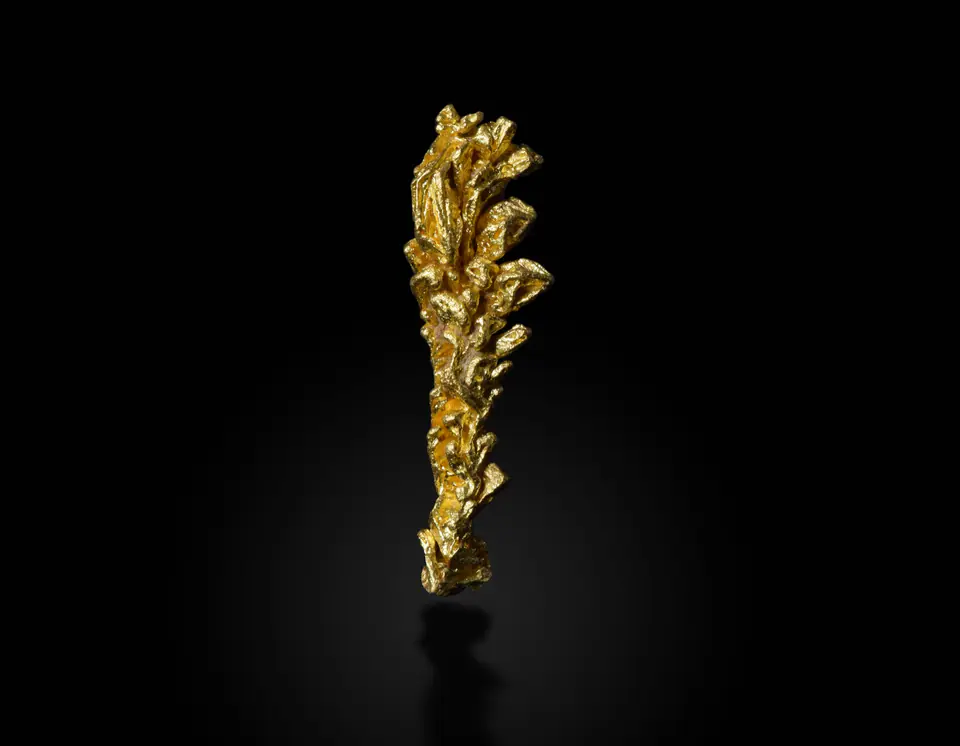
What is gold?
Native gold is elemental Au, commonly alloyed naturally with silver and smaller amounts of copper or other metals. Increasing silver content can make the color paler. Visible gold does not establish the grade or economic value of the surrounding rock.
What does gold look like?
Gold occurs as irregular grains, flakes, wires, dendrites, nuggets, and microscopic particles. Natural crystals are possible but much less common than rounded or distorted forms.
Its metallic yellow color persists on fresh surfaces and in a streak. Thin flakes may look bright against dark sediment, but apparent size is easily exaggerated by reflection.
Identification tests
Begin with observation and use the least destructive test first. Results can change with weathering, mixtures, coatings, and grain size. Review the step-by-step field-test methods before altering an unfamiliar specimen.
Hardness
2.5 to 3Scratched by copper or steel and much softer than pyrite.
Streak
Metallic yellowDistinct from the dark streak of pyrite or chalcopyrite.
Tenacity
Malleable and sectileA loose grain deforms or cuts rather than crumbling, when testing is lawful and nondestructive value is not a concern.
Density
Very high; pure gold has specific gravity near 19.3A substantial grain feels unusually heavy, but mixtures and tiny flakes are difficult to judge.
Useful procedures: Mohs hardness test · Mineral streak test · Specific gravity and density test
Common lookalikes
Pyrite
Paler brass-yellow, much harder, brittle, dark-streaked, and commonly cubic.
Chalcopyrite
Brass-yellow, brittle, commonly tarnished, and leaves a greenish-black streak.
Mica
Forms light, flexible flakes with nonmetallic pearly reflections and very low density.
How does it form?
Gold is concentrated by hydrothermal fluids in veins, shear zones, replacement bodies, and disseminated deposits, and it also occurs in some magmatic and metamorphic systems.
Because gold is dense and resistant to weathering, erosion can concentrate liberated grains in placer deposits, especially in bedrock traps and selected stream sediments.
Geologic setting and occurrence
Gold occurs in many deposit types, but visible grains are uncommon even in productive ore. Placer gold may be transported downstream and mixed with magnetite, garnet, sulfides, and man-made metallic debris.
Appearance cannot establish ownership, claim status, purity, weight, or value. Assay and professional examination are needed for consequential decisions.
Uses and significance
Gold is used in jewelry, electronics, dentistry, aerospace, investment products, and specialized coatings because it is conductive, workable, corrosion resistant, and visually distinctive.
Field notes
- Do not use mercury or improvised chemical extraction methods.
- Check mining claims, private ownership, tribal jurisdiction, and collecting rules before prospecting.
- Historic mine waste may contain arsenic, lead, mercury, or acid-generating sulfides.
This guide supports preliminary field identification, not a laboratory determination, appraisal, hazard assessment, or statement of ownership or collecting permission. Verify land status and local rules before handling or collecting material.
Authoritative sources
LithoMap wrote this guide in original language using the scientific concepts and physical-property standards supported by these sources.
- Gold Statistics and Information U.S. Geological Survey
- Minerals and their physical properties U.S. National Park Service
- Mohs Hardness Scale U.S. National Park Service
- Natural Gemstones: Mineral Gemstones U.S. Geological Survey
Editorial review: September 17, 2026.