
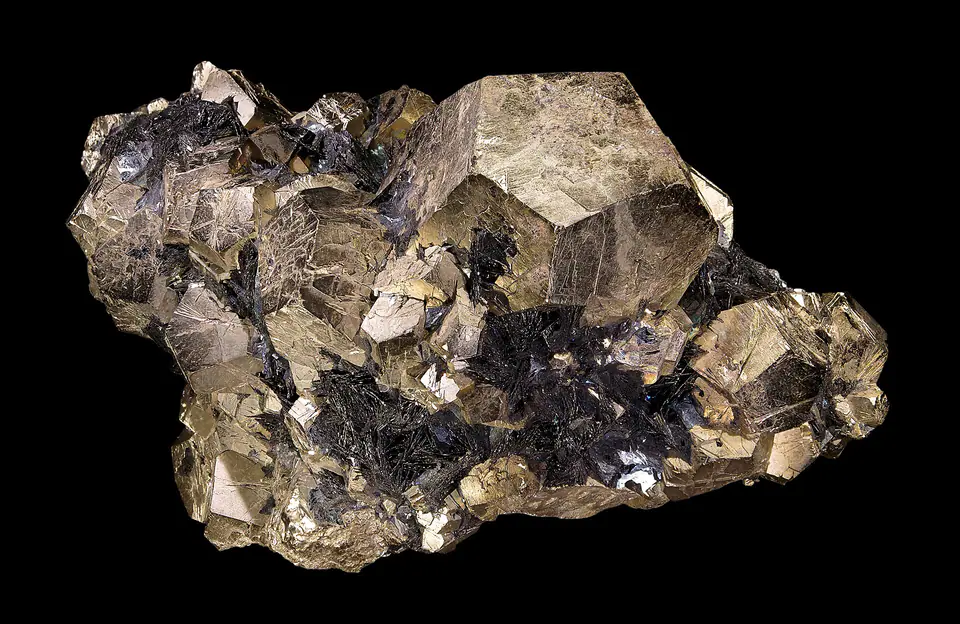

What is pyrite?
Pyrite is iron disulfide. Trace elements can occur, but bright color does not establish precious-metal content.
What does pyrite look like?
Fresh pyrite is bright metallic and pale brass-yellow. Tarnish may darken surfaces or produce iridescent films, while weathering can create rusty iron oxides and acidic sulfate products.
Crystals often form cubes with fine parallel striations on adjacent faces oriented in different directions. It also occurs as nodules, disseminated grains, or massive material.
Identification tests
Begin with observation and use the least destructive test first. Results can change with weathering, mixtures, coatings, and grain size. Review the step-by-step field-test methods before altering an unfamiliar specimen.
Hardness
6 to 6.5Scratches glass and cannot be cut or flattened like native gold.
Streak
Greenish-black to brownish-blackStrongly different from gold’s yellow streak.
Tenacity
BrittleBreaks or powders instead of bending or flattening.
Magnetism
Not strongly magneticSeparates it from magnetite, though mixed samples complicate the test.
Useful procedures: Mohs hardness test · Mineral streak test · Mineral magnetism test
Common lookalikes
Gold
Gold is much denser, malleable, softer, and leaves a yellow streak.
Chalcopyrite
Usually deeper yellow, softer, and commonly tarnishes iridescently without pyrite’s typical striated cubes.
Mica
Reflective flakes are nonmetallic, flexible, and much softer.
How does it form?
Pyrite forms in hydrothermal veins, igneous and metamorphic rocks, and oxygen-poor sedimentary environments where iron and sulfur combine.
It can replace fossils or occur in coal and shale. Exposure to air and water promotes oxidation, which may generate acidity and iron staining.
Geologic setting and occurrence
Pyrite is widespread in many rock types and ore deposits. Its presence is not proof of gold, silver, or an economic deposit.
Oxidized pyrite may be absent at the surface even where it remains below, leaving rusty gossan or sulfate minerals.
Uses and significance
Pyrite has historically supplied sulfur and sulfuric acid and remains important as an indicator mineral and source of environmental acidity in disturbed rock.
Field notes
- Wash hands after handling sulfide-rich material.
- Do not heat or conduct chemical tests on pyrite outside a laboratory.
- Mine waste can generate acidic drainage and contain hazardous metals; avoid disturbing it.
This guide supports preliminary field identification, not a laboratory determination, appraisal, hazard assessment, or statement of ownership or collecting permission. Verify land status and local rules before handling or collecting material.
Authoritative sources
LithoMap wrote this guide in original language using the scientific concepts and physical-property standards supported by these sources.
- Minerals and their physical properties U.S. National Park Service
- Mohs Hardness Scale U.S. National Park Service
- Natural Gemstones: Mineral Gemstones U.S. Geological Survey
Editorial review: September 17, 2026.