
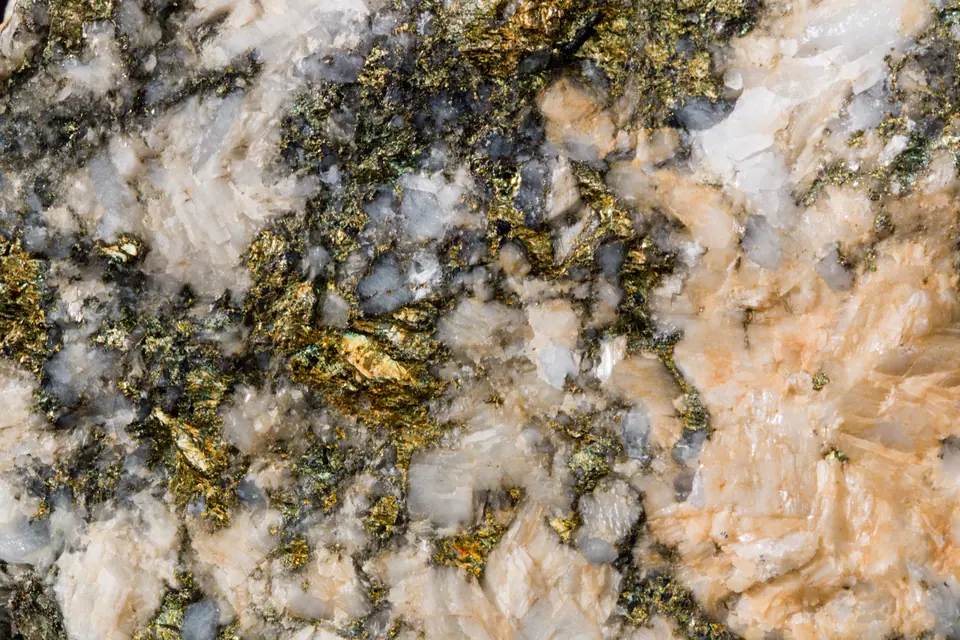
What is chalcopyrite?
Chalcopyrite contains copper, iron, and sulfur. Tarnish and weathering can create iridescent films or green and blue secondary copper minerals, but surface color does not measure copper grade.
What does chalcopyrite look like?
Fresh chalcopyrite is metallic brass-yellow, typically warmer and more saturated than pyrite. It often occurs as massive grains, blebs, vein fillings, or poorly formed crystals.
Exposure can produce bronze, purple, blue, or black tarnish. Strong artificial treatment also creates vivid “peacock ore,” so iridescence alone is not proof of natural alteration or mineral identity.
Identification tests
Begin with observation and use the least destructive test first. Results can change with weathering, mixtures, coatings, and grain size. Review the step-by-step field-test methods before altering an unfamiliar specimen.
Hardness
3.5 to 4Scratched by steel and substantially softer than pyrite.
Streak
Greenish-black to blackSeparates it from yellow-streaking gold.
Tenacity
BrittleBreaks or powders rather than flattening like gold.
Magnetism
Ordinarily not strongly magneticStrong attraction suggests magnetite or a mixed specimen.
Useful procedures: Mohs hardness test · Mineral streak test · Mineral magnetism test
Common lookalikes
How does it form?
Chalcopyrite forms in hydrothermal veins, porphyry copper systems, volcanogenic massive sulfide deposits, skarns, magmatic sulfide accumulations, and metamorphosed ore bodies.
It commonly occurs with pyrite, bornite, sphalerite, galena, quartz, calcite, and secondary copper minerals. Association helps establish context but not grade.
Geologic setting and occurrence
Chalcopyrite is one of the most widespread copper minerals and occurs in many major copper deposit types. A visible grain does not establish an economic ore body.
Weathered exposures may preserve only stains or secondary copper minerals above primary chalcopyrite. Mine dumps can contain useful textures but may also be unstable, claimed, or contaminated.
Uses and significance
Chalcopyrite is a principal copper ore. Copper derived from sulfide deposits supports electrical systems, construction, transportation, alloys, and many manufactured products.
Field notes
- Wash hands after handling sulfide-rich specimens and avoid creating dust.
- Do not roast, heat, or chemically test sulfides outside a laboratory.
- Iridescent material sold as peacock ore may be treated or may represent another copper sulfide.
This guide supports preliminary field identification, not a laboratory determination, appraisal, hazard assessment, or statement of ownership or collecting permission. Verify land status and local rules before handling or collecting material.
Authoritative sources
LithoMap wrote this guide in original language using the scientific concepts and physical-property standards supported by these sources.
- Chalcopyrite—Bearer of a Precious, Non-Precious Metal U.S. Geological Survey
- Minerals and their physical properties U.S. National Park Service
- Mohs Hardness Scale U.S. National Park Service
- Natural Gemstones: Mineral Gemstones U.S. Geological Survey
Editorial review: September 17, 2026.