
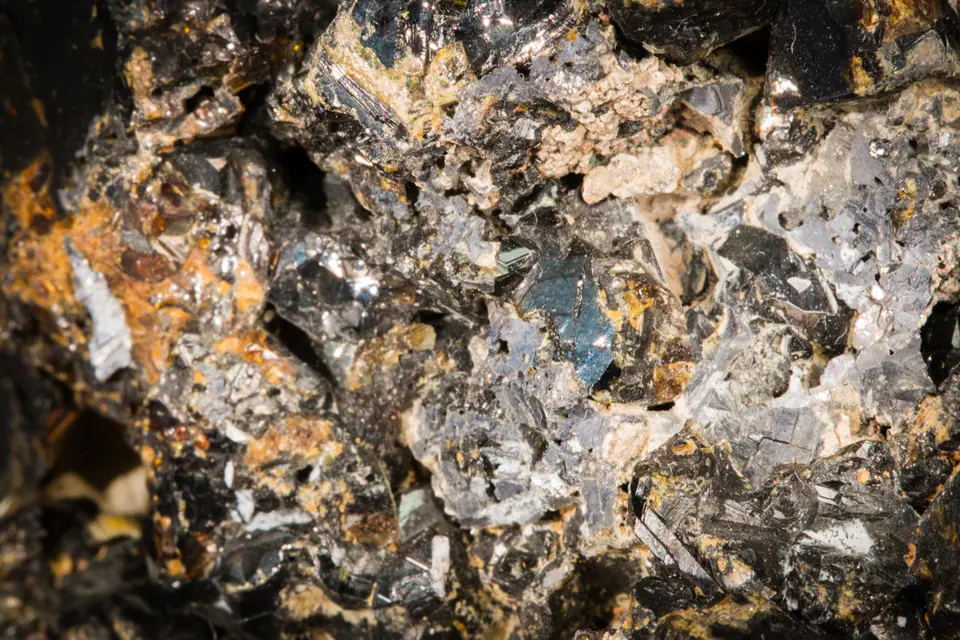
What is sphalerite?
Sphalerite is zinc sulfide, ZnS, with iron commonly substituting for zinc and darkening the mineral. Cadmium, manganese, mercury, gallium, germanium, and other elements may occur in trace amounts; composition cannot be inferred safely from color.
What does sphalerite look like?
Sphalerite ranges from honey-yellow and red-brown to nearly black. Transparent pale crystals may be highly brilliant, while iron-rich material can look dark and submetallic.
Crystals are commonly tetrahedral or complex, but massive granular material is widespread. Numerous bright cleavage faces can create a flashing resinous appearance.
Identification tests
Begin with observation and use the least destructive test first. Results can change with weathering, mixtures, coatings, and grain size. Review the step-by-step field-test methods before altering an unfamiliar specimen.
Hardness
3.5 to 4Scratched by steel and harder than galena.
Streak
White to pale yellow or light brownUsually much lighter than the gray-black streak of galena.
Cleavage
Perfect in six directionsProduces many repeated reflective faces rather than cubic blocks.
Luster
Resinous to adamantine; sometimes submetallicThe resin-like shine is a useful clue, especially in brown material.
Useful procedures: Mohs hardness test · Mineral streak test · Cleavage versus fracture
Common lookalikes
Galena
Denser, metallic lead-gray, much darker-streaked, and cubically cleaved.
Garnet
Harder, lacks cleavage, and commonly forms equant many-faced crystals.
Chalcopyrite
Brass-yellow, metallic, greenish-black-streaked, and lacks sphalerite’s six perfect cleavages.
How does it form?
Sphalerite forms in hydrothermal veins, carbonate-hosted lead-zinc deposits, volcanogenic massive sulfides, skarns, and sedimentary exhalative deposits.
It commonly occurs with galena, pyrite, chalcopyrite, calcite, dolomite, fluorite, barite, and quartz. These intergrowths can complicate simple field tests.
Geologic setting and occurrence
Sphalerite is widespread in zinc and lead-zinc districts. Dark iron-rich varieties and pale gemmy varieties can look so different that testing is essential.
An identification does not determine zinc grade or byproduct-metal content. Consequential decisions require sampling and laboratory analysis.
Uses and significance
Sphalerite is the primary ore mineral for zinc, which is used for galvanizing steel, brass and other alloys, batteries, die casting, and chemical products.
Field notes
- Avoid creating or inhaling sulfide dust and wash hands after handling.
- Do not rely on a sulfur odor test; scratching or striking unknown material can create unnecessary dust.
- Old lead-zinc mine sites may contain lead, cadmium, arsenic, and unstable workings.
This guide supports preliminary field identification, not a laboratory determination, appraisal, hazard assessment, or statement of ownership or collecting permission. Verify land status and local rules before handling or collecting material.
Authoritative sources
LithoMap wrote this guide in original language using the scientific concepts and physical-property standards supported by these sources.
- Zinc Statistics and Information U.S. Geological Survey
- Minerals and their physical properties U.S. National Park Service
- Mohs Hardness Scale U.S. National Park Service
- Natural Gemstones: Mineral Gemstones U.S. Geological Survey
Editorial review: September 17, 2026.