

What is garnet?
Garnets share a crystal structure but vary in calcium, magnesium, iron, manganese, aluminum, and chromium. Common species include almandine, pyrope, spessartine, grossular, and andradite.
What does garnet look like?
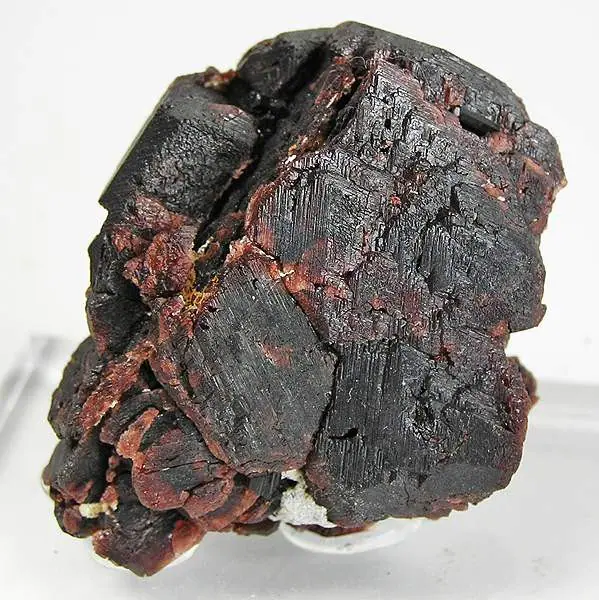
Garnet commonly forms rounded or sharply faceted equant crystals embedded in schist, gneiss, skarn, or igneous rock. Broken surfaces are uneven to conchoidal.
Weathered garnets may be dull, fractured, or surrounded by alteration rims. Color cannot reliably determine species because compositions overlap.
Identification tests
Begin with observation and use the least destructive test first. Results can change with weathering, mixtures, coatings, and grain size. Review the step-by-step field-test methods before altering an unfamiliar specimen.
Hardness
6.5 to 7.5Most garnet scratches glass.
Streak
White or colorlessBody color is much more varied than streak.
Cleavage
NoneBreakage lacks repeated flat cleavage planes.
Habit
Equant many-faced crystalsA strong clue when crystal faces are preserved.
Useful procedures: Mohs hardness test · Mineral streak test · Cleavage versus fracture
Common lookalikes
Ruby or spinel
Color can overlap; crystal form, hardness, density, and laboratory optical tests may be required.
Staurolite
Commonly prismatic and may form cross twins, with different cleavage and habit.
Weathered iron oxide nodule
Usually leaves a colored streak and lacks garnet’s glassy hard interior.
How does it form?
Garnet grows during metamorphism over a broad range of pressures and temperatures and can preserve zoning that records changing conditions.
It also crystallizes in some igneous rocks, pegmatites, skarns, and hydrothermal environments. Resistant grains accumulate in heavy-mineral sands.
Geologic setting and occurrence
Garnet is common in metamorphic rocks and some igneous and contact-metamorphic deposits. Stream sediments may concentrate durable grains downstream.
Finding garnet does not by itself establish gem quality or a profitable deposit. Most grains are fractured, included, small, or unsuitable for cutting.
Uses and significance
Garnet is used as an abrasive in sandpaper, blasting, and waterjet cutting; transparent attractive crystals are cut as gemstones.
Field notes
- Do not determine value from color alone.
- Use a hand lens to check fractures, inclusions, and crystal habit.
- Never undermine mica-rich slopes to remove embedded crystals.
This guide supports preliminary field identification, not a laboratory determination, appraisal, hazard assessment, or statement of ownership or collecting permission. Verify land status and local rules before handling or collecting material.
Authoritative sources
LithoMap wrote this guide in original language using the scientific concepts and physical-property standards supported by these sources.
- Minerals and their physical properties U.S. National Park Service
- Mohs Hardness Scale U.S. National Park Service
- Natural Gemstones: Mineral Gemstones U.S. Geological Survey
Editorial review: September 17, 2026.