
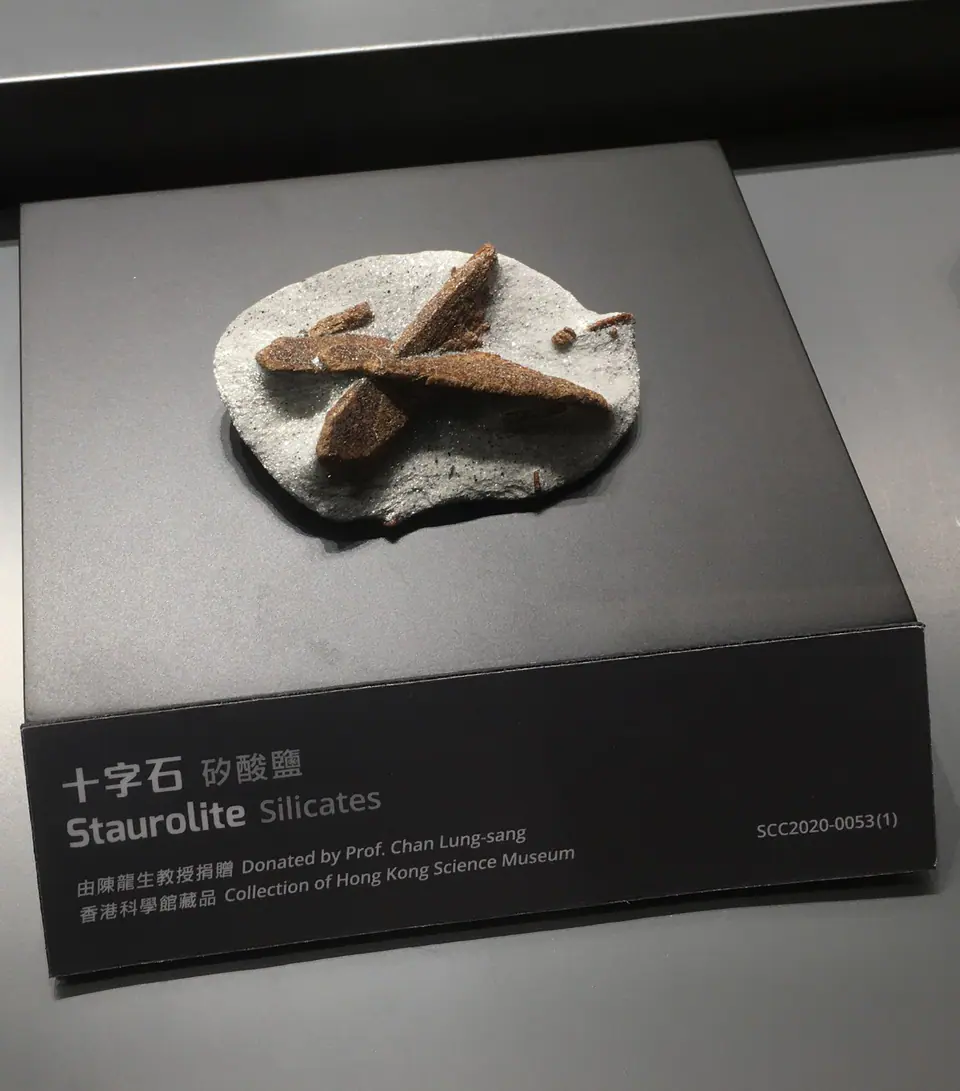

What is staurolite?
Staurolite is a complex iron-, magnesium-, and aluminum-bearing silicate hydroxide with variable substitutions. Its exact formula and composition can vary among specimens.
What does staurolite look like?
Crystals are commonly stout prisms with rough surfaces and resinous to subvitreous luster. Penetration twins may form crosses intersecting near 60 or 90 degrees.
Untwinned crystals, broken grains, and matrix-bound porphyroblasts may lack the famous cross and resemble garnet, tourmaline, or dark metamorphic minerals.
Identification tests
Begin with observation and use the least destructive test first. Results can change with weathering, mixtures, coatings, and grain size. Review the step-by-step field-test methods before altering an unfamiliar specimen.
Hardness
About 7 to 7.5Scratches glass and is not readily scratched by steel.
Habit
Stout prismatic crystals, commonly twinnedCross twins are highly characteristic but not universal.
Cleavage
PoorBroken surfaces are uneven rather than dominated by repeated cleavage.
Streak
White to grayishSeparates it from dark-streaking metallic minerals.
Useful procedures: Mohs hardness test · Cleavage versus fracture · Mineral streak test
Common lookalikes
Garnet
Usually equant with dodecahedral or rounded forms rather than prismatic cross twins.
Tourmaline
Commonly longer, strongly striated, and triangular in cross section.
Manufactured or carved cross
May show tool marks, unnatural symmetry, or lack a metamorphic matrix and crystal surfaces.
How does it form?
Staurolite forms during medium-grade regional metamorphism of aluminum-rich sedimentary rocks.
It commonly occurs with mica, garnet, kyanite, quartz, and other index minerals used to interpret metamorphic conditions.
Geologic setting and occurrence
Staurolite is characteristic of selected metamorphic belts and occurs in schist and gneiss across parts of the Appalachians, New England, the southern Rocky Mountains, and other regions.
A cross-shaped object should be evaluated for natural crystal faces and lawful provenance rather than assumed to be a natural twin.
Uses and significance
Staurolite is chiefly a collector mineral and metamorphic indicator. Cross twins are sold as “fairy stones,” but commercial pieces may be altered, mounted, or manufactured.
Field notes
- Do not pry crystals from outcrops or damage protected sites.
- Cross shape is strong evidence only when natural crystal texture is present.
- Avoid destructive testing of complete twins.
This guide supports preliminary field identification, not a laboratory determination, appraisal, hazard assessment, or statement of ownership or collecting permission. Verify land status and local rules before handling or collecting material.
Authoritative sources
LithoMap wrote this guide in original language using the scientific concepts and physical-property standards supported by these sources.
- Minerals and their physical properties U.S. National Park Service
- Mohs Hardness Scale U.S. National Park Service
- Natural Gemstones: Mineral Gemstones U.S. Geological Survey
Editorial review: September 17, 2026.