
.jpg)
What is tourmaline?
Tourmaline is a chemically complex mineral group containing boron with varying sodium, calcium, lithium, magnesium, iron, aluminum, and other elements. Species such as schorl, elbaite, and dravite cannot be assigned reliably from color alone.
What does tourmaline look like?
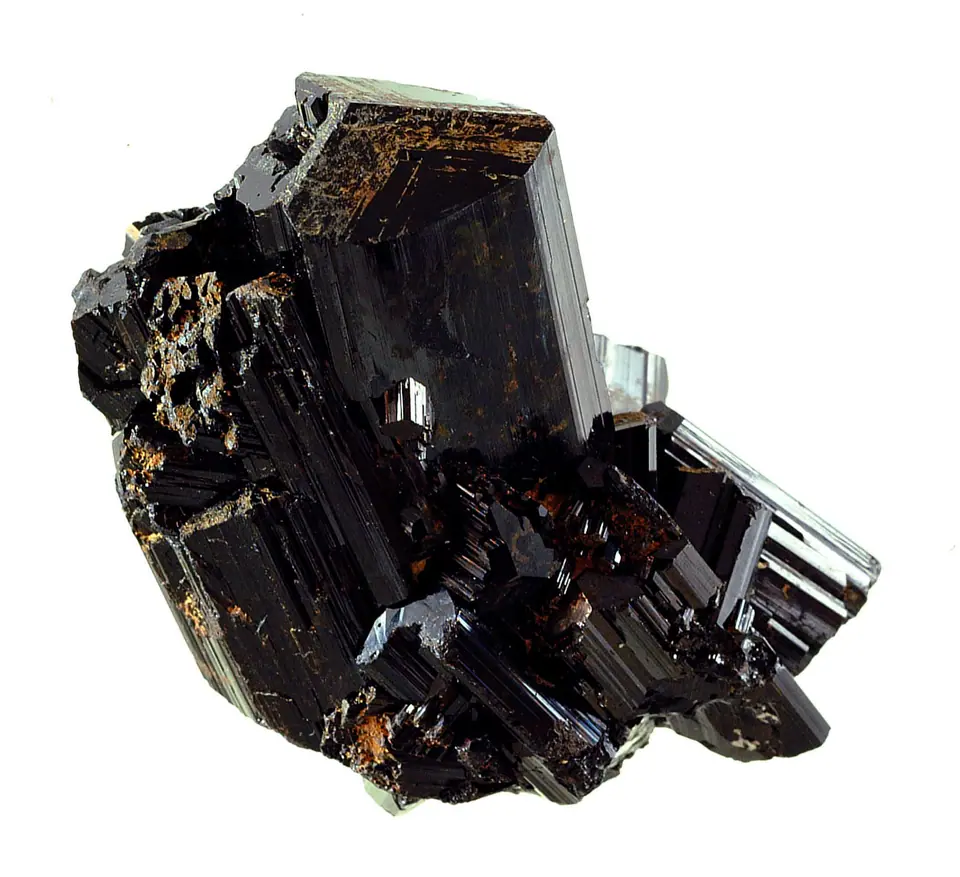
Tourmaline commonly forms elongated prisms with deep parallel grooves. Cross sections are often three-sided or six-sided in a way that reflects trigonal symmetry, and crystal ends may differ from one another.
Black schorl is widespread; gem tourmalines may be transparent and color-zoned. Massive, radiating, acicular, or fibrous aggregates also occur.
Identification tests
Begin with observation and use the least destructive test first. Results can change with weathering, mixtures, coatings, and grain size. Review the step-by-step field-test methods before altering an unfamiliar specimen.
Hardness
About 7 to 7.5Typically scratches glass and resists a steel point.
Cleavage
Poor or indistinctBreaks irregularly rather than into repeated flat cleavage fragments.
Habit
Strongly striated trigonal prismsThe combination of grooves and triangular cross section is highly useful.
Streak
WhiteNot usually diagnostic.
Useful procedures: Mohs hardness test · Cleavage versus fracture · Mineral streak test
Common lookalikes
Hornblende
Softer, has two good cleavage directions near 60 and 120 degrees, and commonly forms splintery amphibole prisms.
Beryl
Forms true hexagonal prisms, often with flatter faces and a hexagonal rather than triangular cross section.
Garnet
Commonly equant with dodecahedral forms rather than long striated prisms.
How does it form?
Tourmaline crystallizes in granitic pegmatites, hydrothermal veins, and metamorphic rocks and can survive weathering into sediment.
Its composition records aspects of the fluids and rocks in which it grew, but chemical analysis is needed for precise species and provenance.
Geologic setting and occurrence
Tourmaline is widespread in pegmatites and metamorphic rocks and can occur as accessory grains in granite, schist, and stream sediment.
Black prismatic material in pegmatite is often schorl, but species assignment and gem identification require more than color and setting.
Uses and significance
Transparent colored tourmaline is used as a gemstone; black and opaque material is chiefly collected or studied. Tourmaline also has scientific value as a durable recorder of geologic fluids and conditions.
Field notes
- Inspect cross section and striations before using color.
- Do not break a crystal merely to test cleavage or interior color.
- Gem quality, treatment, and species require professional testing.
This guide supports preliminary field identification, not a laboratory determination, appraisal, hazard assessment, or statement of ownership or collecting permission. Verify land status and local rules before handling or collecting material.
Authoritative sources
LithoMap wrote this guide in original language using the scientific concepts and physical-property standards supported by these sources.
- Minerals and their physical properties U.S. National Park Service
- Mohs Hardness Scale U.S. National Park Service
- Natural Gemstones: Mineral Gemstones U.S. Geological Survey
Editorial review: September 17, 2026.