
.jpg)
What is hornblende?
Hornblende refers to compositionally complex calcic amphiboles containing varying calcium, sodium, magnesium, iron, aluminum, silicon, and hydroxyl. Precise amphibole naming can require chemical and crystallographic analysis.
What does hornblende look like?
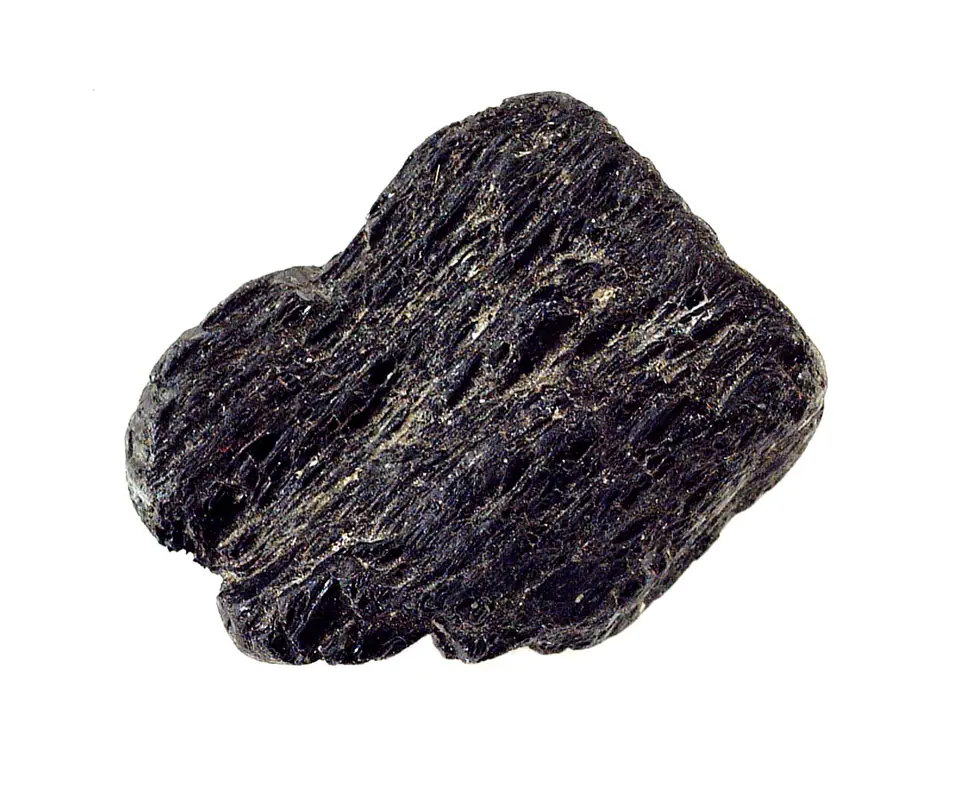
Crystals are commonly long, bladed, columnar, or fibrous-looking, with dark green to black color and glassy to dull luster. Cross sections may appear diamond-shaped or roughly six-sided.
Cleavage surfaces intersect at oblique angles and can create splintery fragments. Fine grains in dark rock may be difficult to separate visually from pyroxene, biotite, or tourmaline.
Identification tests
Begin with observation and use the least destructive test first. Results can change with weathering, mixtures, coatings, and grain size. Review the step-by-step field-test methods before altering an unfamiliar specimen.
Hardness
About 5 to 6Harder than a knife blade in many directions but generally softer than quartz.
Cleavage
Two good directions near 56 and 124 degreesThe oblique amphibole cleavage is the strongest distinction from pyroxene.
Habit
Elongate prisms or splintery aggregatesSupports amphibole rather than blockier augite.
Streak
White to pale grayUsually not diagnostic.
Useful procedures: Mohs hardness test · Cleavage versus fracture · Mineral streak test
Common lookalikes
Augite
Usually blockier with two cleavage directions closer to 90 degrees.
Tourmaline
Harder, strongly lengthwise-striated, commonly triangular in cross section, and lacks hornblende’s good cleavage.
Biotite
Splits into flexible thin sheets along one perfect basal cleavage.
How does it form?
Hornblende crystallizes in many intermediate to felsic igneous rocks and forms during regional or contact metamorphism where water is available.
It is common in diorite, granodiorite, amphibolite, gneiss, schist, and related rocks, but a dark grain alone does not establish the host-rock name.
Geologic setting and occurrence
Hornblende is widespread in continental igneous and metamorphic rocks and may occur as individual crystals, aligned metamorphic grains, or a major component of amphibolite.
Visual identification generally supports “hornblende-like amphibole”; precise species classification may require laboratory chemistry.
Uses and significance
Hornblende has limited direct industrial use but is important for classifying rocks, reconstructing metamorphic conditions, and interpreting magma water content and evolution.
Field notes
- Measure cleavage angles across several grains rather than judging one break.
- Do not call every black prismatic mineral hornblende.
- Avoid producing dust from fibrous or altered amphibole-bearing material.
This guide supports preliminary field identification, not a laboratory determination, appraisal, hazard assessment, or statement of ownership or collecting permission. Verify land status and local rules before handling or collecting material.
Authoritative sources
LithoMap wrote this guide in original language using the scientific concepts and physical-property standards supported by these sources.
- Minerals and their physical properties U.S. National Park Service
- Mohs Hardness Scale U.S. National Park Service
- Natural Gemstones: Mineral Gemstones U.S. Geological Survey
Editorial review: September 17, 2026.