
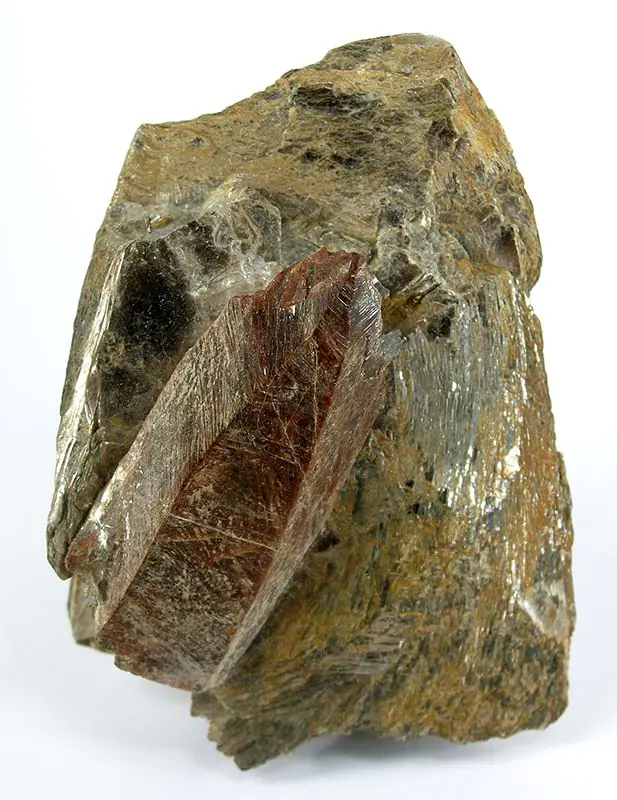

What is biotite?
Biotite is a field grouping within the mica family rather than one tightly fixed composition. Iron, magnesium, potassium, aluminum, silicon, hydroxyl, and fluorine occur in varying proportions.
What does biotite look like?
Biotite forms platy crystals, books, or scattered shiny flakes. Very thin flakes may be brown or green and partly transparent when held to light.
Weathering can bleach biotite, expand its layers, or produce golden-brown alteration that resembles other micaceous minerals.
Identification tests
Begin with observation and use the least destructive test first. Results can change with weathering, mixtures, coatings, and grain size. Review the step-by-step field-test methods before altering an unfamiliar specimen.
Hardness
2.5 to 3A fingernail may scratch softer flakes; a copper coin scratches most.
Streak
White to graySheet habit is more useful.
Cleavage
Perfect in one directionProduces flexible elastic sheets.
Color in thin sheet
Brown to greenish and translucentHelps distinguish it from opaque metallic flakes.
Useful procedures: Mohs hardness test · Mineral streak test · Cleavage versus fracture
Common lookalikes
How does it form?
Biotite crystallizes in many intermediate to felsic igneous rocks and grows during metamorphism over a range of temperatures and pressures.
Its chemistry and textures can help geologists interpret magma evolution and metamorphic history, but hand specimens rarely resolve its exact composition.
Geologic setting and occurrence
Biotite is common in granite, diorite, gneiss, schist, and many volcanic rocks as phenocrysts or fine flakes.
Its presence alone does not define a rock name; abundance, associated minerals, texture, and field setting all matter.
Uses and significance
Biotite has limited direct industrial use compared with muscovite, but it is important in geological interpretation and geochronology.
Field notes
- Record weathering state because altered biotite changes color and behavior.
- Do not assign an exact mica species from dark color alone.
- Avoid unnecessary dust from mica-rich rock.
This guide supports preliminary field identification, not a laboratory determination, appraisal, hazard assessment, or statement of ownership or collecting permission. Verify land status and local rules before handling or collecting material.
Authoritative sources
LithoMap wrote this guide in original language using the scientific concepts and physical-property standards supported by these sources.
- Minerals and their physical properties U.S. National Park Service
- Mohs Hardness Scale U.S. National Park Service
- Natural Gemstones: Mineral Gemstones U.S. Geological Survey
Editorial review: September 17, 2026.