


The most useful distinction
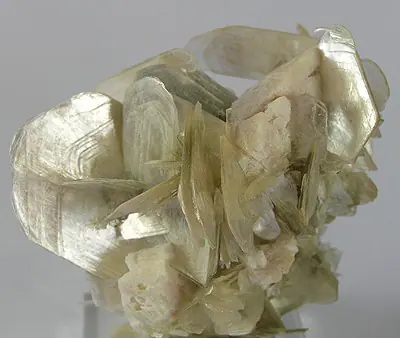
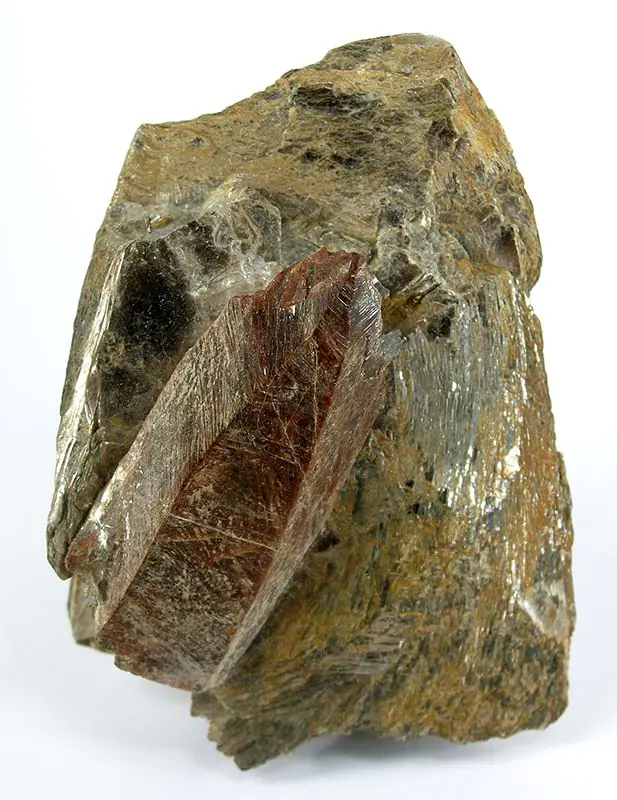
First confirm mica by its elastic, peelable sheets. Then compare thin flakes rather than a thick book: pale, nearly colorless sheets favor muscovite; brown, green-brown, or black sheets favor biotite.
Muscovite and Biotite comparison table
| Property | Muscovite | Biotite | How to use it |
|---|---|---|---|
| Color in thin sheets | Colorless, silvery, pale tan, or faintly green | Brown, dark green-brown, or black | Thin-sheet color is more reliable than the surface of a thick mica book. |
| Cleavage | One perfect basal direction; peels into elastic sheets | One perfect basal direction; peels into elastic sheets | This confirms mica but does not separate the two species. |
| Composition | Potassium-rich aluminum mica with little iron and magnesium | Iron- and magnesium-bearing dark mica | Composition explains the typical color difference but cannot be measured precisely in the field. |
| Weathering | May remain silvery or alter to clay minerals | May bleach, bronze, or develop rusty alteration | Weathering can make biotite deceptively pale, so inspect a fresh thin flake. |
A practical identification sequence
- 1
Confirm one perfect cleavage and flexible, elastic sheets.
- 2
Separate a naturally loose thin flake without damaging an outcrop.
- 3
Hold the flake against light and a white background to judge transmitted color.
- 4
Use the host rock and fresh surfaces to check for weathering or mixed mica.
Where the distinction gets difficult
- Mica books can contain intergrown or compositionally intermediate material.
- Altered biotite may resemble pale mica, chlorite, or vermiculite.
- Do not peel or damage museum, teaching, valuable, or protected specimens.
Use several independent observations. This comparison supports preliminary field identification, not laboratory confirmation, appraisal, proof of origin, or collecting permission.
Muscovite vs. biotite FAQ
Are muscovite and biotite both mica?
Yes. Both are mica-group sheet silicates and share perfect basal cleavage, but their chemistry and typical colors differ.
Can biotite be shiny?
Yes. Biotite commonly has a bright pearly or vitreous reflection even though its thin flakes are brown to black.
Can muscovite look dark?
A thick stack, inclusions, staining, or shadow can make muscovite look darker. A clean thin sheet usually remains pale and transmits light.
Authoritative sources
LithoMap wrote this comparison in original language from the physical properties and geological concepts supported by these public scientific references.
- Minerals and their physical properties U.S. National Park Service
- Mohs Hardness Scale U.S. National Park Service
- Natural Gemstones: Mineral Gemstones U.S. Geological Survey
Editorial review: September 17, 2026.