
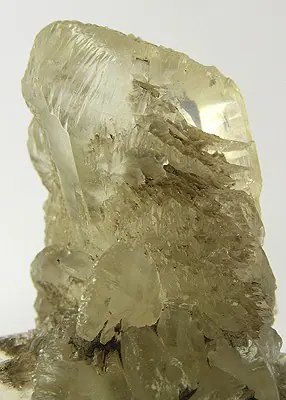

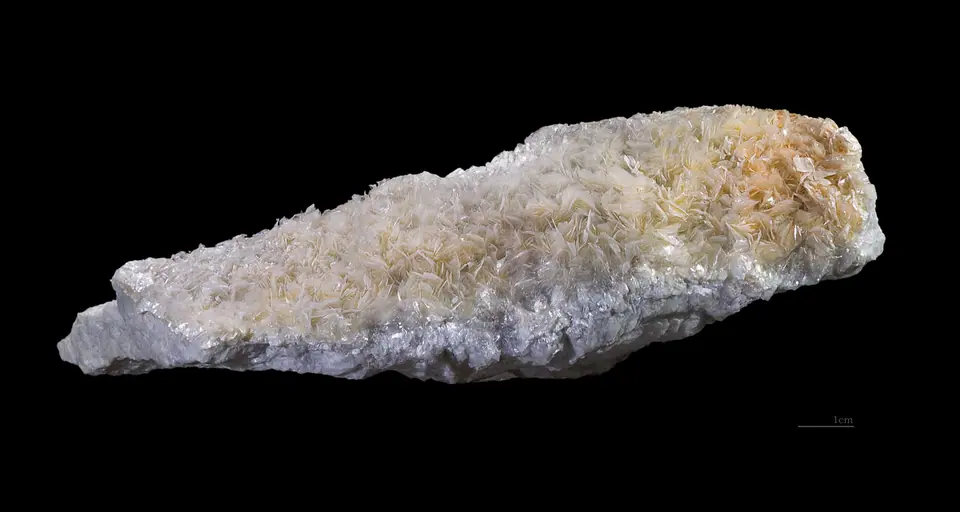

The most useful distinction
Both yield to a fingernail, so compare degree and feel. Talc scratches with almost no effort and often feels greasy; gypsum offers slightly more resistance and shows characteristic bladed, fibrous, or clear cleavage forms.
Gypsum and Talc comparison table
| Property | Gypsum | Talc | How to use it |
|---|---|---|---|
| Hardness | Mohs 2 | Mohs 1 | Both are fingernail-soft, but talc is the softer standard mineral. |
| Feel | Usually not greasy; fibrous varieties may feel silky | Commonly greasy, soapy, or slick on a clean massive surface | Feel is useful supporting evidence but should not be tested by rubbing dusty unknown material. |
| Habit | Tabular, bladed, fibrous, rosette, massive, or clear cleavage sheets | Foliated, scaly, fine-grained, or massive soapstone-like material | Well-developed form often separates typical specimens. |
| Cleavage behavior | One perfect direction; some sheets are flexible but not elastic | Perfect basal cleavage; thin plates are flexible but not elastic | Because both are platy, hardness and habit must accompany cleavage. |
A practical identification sequence
- 1
Use a clean existing surface and try a very gentle fingernail scratch.
- 2
Observe whether the surface feels greasy without generating dust.
- 3
Inspect habit for blades, fibers, clear sheets, scales, or a massive soapstone texture.
- 4
Use host rock and mapped setting to distinguish evaporite gypsum from metamorphic or altered talc.
Where the distinction gets difficult
- Do not inhale or deliberately create fine mineral dust.
- Talc-bearing rock can occur near fibrous amphibole or serpentine minerals that visual inspection cannot certify as safe.
- Mixed fine-grained rock may need microscopy or chemical analysis.
Use several independent observations. This comparison supports preliminary field identification, not laboratory confirmation, appraisal, proof of origin, or collecting permission.
Gypsum vs. talc FAQ
Can a fingernail distinguish gypsum from talc?
Both can be scratched, but talc yields more easily. The test is strongest when paired with surface feel, habit, and geologic setting.
Is soapstone pure talc?
No. Soapstone is a talc-rich metamorphic rock that can also contain carbonate, chlorite, amphibole, serpentine, or other minerals.
Is silky gypsum the same as talc?
No. Fibrous satin-spar gypsum can have a silky luster, but its fibers, slightly greater hardness, and evaporite setting differ from typical talc.
Authoritative sources
LithoMap wrote this comparison in original language from the physical properties and geological concepts supported by these public scientific references.
- Minerals and their physical properties U.S. National Park Service
- Mohs Hardness Scale U.S. National Park Service
- Natural Gemstones: Mineral Gemstones U.S. Geological Survey
- Talc and Pyrophyllite Statistics and Information U.S. Geological Survey
Editorial review: September 17, 2026.