
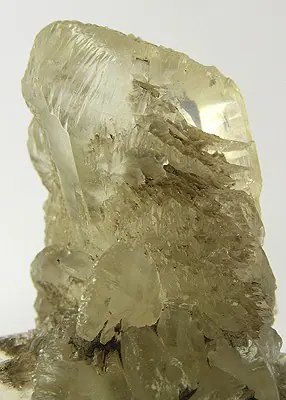

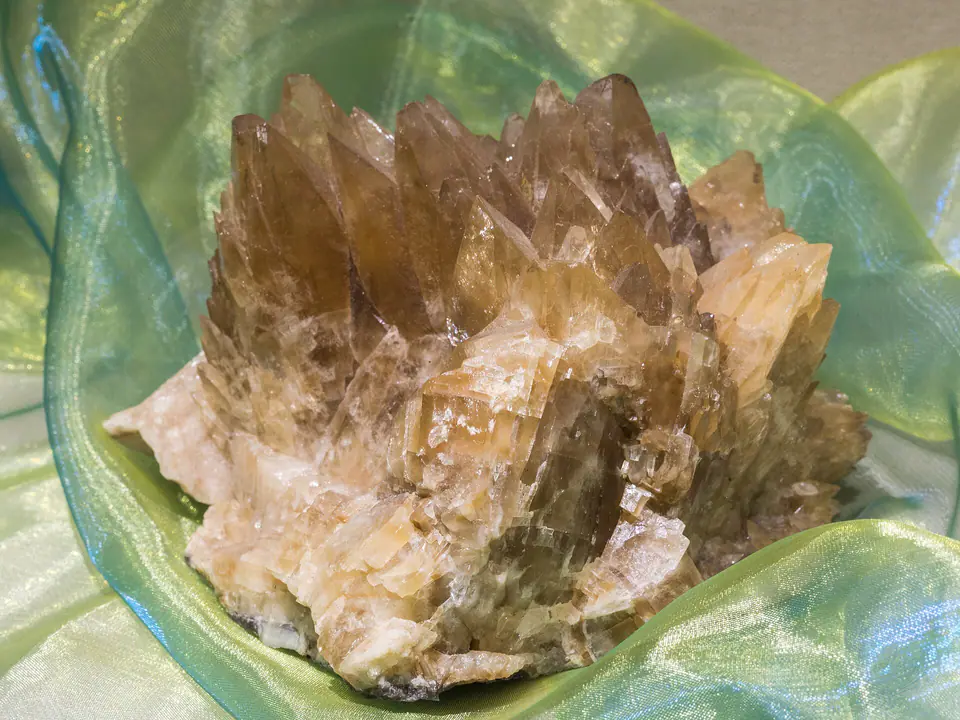

The most useful distinction
Begin with hardness. A fingernail scratch favors gypsum; material that resists a fingernail but scratches under a copper coin favors calcite. A clean calcite surface then fizzes readily with dilute acid.
Gypsum and Calcite comparison table
| Property | Gypsum | Calcite | How to use it |
|---|---|---|---|
| Hardness | Mohs 2; scratched easily by a fingernail | Mohs 3; resists a fingernail but is scratched by copper or steel | The fingernail test is the simplest nonchemical separation on a fresh surface. |
| Acid response | No ordinary effervescence with dilute hydrochloric acid | Readily effervesces on a clean surface | Acid confirms calcite after hardness narrows the choice. |
| Cleavage and habit | One perfect cleavage with other directions less distinct; tabular, fibrous, bladed, or massive forms | Three perfect directions not at 90°, commonly yielding rhombohedral fragments | Habit and cleavage help when scratches are ambiguous. |
| Feel and flexibility | Some clear sheets are slightly flexible but not elastic; fibrous forms may feel silky | Cleavage fragments are brittle and do not form flexible sheets | This is supporting evidence and varies with form. |
A practical identification sequence
- 1
Try a fingernail on a clean, inconspicuous edge.
- 2
Inspect broken surfaces for rhombohedral calcite cleavage or tabular and fibrous gypsum habits.
- 3
Use dilute acid safely on an expendable fresh spot if calcite remains possible.
- 4
Confirm that coatings, clay, or mixed grains are not controlling the test.
Where the distinction gets difficult
- Fine-grained evaporite rock can mix gypsum, carbonate, clay, and salts.
- A weathered or polished surface may give an unreliable scratch.
- Never taste an unknown mineral or apply acid to caves, formations, finished stone, or valuable material.
Use several independent observations. This comparison supports preliminary field identification, not laboratory confirmation, appraisal, proof of origin, or collecting permission.
Gypsum vs. calcite FAQ
Can gypsum fizz in acid?
Gypsum does not produce the strong carbonate effervescence expected from calcite. Fizzing may come from admixed calcite or a carbonate coating.
Can calcite be scratched by a fingernail?
Typical calcite is slightly harder than a fingernail. Powdery weathering, thin edges, or soft material on the surface can create a misleading result.
Are transparent gypsum and calcite easy to confuse?
They can look alike, but hardness, cleavage geometry, and acid response separate fresh specimens reliably in most field situations.
Authoritative sources
LithoMap wrote this comparison in original language from the physical properties and geological concepts supported by these public scientific references.
- Minerals and their physical properties U.S. National Park Service
- Mohs Hardness Scale U.S. National Park Service
- Natural Gemstones: Mineral Gemstones U.S. Geological Survey
Editorial review: September 17, 2026.