
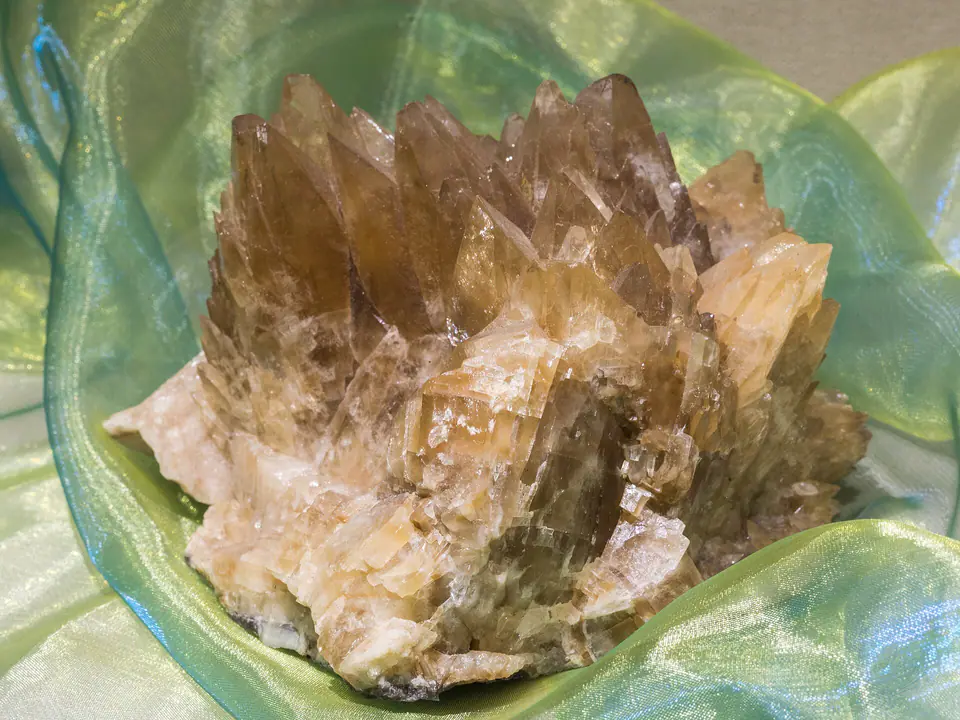

What is calcite?
Calcite is calcium carbonate. Magnesium, iron, manganese, and other elements may substitute in small amounts, and inclusions can change color or transparency.
What does calcite look like?
Calcite has many crystal habits, including rhombohedra and scalenohedra, and also occurs massive, granular, fibrous, or earthy.
Clear cleavage fragments may show double refraction, making a line viewed through the crystal appear doubled. Weathered calcite can be dull or chalky.
Identification tests
Begin with observation and use the least destructive test first. Results can change with weathering, mixtures, coatings, and grain size. Review the step-by-step field-test methods before altering an unfamiliar specimen.
Hardness
3Scratched by a copper coin or steel point; harder than a fingernail.
Streak
WhiteHelpful for colored samples but not unique.
Cleavage
Perfect in three directions, not at 90°Produces repeated rhombohedral fragments.
Acid
Strong fizz on a fresh surfaceA defining carbonate test when performed safely.
Useful procedures: Mohs hardness test · Mineral streak test · Cleavage versus fracture · Acid reaction test
Common lookalikes
How does it form?
Calcite forms in marine and freshwater sediments, shells and skeletons, caves, hydrothermal veins, altered rocks, and metamorphic marble.
It precipitates from water and also recrystallizes during burial or metamorphism, so the same mineral can record very different environments.
Geologic setting and occurrence
Calcite is the principal mineral in most limestone and marble and is common in veins, geodes, travertine, cave deposits, and fossil material.
Optical clarity, color, and crystal shape vary. A hand-sample identification does not determine whether a specimen is natural, treated, or commercially valuable.
Uses and significance
Calcite-bearing rock supplies cement, lime, aggregate, agricultural lime, fillers, and dimension stone. Crystalline calcite also has optical and collecting uses.
Field notes
- Dilute acid can damage specimens and structures; use only where permitted with eye protection.
- Never remove cave formations.
- Do not lick or taste an unknown specimen.
This guide supports preliminary field identification, not a laboratory determination, appraisal, hazard assessment, or statement of ownership or collecting permission. Verify land status and local rules before handling or collecting material.
Authoritative sources
LithoMap wrote this guide in original language using the scientific concepts and physical-property standards supported by these sources.
- Minerals and their physical properties U.S. National Park Service
- Mohs Hardness Scale U.S. National Park Service
- Natural Gemstones: Mineral Gemstones U.S. Geological Survey
Editorial review: September 17, 2026.