
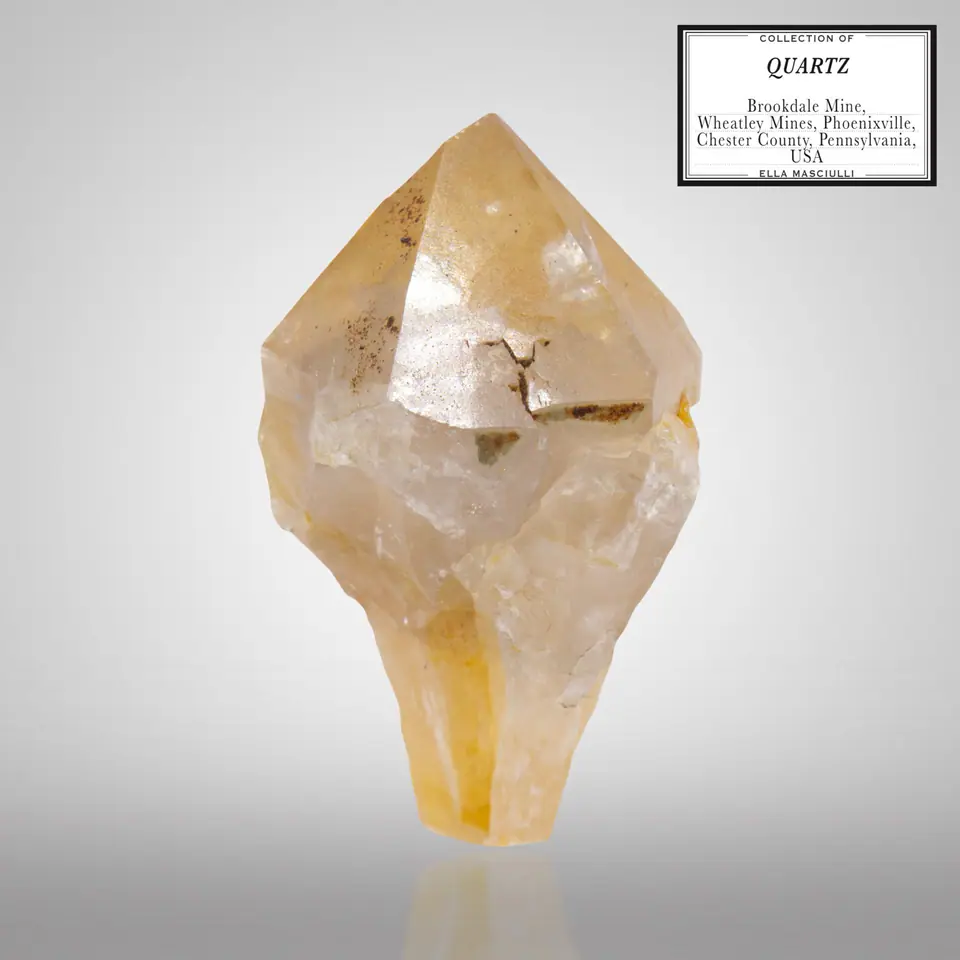

What is quartz?
Quartz is crystalline silicon dioxide. Trace elements, radiation effects, microscopic inclusions, and structural defects create varieties including amethyst, smoky quartz, citrine, rose quartz, and milky quartz.
What does quartz look like?
Crystals commonly form six-sided prisms terminated by pyramidal faces, but quartz also occurs massive, granular, fibrous, or cryptocrystalline.
Color is highly variable and is not diagnostic. Fresh massive quartz is commonly white, gray, or translucent with a glassy to greasy luster.
Identification tests
Begin with observation and use the least destructive test first. Results can change with weathering, mixtures, coatings, and grain size. Review the step-by-step field-test methods before altering an unfamiliar specimen.
Hardness
7Scratches glass and is not scratched by an ordinary steel knife.
Streak
White; often little powder on a standard plate because quartz is hardStreak is less useful than hardness and fracture.
Cleavage
NoneBroken surfaces curve rather than repeat as flat planes.
Luster
Vitreous to greasyBest judged on a fresh, unweathered surface.
Useful procedures: Mohs hardness test · Mineral streak test · Cleavage versus fracture
Common lookalikes
How does it form?
Quartz crystallizes in igneous rocks, grows in hydrothermal veins and cavities, survives weathering into sediment, and recrystallizes in metamorphic rocks.
Its durability makes it a major component of many sands and sandstones. Chalcedony and chert consist of extremely fine silica material and may not resemble ordinary crystals.
Geologic setting and occurrence
Quartz is one of the most widespread crustal minerals and occurs in many igneous, sedimentary, metamorphic, and hydrothermal environments.
A quartz vein alone does not prove precious-metal mineralization. Veins are common, and economic significance requires geological and analytical evidence.
Uses and significance
Quartz is used in glass, foundry sand, abrasives, engineered stone, electronics, optics, and gemstones. High-purity material has specialized industrial value.
Field notes
- Test hardness on an inconspicuous fresh surface.
- Silica dust is hazardous; do not grind, saw, or crush specimens without proper controls.
- Crystal quality or color does not establish origin, treatment, or value.
This guide supports preliminary field identification, not a laboratory determination, appraisal, hazard assessment, or statement of ownership or collecting permission. Verify land status and local rules before handling or collecting material.
Authoritative sources
LithoMap wrote this guide in original language using the scientific concepts and physical-property standards supported by these sources.
- Minerals and their physical properties U.S. National Park Service
- Mohs Hardness Scale U.S. National Park Service
- Natural Gemstones: Mineral Gemstones U.S. Geological Survey
Editorial review: September 17, 2026.