
.jpg)
What is feldspar?
Feldspar includes potassium-rich alkali feldspars and the sodium-calcium plagioclase series. Compositions vary continuously in parts of the group, so “feldspar” is often the appropriate field identification.
What does feldspar look like?
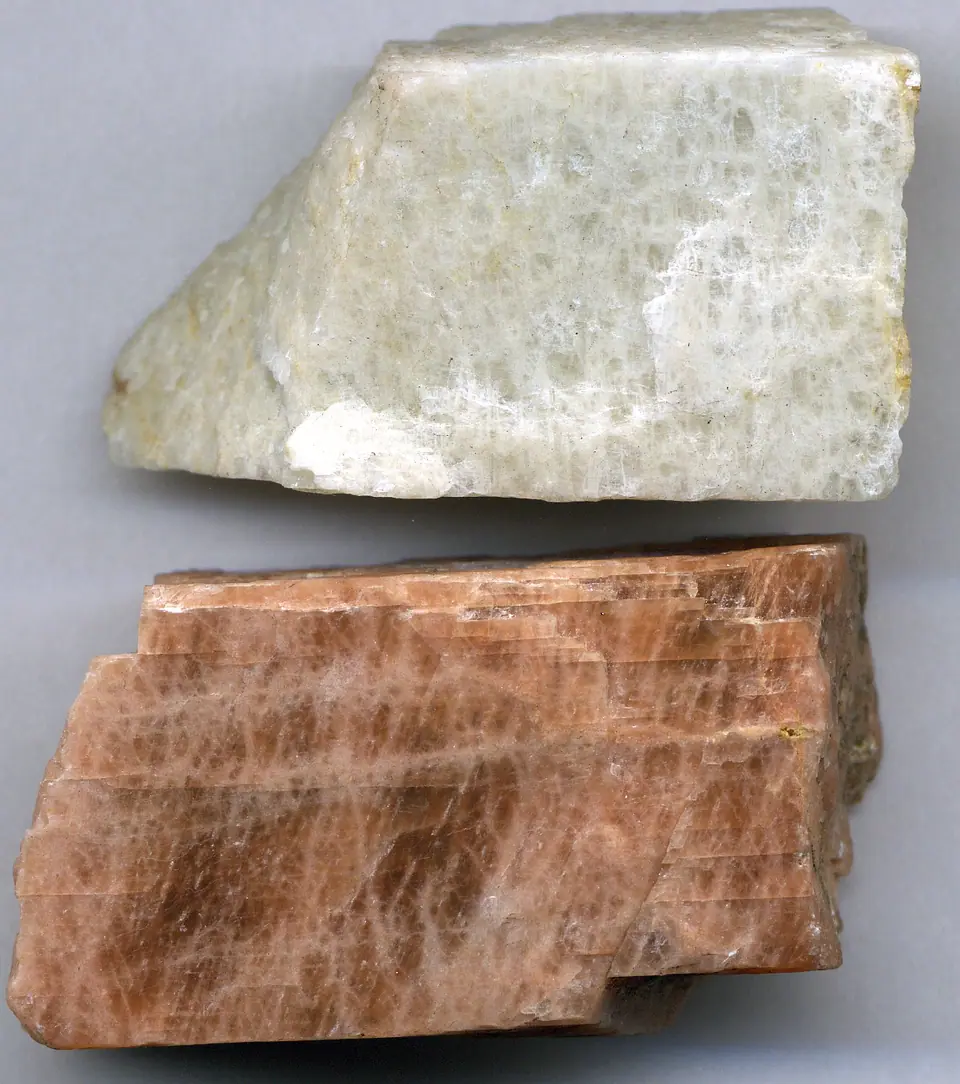
Feldspar commonly forms blocky crystals with pearly cleavage faces. Plagioclase may show fine parallel striations on cleavage surfaces; alkali feldspar can show different twinning or intergrowth textures.
Weathering changes feldspar to clay minerals, making surfaces chalky, dull, or soft while fresh interiors remain hard.
Identification tests
Begin with observation and use the least destructive test first. Results can change with weathering, mixtures, coatings, and grain size. Review the step-by-step field-test methods before altering an unfamiliar specimen.
Hardness
About 6Usually scratches glass but can be scratched by quartz.
Streak
WhiteConsistent but not diagnostic.
Cleavage
Two good directions near 90°Separates feldspar from cleavage-free quartz.
Striations
Possible on plagioclase cleavage facesA strong clue for plagioclase when clearly present.
Useful procedures: Mohs hardness test · Mineral streak test · Cleavage versus fracture
Common lookalikes
Quartz
No cleavage, harder, and commonly has conchoidal fracture.
Calcite
Much softer, has three rhombohedral cleavages, and fizzes with acid.
Kaolinite or weathered feldspar
Clay alteration is much softer and lacks a fresh glassy cleavage.
How does it form?
Feldspars crystallize from magma and are major constituents of granite, basalt, gabbro, rhyolite, and many other igneous rocks.
They also occur in metamorphic rocks and sediment, though chemical weathering makes them less durable at Earth’s surface than quartz.
Geologic setting and occurrence
Feldspar is the most abundant mineral group in much of Earth’s crust and is present in a wide variety of igneous and metamorphic rocks.
Color is unreliable for separating feldspar species. Pink does not automatically mean potassium feldspar, and white does not automatically mean plagioclase.
Uses and significance
Feldspar is used in glass, ceramics, fillers, glazes, and abrasives. Gem varieties include moonstone, sunstone, amazonite, and labradorite.
Field notes
- Use a fresh cleavage face to look for striations.
- Record “feldspar” when the evidence does not support a species.
- Avoid creating silica-bearing dust when breaking feldspar-rich rock.
This guide supports preliminary field identification, not a laboratory determination, appraisal, hazard assessment, or statement of ownership or collecting permission. Verify land status and local rules before handling or collecting material.
Authoritative sources
LithoMap wrote this guide in original language using the scientific concepts and physical-property standards supported by these sources.
- Minerals and their physical properties U.S. National Park Service
- Mohs Hardness Scale U.S. National Park Service
- Natural Gemstones: Mineral Gemstones U.S. Geological Survey
Editorial review: September 17, 2026.