

.jpg)
The most useful distinction
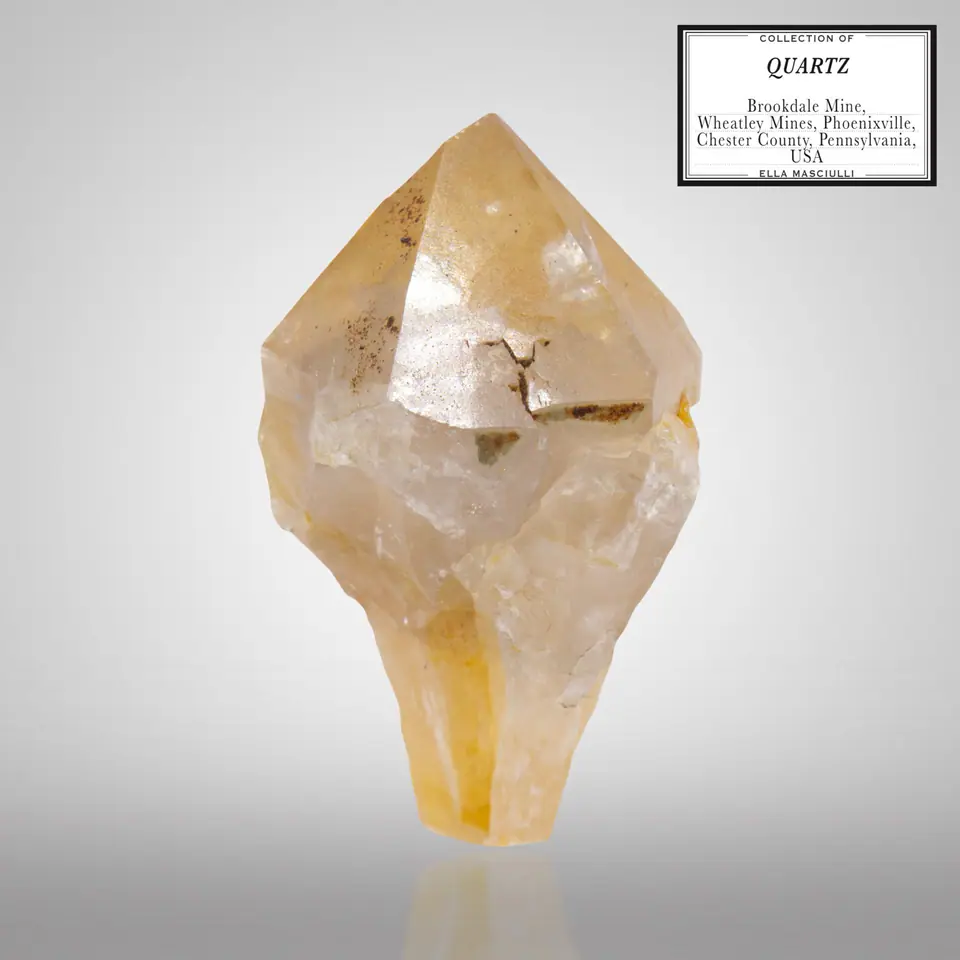
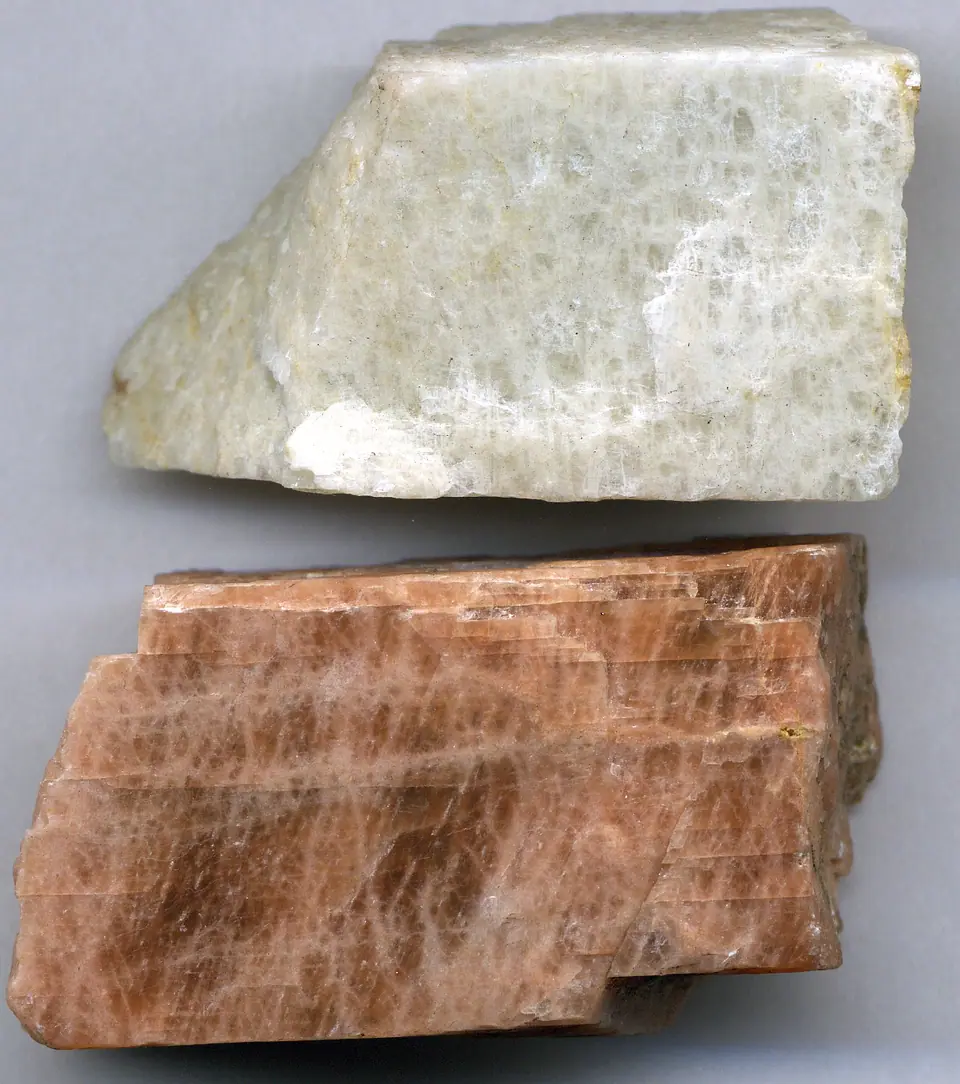
Study how the grain ends. Quartz usually has curved or irregular broken surfaces with no repeated flat direction; feldspar commonly shows two recurring cleavage planes that meet near 90 degrees.
Quartz and Feldspar comparison table
| Property | Quartz | Feldspar | How to use it |
|---|---|---|---|
| Cleavage | Absent; breaks by conchoidal or irregular fracture | Two good cleavage directions, commonly near 90° | Repeated planar breakage is the strongest field distinction. |
| Hardness | Mohs 7 | About Mohs 6 | Both can scratch glass, so hardness alone rarely resolves the pair. |
| Luster and clarity | Commonly glassy and translucent, with gray, clear, or smoky grains | Commonly pearly to glassy and white, pink, cream, or gray; alteration may make it cloudy | Appearance is useful only after cleavage is checked. |
| Surface markings | Natural faces may show horizontal growth lines but not feldspar twinning striations | Plagioclase cleavage faces may show fine parallel striations; potassium feldspar may show other twinning | Striations can confirm plagioclase when visible with a hand lens. |
A practical identification sequence
- 1
Rotate the grain under light and search for repeated flat cleavage surfaces.
- 2
Check whether two planar directions meet at approximately a right angle.
- 3
Look with a hand lens for fine parallel striations on a possible plagioclase face.
- 4
Use hardness, color, and the enclosing rock only as supporting evidence.
Where the distinction gets difficult
- Tiny grains in granite may not expose enough surface to show cleavage clearly.
- Weathered feldspar can look chalky or clay-like, while iron staining changes either mineral’s color.
- “Feldspar” is a mineral group; precise species identification may require optical or chemical analysis.
Use several independent observations. This comparison supports preliminary field identification, not laboratory confirmation, appraisal, proof of origin, or collecting permission.
Quartz vs. feldspar FAQ
Is the clear mineral in granite always quartz?
Often, but not always. Some feldspar is translucent, so cleavage and grain shape should be checked rather than relying on clarity.
Can feldspar scratch glass?
Yes. Most feldspar is about Mohs 6 and can scratch common glass, so a glass test does not prove a grain is quartz.
Why is feldspar commonly pink?
Some potassium feldspar is pink, salmon, or reddish, but many feldspars are white, cream, gray, green, or nearly colorless. Color is not diagnostic by itself.
Authoritative sources
LithoMap wrote this comparison in original language from the physical properties and geological concepts supported by these public scientific references.
- Minerals and their physical properties U.S. National Park Service
- Mohs Hardness Scale U.S. National Park Service
- Natural Gemstones: Mineral Gemstones U.S. Geological Survey
Editorial review: September 17, 2026.