
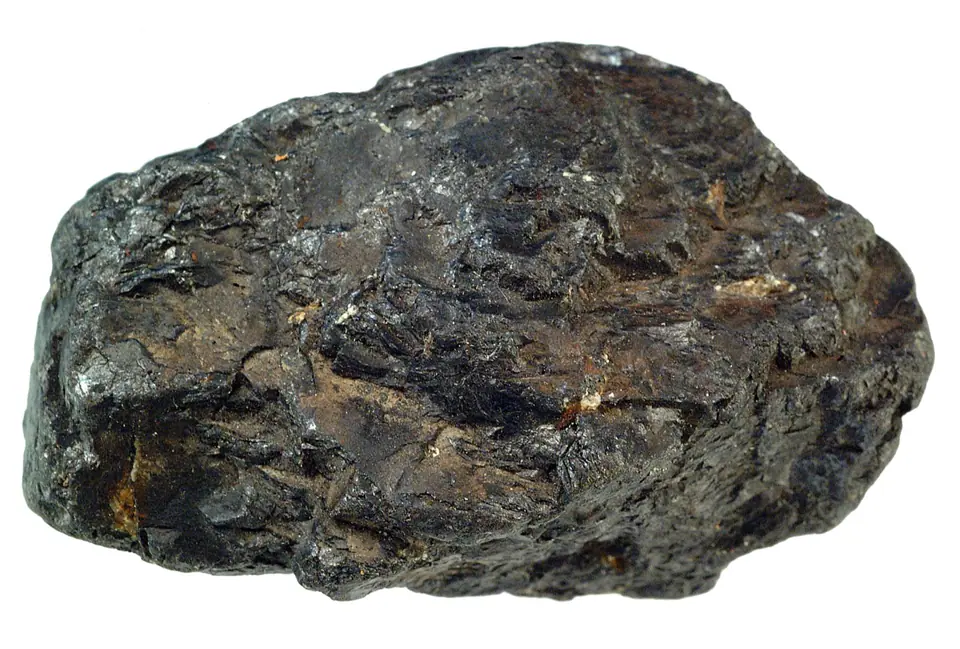

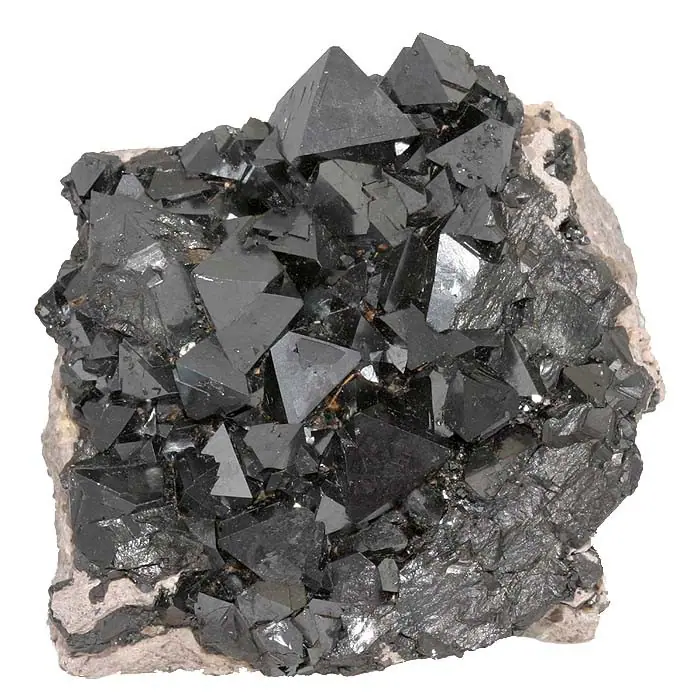

The most useful distinction
Compare magnetic strength with a known magnet, then streak. Strong attraction and black powder favor magnetite; weak response with black to brownish-red powder may favor ilmenite.
Ilmenite and Magnetite comparison table
| Property | Ilmenite | Magnetite | How to use it |
|---|---|---|---|
| Magnetism | Usually weak, absent, or variable | Usually strongly attracted to a magnet | The fastest field distinction on clean grains. |
| Streak | Black to brownish red | Black to dark gray | A brown-red cast can support ilmenite but is not universal. |
| Crystal habit | Thick tabular, granular, or massive | Octahedral, granular, or massive | Complete crystals may help; sand grains usually do not. |
| Alteration | May alter toward pale titanium-rich leucoxene | May oxidize toward hematite or maghemite | Weathering can weaken or complicate magnetic and streak responses. |
A practical identification sequence
- 1
Separate a few clean grains from attached matrix without grinding.
- 2
Compare their response to the same known magnet at the same distance.
- 3
Make a small streak if grains are large enough and expendable.
- 4
Use reflected-light microscopy or chemistry for mixed concentrates.
Where the distinction gets difficult
- Magnetite-ilmenite intergrowths may respond strongly despite abundant ilmenite.
- A magnet separates magnetic behavior, not mineral identity by itself.
- Avoid inhaling fine black-sand or mine-concentrate dust.
Use several independent observations. This comparison supports preliminary field identification, not laboratory confirmation, appraisal, proof of origin, or collecting permission.
Ilmenite vs. magnetite FAQ
Is ilmenite magnetic?
Pure ilmenite is generally weakly magnetic or nonmagnetic in a simple hand test, but intergrowths, exsolution, and alteration can increase its response.
Can ilmenite and magnetite occur in one grain?
Yes. Microscopic intergrowths and exsolution textures are common and can make field separation unreliable.
Is every strongly magnetic black sand magnetite?
No. A concentrate can include several minerals and industrial fragments, although strong attraction makes magnetite a leading possibility.
Authoritative sources
LithoMap wrote this comparison in original language from the physical properties and geological concepts supported by these public scientific references.
- Titanium Statistics and Information U.S. Geological Survey
- Mineral Commodity Summaries: Titanium Mineral Concentrates U.S. Geological Survey
- Minerals and their physical properties U.S. National Park Service
- Mohs Hardness Scale U.S. National Park Service
- Natural Gemstones: Mineral Gemstones U.S. Geological Survey
Editorial review: September 17, 2026.