
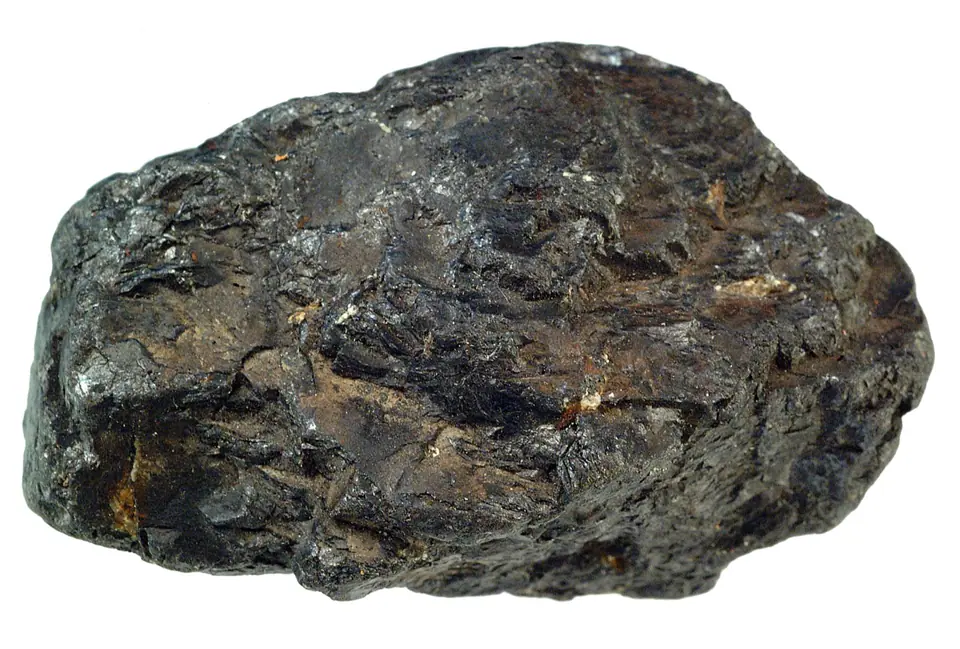

What is ilmenite?
Ideal ilmenite is FeTiO₃, but magnesium, manganese, ferric iron, and other elements may substitute. Intergrowths with magnetite or hematite and alteration toward leucoxene can substantially change its field behavior.
What does ilmenite look like?
Ilmenite commonly forms thick tabular crystals, granular aggregates, massive layers, or small opaque grains. Fresh surfaces are black with metallic to submetallic luster; weathering may produce brown rims or pale titanium-rich alteration.
In black sand it commonly occurs as rounded dark grains mixed with magnetite, garnet, zircon, rutile, and other dense minerals.
Identification tests
Begin with observation and use the least destructive test first. Results can change with weathering, mixtures, coatings, and grain size. Review the step-by-step field-test methods before altering an unfamiliar specimen.
Magnetism
Weak, absent, or variable in an ordinary hand testStrong attraction favors magnetite, but intergrowths can make ilmenite magnetic.
Streak
Black to brownish redCan overlap altered magnetite or hematite and should be combined with magnetism.
Hardness
About 5 to 6Overlaps iron oxides and is not decisive alone.
Density
High; commonly around 4.5 to 5Supports a heavy oxide mineral when matrix-free.
Useful procedures: Mineral magnetism test · Mineral streak test · Mohs hardness test · Specific gravity and density test
Common lookalikes
Magnetite
Usually strongly magnetic and leaves a black streak.
Hematite
Leaves a more consistently red to reddish-brown streak and is normally nonmagnetic.
Cassiterite
Usually harder, commonly leaves a light streak, and is typically even denser.
How does it form?
Ilmenite crystallizes in mafic and ultramafic igneous rocks and can concentrate into oxide-rich layers as magma evolves. It also occurs in metamorphic rocks.
Because it is dense and reasonably resistant to weathering, ilmenite is concentrated in stream, beach, and dune placers, including deposits along parts of the U.S. Atlantic Coastal Plain.
Geologic setting and occurrence
Ilmenite is widespread as an accessory mineral in basalt, gabbro, anorthosite, metamorphic rock, and heavy-mineral sands. Economically significant material may occur in hard-rock bodies or placer deposits.
A dark magnetic concentrate can contain several oxides; visual sorting is insufficient when identification affects resource, environmental, or property decisions.
Uses and significance
Ilmenite supplies most of the world’s titanium-mineral feedstock. It is processed chiefly for titanium dioxide pigment, with smaller portions contributing to titanium metal, welding products, and other titanium compounds.
Field notes
- Use a known magnet and record attraction strength instead of calling every response “magnetic.”
- Do not infer a commercial deposit from a handful of dark grains.
- Avoid dust from concentrates, tailings, and altered ore.
This guide supports preliminary field identification, not a laboratory determination, appraisal, hazard assessment, or statement of ownership or collecting permission. Verify land status and local rules before handling or collecting material.
Authoritative sources
LithoMap wrote this guide in original language using the scientific concepts and physical-property standards supported by these sources.
- Titanium Statistics and Information U.S. Geological Survey
- Mineral Commodity Summaries: Titanium Mineral Concentrates U.S. Geological Survey
- Minerals and their physical properties U.S. National Park Service
- Mohs Hardness Scale U.S. National Park Service
- Natural Gemstones: Mineral Gemstones U.S. Geological Survey
Editorial review: September 17, 2026.