
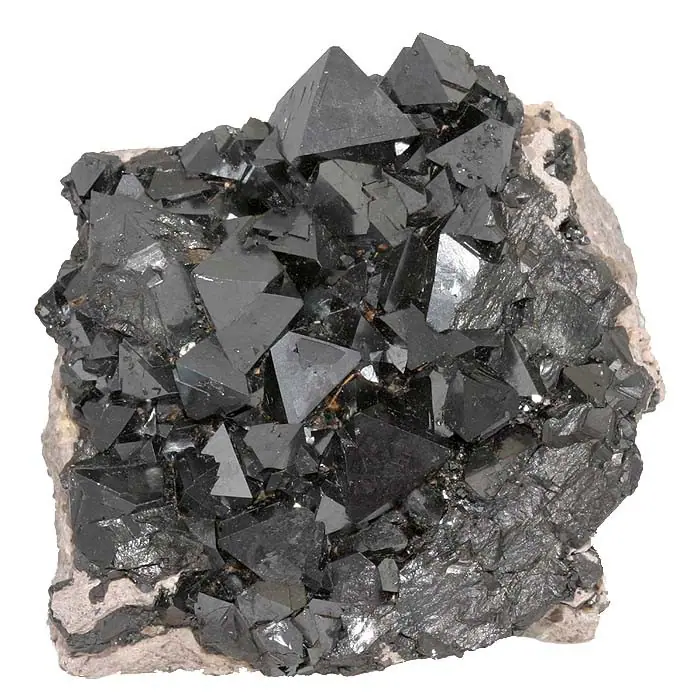

What is magnetite?
Magnetite contains both ferrous and ferric iron. Titanium and other elements can substitute, and intergrowths with related oxides may affect magnetic behavior.
What does magnetite look like?
Magnetite forms octahedral crystals, granular aggregates, massive layers, and disseminated grains. Fresh surfaces are black with metallic to dull luster.
Weathering can replace magnetite with hematite, maghemite, goethite, or mixtures, producing rusty surfaces and weaker magnetism.
Identification tests
Begin with observation and use the least destructive test first. Results can change with weathering, mixtures, coatings, and grain size. Review the step-by-step field-test methods before altering an unfamiliar specimen.
Magnetism
Strong attraction to a hand magnetThe key field property; test several parts of mixed rock.
Streak
BlackSeparates magnetite from red-streaking hematite.
Hardness
5.5 to 6.5Harder than many black oxides and most weathered coatings.
Density
Noticeably heavy for sizeSupports an iron-rich mineral but is not unique.
Useful procedures: Mineral magnetism test · Mineral streak test · Mohs hardness test · Specific gravity and density test
Common lookalikes
How does it form?
Magnetite crystallizes from magma, develops during metamorphism, forms in hydrothermal systems, and accumulates as heavy grains in sediment.
It can occur as an accessory mineral or dominate iron-rich layers and ore bodies. Geological context determines significance.
Geologic setting and occurrence
Magnetite occurs in many igneous and metamorphic rocks, iron formations, skarns, black sands, and some hydrothermal deposits.
Magnetic black sand may include magnetite with several other dense minerals. A magnet concentrates grains but does not identify every component.
Uses and significance
Magnetite is a major iron ore and is used in dense media, pigments, magnetic materials, and specialized industrial applications.
Field notes
- A magnetic rock is not automatically a meteorite.
- Keep strong magnets away from electronics and medical devices.
- Mine dumps and iron-rich dust can contain additional hazardous minerals.
This guide supports preliminary field identification, not a laboratory determination, appraisal, hazard assessment, or statement of ownership or collecting permission. Verify land status and local rules before handling or collecting material.
Authoritative sources
LithoMap wrote this guide in original language using the scientific concepts and physical-property standards supported by these sources.
- Minerals and their physical properties U.S. National Park Service
- Mohs Hardness Scale U.S. National Park Service
- Natural Gemstones: Mineral Gemstones U.S. Geological Survey
Editorial review: September 17, 2026.