
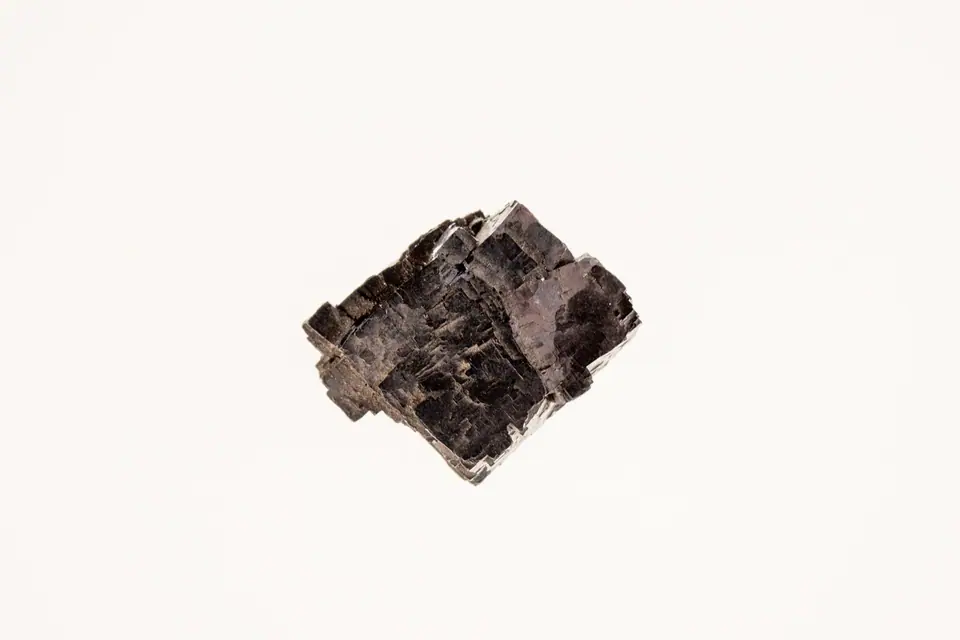
What is galena?
Galena is lead sulfide, PbS. It may contain silver and other trace elements, but visible galena does not reveal silver content or ore grade. Weathering can produce anglesite, cerussite, and lead-bearing surface coatings.
What does galena look like?
Galena commonly forms cubes, blocky cleavage fragments, granular masses, and coarse metallic veins. Fresh surfaces are bright lead-gray; weathered surfaces become dull gray or dark.
Three perfect cleavage directions meet at right angles, repeatedly producing cubes and rectangular steps. That geometry is more diagnostic than brightness.
Identification tests
Begin with observation and use the least destructive test first. Results can change with weathering, mixtures, coatings, and grain size. Review the step-by-step field-test methods before altering an unfamiliar specimen.
Hardness
About 2.5Soft enough to scratch with copper or steel.
Streak
Lead-gray to blackSupports galena but should be performed without generating unnecessary powder.
Cleavage
Perfect cubic cleavageThree directions at 90° are the strongest visual clue.
Density
Very high; specific gravity about 7.5A compact piece feels conspicuously heavy.
Useful procedures: Mohs hardness test · Mineral streak test · Cleavage versus fracture · Specific gravity and density test
Common lookalikes
How does it form?
Galena forms in hydrothermal veins, replacement deposits, carbonate-hosted Mississippi Valley–type deposits, volcanogenic massive sulfides, skarns, and some metamorphic settings.
Common associates include sphalerite, pyrite, chalcopyrite, fluorite, barite, calcite, and quartz. Mixed ore can combine their streaks and hardness responses.
Geologic setting and occurrence
Galena is widespread in lead-zinc districts and many polymetallic veins. Its presence may indicate an ore-forming system but does not establish a commercial deposit.
Mine waste and old smelter areas may contain dispersed lead contamination even where attractive crystals are absent.
Uses and significance
Galena has historically been the principal mineral source of lead, used in lead-acid batteries, radiation shielding, specialized alloys, and other controlled industrial applications.
Field notes
- Do not lick, taste, grind, saw, or polish galena.
- Wash hands after handling and keep specimens away from children and food areas.
- Avoid dust at mines, dumps, and old processing sites where lead contamination may be widespread.
This guide supports preliminary field identification, not a laboratory determination, appraisal, hazard assessment, or statement of ownership or collecting permission. Verify land status and local rules before handling or collecting material.
Authoritative sources
LithoMap wrote this guide in original language using the scientific concepts and physical-property standards supported by these sources.
- Lead—Soft and Easy to Cast U.S. Geological Survey
- Minerals and their physical properties U.S. National Park Service
- Mohs Hardness Scale U.S. National Park Service
- Natural Gemstones: Mineral Gemstones U.S. Geological Survey
Editorial review: September 17, 2026.