
.jpg)
What is silver?
Native silver is elemental Ag and may contain gold, copper, mercury, or other metals. Natural silver also occurs in many sulfide, sulfosalt, halide, and telluride minerals, so a silver-bearing specimen is not necessarily native silver.
What does silver look like?
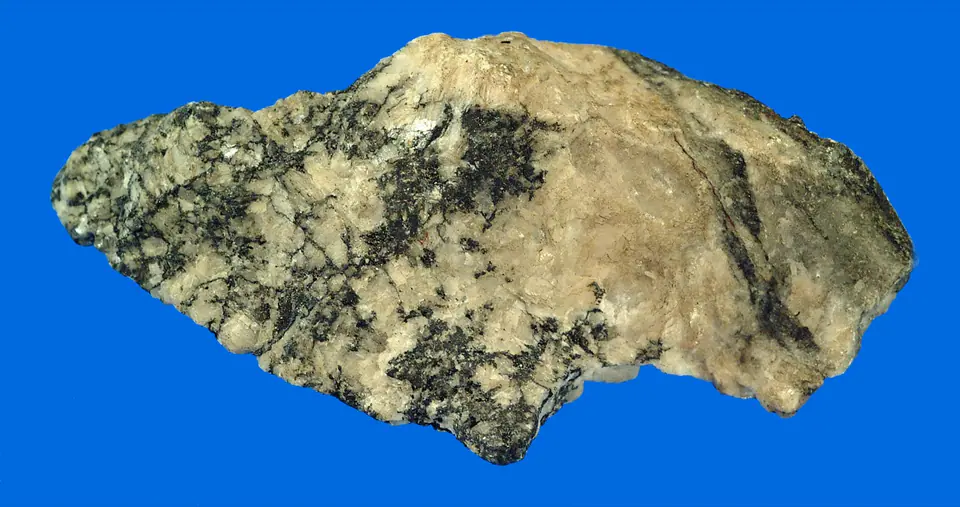
Fresh native silver has a bright metallic white color, but exposure can produce gray to black tarnish that conceals it. Wires, curls, branching aggregates, plates, and compact masses are characteristic forms.
Thin coatings, metallic lead, galena, and manufactured metal can look similar. Visual appearance alone cannot establish elemental silver, fineness, or economic value.
Identification tests
Begin with observation and use the least destructive test first. Results can change with weathering, mixtures, coatings, and grain size. Review the step-by-step field-test methods before altering an unfamiliar specimen.
Hardness
2.5 to 3Scratched by copper or steel; much softer than pyrite.
Streak
Silver-whiteDiffers from galena’s gray-black streak, although tarnish can interfere.
Tenacity
Malleable, ductile, and sectileA loose expendable piece deforms instead of breaking like galena.
Density
Very high; specific gravity about 10.5Heft supports identification but does not distinguish every heavy metal.
Useful procedures: Mohs hardness test · Mineral streak test · Specific gravity and density test
Common lookalikes
Galena
Brittle, gray-streaked, and breaks along cubic cleavage instead of bending.
Native lead
Darker, softer, and commonly associated with human-made material; context and analysis may be required.
Manufactured metal
Solder, foil, wire, and fragments often have regular shapes or occur near human activity.
How does it form?
Native silver forms in hydrothermal veins, enriched zones of silver-bearing deposits, and some volcanic or sediment-hosted systems where chemical conditions allow elemental metal to precipitate.
It may occur with native copper and gold, calcite, quartz, galena, acanthite, cobalt-nickel minerals, and other ore minerals.
Geologic setting and occurrence
Native silver is uncommon compared with silver hosted in other minerals. Even a productive silver deposit may contain little visible native metal.
Dark tarnish and small grain size make field recognition difficult. Laboratory analysis is appropriate before appraisal, processing, or claims about composition.
Uses and significance
Silver is used in electronics, solar cells, brazing alloys, mirrors, antimicrobial applications, photography, jewelry, tableware, and investment products.
Field notes
- Do not use acids or improvised chemical tests on suspected silver.
- Lead- and arsenic-bearing minerals commonly occur in silver deposits; avoid dust and wash hands.
- Field appearance cannot establish fineness, authenticity, provenance, or value.
This guide supports preliminary field identification, not a laboratory determination, appraisal, hazard assessment, or statement of ownership or collecting permission. Verify land status and local rules before handling or collecting material.
Authoritative sources
LithoMap wrote this guide in original language using the scientific concepts and physical-property standards supported by these sources.
- Silver Statistics and Information U.S. Geological Survey
- Minerals and their physical properties U.S. National Park Service
- Mohs Hardness Scale U.S. National Park Service
- Natural Gemstones: Mineral Gemstones U.S. Geological Survey
Editorial review: September 17, 2026.