
.jpg)
What is azurite?
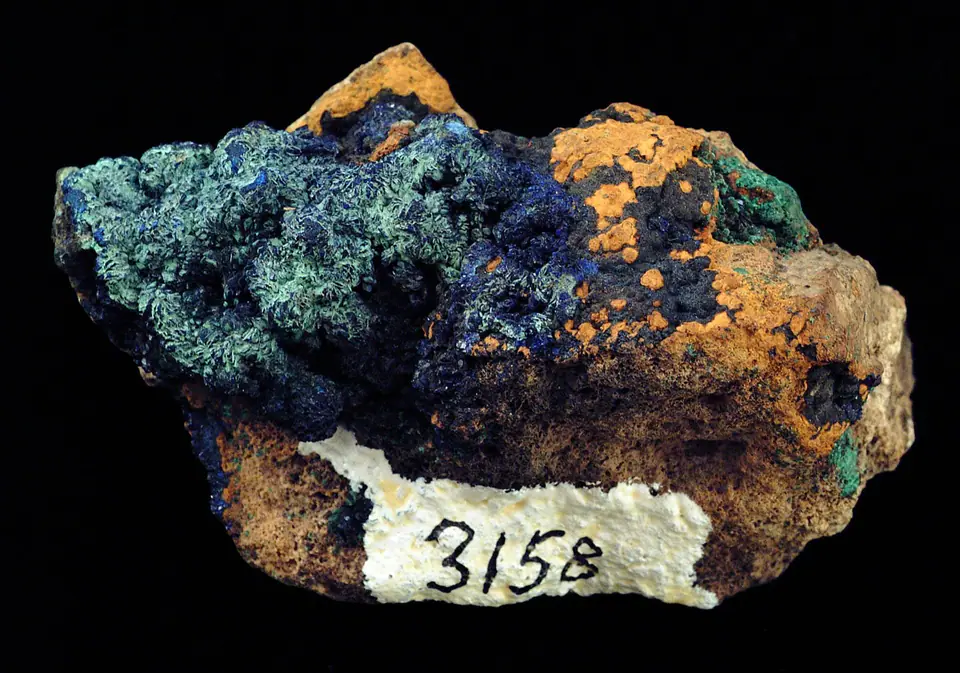
Azurite contains copper, carbonate, and hydroxide, with a different copper-to-carbonate ratio from malachite. It may alter to malachite at the surface, producing blue cores, green rims, or mixed blue-green patterns.
What does azurite look like?
Azurite forms tabular or prismatic crystals, radiating clusters, nodules, crusts, earthy coatings, and compact masses. Fine crystals can be glassy, while weathered material looks dull or powdery.
Color is striking but variable. Dark crystals may appear nearly black until strong light reveals blue along thin edges or in the streak.
Identification tests
Begin with observation and use the least destructive test first. Results can change with weathering, mixtures, coatings, and grain size. Review the step-by-step field-test methods before altering an unfamiliar specimen.
Hardness
About 3.5 to 4Scratched by steel and similar in hardness to malachite.
Streak
Blue to light blueThe clearest simple distinction from green-streaking malachite.
Acid response
Reacts with acidSupports a carbonate but is destructive and can mobilize copper.
Color in thin areas
Distinctly blueHelps reveal azurite in crystals that look black in reflected light.
Useful procedures: Mohs hardness test · Mineral streak test · Acid reaction test
Common lookalikes
Malachite
Green with a green streak; intergrowths and alteration between the pair are common.
Lapis lazuli
A rock dominated by blue lazurite with other minerals, typically harder and not a copper-carbonate crust.
Blue paint or manufactured pigment
May form uniform films or occur in archaeological and industrial settings without natural crystal texture.
How does it form?
Azurite forms in oxidized copper deposits where carbonate-bearing groundwater reacts with primary copper minerals.
It commonly occurs with malachite, chrysocolla, cuprite, limonite, calcite, and surviving sulfides. Changing water and carbon-dioxide conditions can favor conversion to malachite.
Geologic setting and occurrence
Azurite occurs in the oxidized zones of copper deposits, commonly in fractures, cavities, and replacement bodies above primary mineralization.
It is generally less stable than malachite under many surface conditions, so green replacement may partly obscure earlier azurite.
Uses and significance
Azurite has been used as a blue pigment, ornamental stone, collectible mineral, and minor copper ore. Historical pigments can be culturally important and must not be sampled casually.
Field notes
- Avoid creating copper-bearing dust and wash hands after handling powdery material.
- Do not acid-test art, archaeological objects, masonry, or valuable specimens.
- Blue stains near mines may be mixed minerals or contaminated drainage rather than collectible azurite.
This guide supports preliminary field identification, not a laboratory determination, appraisal, hazard assessment, or statement of ownership or collecting permission. Verify land status and local rules before handling or collecting material.
Authoritative sources
LithoMap wrote this guide in original language using the scientific concepts and physical-property standards supported by these sources.
- Assessment of Selected Copper Minerals in Mine Wastes U.S. Geological Survey
- Copper Statistics and Information U.S. Geological Survey
- Minerals and their physical properties U.S. National Park Service
- Mohs Hardness Scale U.S. National Park Service
- Natural Gemstones: Mineral Gemstones U.S. Geological Survey
Editorial review: September 17, 2026.