
.jpg)
What is augite?
Augite is a chemically variable clinopyroxene containing calcium with magnesium, iron, aluminum, titanium, sodium, silicon, and oxygen in solid solution. Exact compositions and names require analytical work.
What does augite look like?
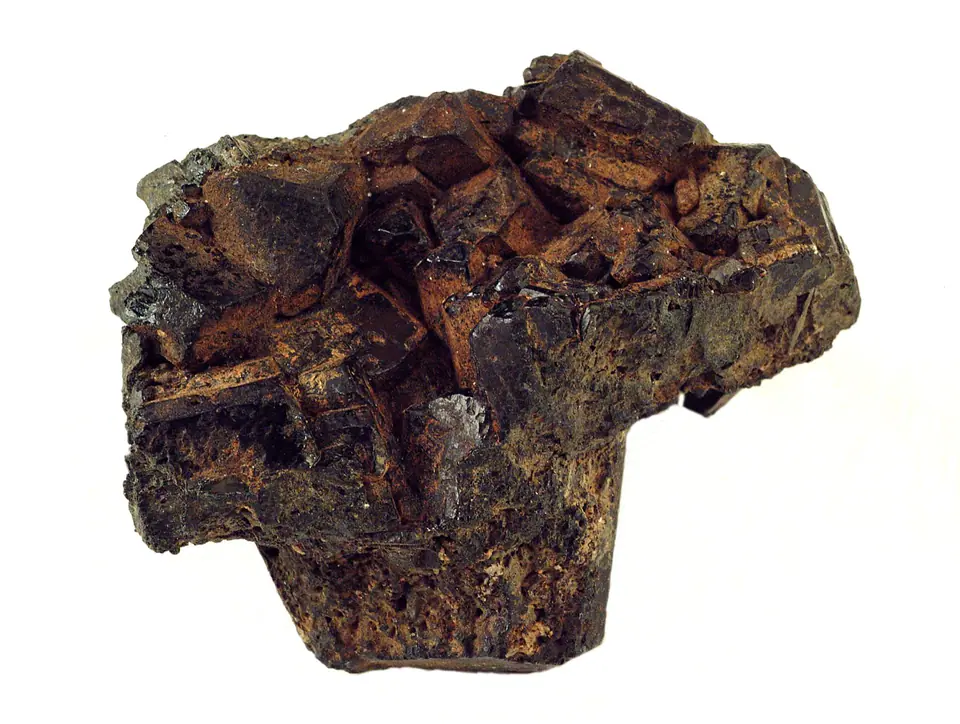
Augite grains are commonly stubby, blocky, or granular rather than strongly elongated. Fresh crystals have vitreous luster, while alteration can turn surfaces dull green or brown.
Cross sections may look nearly square or eight-sided. In fine-grained basalt, most augite crystals are too small to identify without microscopy.
Identification tests
Begin with observation and use the least destructive test first. Results can change with weathering, mixtures, coatings, and grain size. Review the step-by-step field-test methods before altering an unfamiliar specimen.
Hardness
About 5.5 to 6Similar to hornblende and less useful than cleavage geometry.
Cleavage
Two good directions near 87 and 93 degreesNear-right-angle pyroxene cleavage distinguishes it from amphibole.
Habit
Short, blocky prismsContrasts with more elongate or splintery hornblende.
Streak
White to pale grayNot usually diagnostic.
Useful procedures: Mohs hardness test · Cleavage versus fracture · Mineral streak test
Common lookalikes
Hornblende
More elongate and splintery with cleavage near 60 and 120 degrees.
Tourmaline
Commonly deeply striated, triangular in cross section, harder, and poorly cleaved.
Olivine
Usually olive green and granular with poor cleavage rather than dark blocky prisms.
How does it form?
Augite crystallizes from mafic to intermediate magma and is common in basalt, gabbro, diabase, and some andesite.
It also occurs in selected high-temperature metamorphic rocks and can alter to amphibole, chlorite, clay, or other secondary minerals.
Geologic setting and occurrence
Augite is widespread in mafic volcanic and intrusive rocks, especially basaltic lava, gabbro, and diabase. Coarse crystals can occur in pegmatitic zones or volcanic nodules.
A dark pyroxene-like grain may belong to another clinopyroxene; field appearance alone rarely supports a precise species.
Uses and significance
Augite is primarily important for rock identification and interpreting igneous crystallization. It has little direct commodity use, though augite-bearing rock is quarried as aggregate.
Field notes
- Use a hand lens on a fresh surface and seek repeated near-right-angle cleavage.
- Fine basaltic grains generally require microscopy.
- Do not infer a specific lava flow or intrusion from one loose crystal.
This guide supports preliminary field identification, not a laboratory determination, appraisal, hazard assessment, or statement of ownership or collecting permission. Verify land status and local rules before handling or collecting material.
Authoritative sources
LithoMap wrote this guide in original language using the scientific concepts and physical-property standards supported by these sources.
- Minerals and their physical properties U.S. National Park Service
- Mohs Hardness Scale U.S. National Park Service
- Natural Gemstones: Mineral Gemstones U.S. Geological Survey
Editorial review: September 17, 2026.