
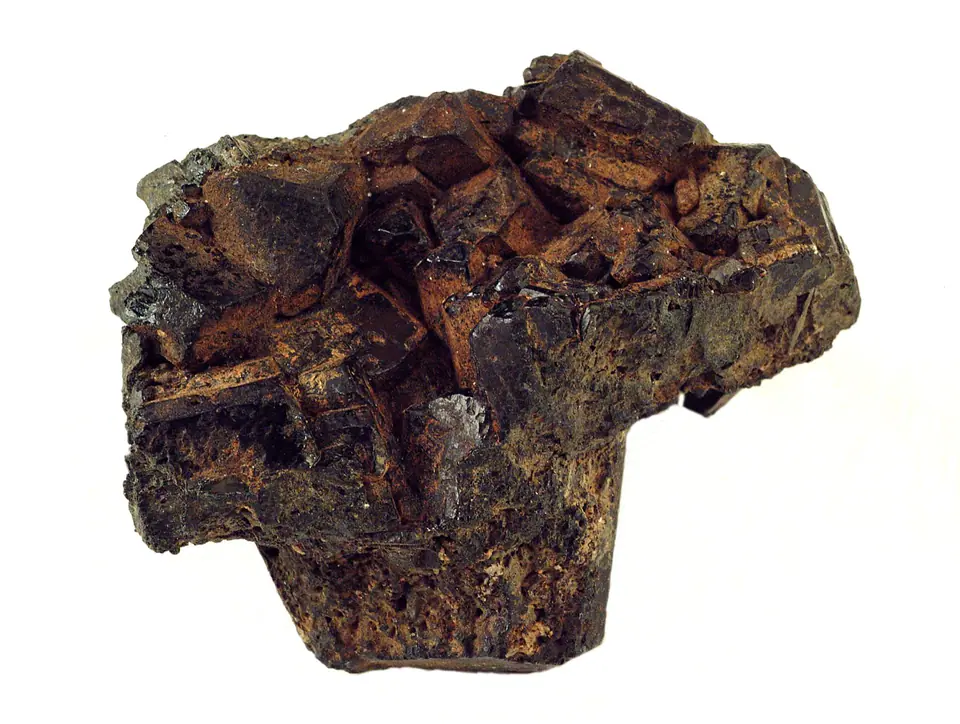
.jpg)
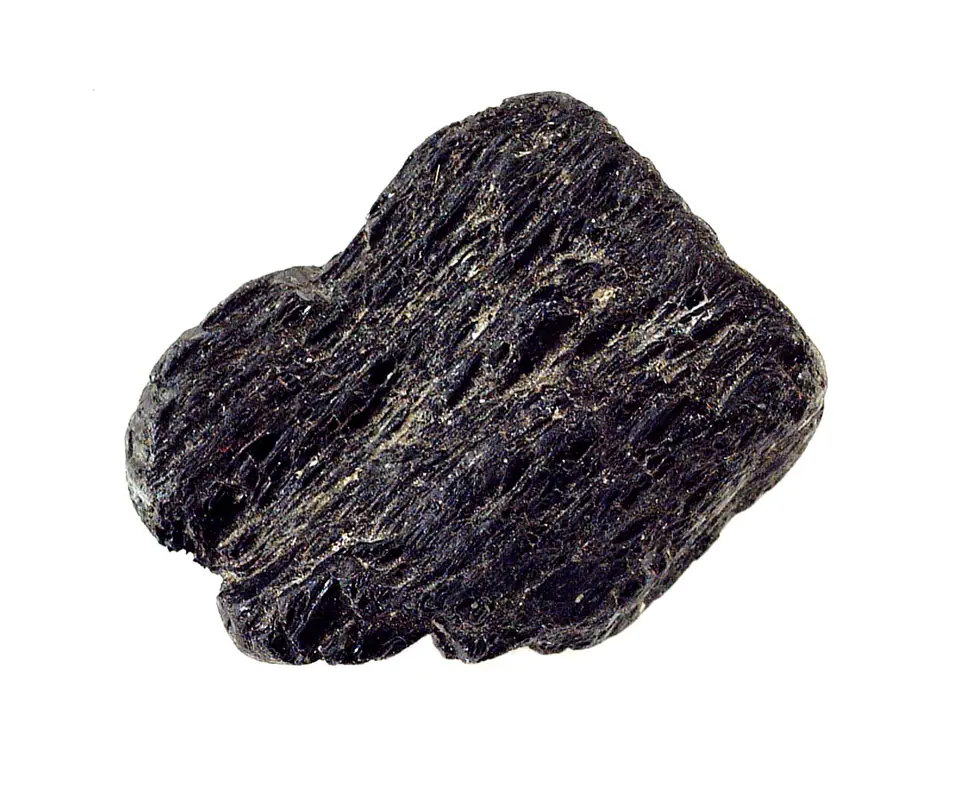
.jpg)
The most useful distinction
Measure the intersection of repeated cleavage surfaces. Near-right angles favor augite; distinctly oblique amphibole angles favor hornblende.
Augite and Hornblende comparison table
| Property | Augite | Hornblende | How to use it |
|---|---|---|---|
| Cleavage angle | Two directions near 87 and 93 degrees | Two directions near 56 and 124 degrees | The defining field distinction between typical pyroxene and amphibole. |
| Crystal habit | Short, stubby, or blocky prisms | Longer, bladed, or splintery prisms | Habit reinforces cleavage geometry. |
| Hardness | Mohs about 5.5 to 6 | Mohs about 5 to 6 | The ranges overlap and do not separate the pair. |
| Common rocks | Basalt, gabbro, diabase, and other mafic igneous rocks | Diorite, granodiorite, amphibolite, gneiss, and schist | Rock context is supporting evidence only. |
A practical identification sequence
- 1
Choose a grain large enough to show more than one broken surface.
- 2
Find repeated cleavage rather than one accidental fracture.
- 3
Estimate whether intersections approach 90 degrees or 60/120 degrees.
- 4
Use microscopy when grains are small or altered.
Where the distinction gets difficult
- Alteration can replace augite with amphibole and create mixed textures.
- Perspective makes cleavage angles difficult on tiny grains.
- Black color and hardness alone cannot distinguish them.
Use several independent observations. This comparison supports preliminary field identification, not laboratory confirmation, appraisal, proof of origin, or collecting permission.
Augite vs. hornblende FAQ
Is augite a pyroxene?
Yes. Augite belongs to the clinopyroxene group, while hornblende belongs to the amphibole group.
Which mineral is more elongated?
Hornblende is commonly more elongate or needle-like, while augite is usually shorter and blockier.
Can both occur in one rock?
Yes. Igneous crystallization and later alteration or metamorphism can place pyroxene and amphibole together.
Authoritative sources
LithoMap wrote this comparison in original language from the physical properties and geological concepts supported by these public scientific references.
- Minerals and their physical properties U.S. National Park Service
- Mohs Hardness Scale U.S. National Park Service
- Natural Gemstones: Mineral Gemstones U.S. Geological Survey
Editorial review: September 17, 2026.