
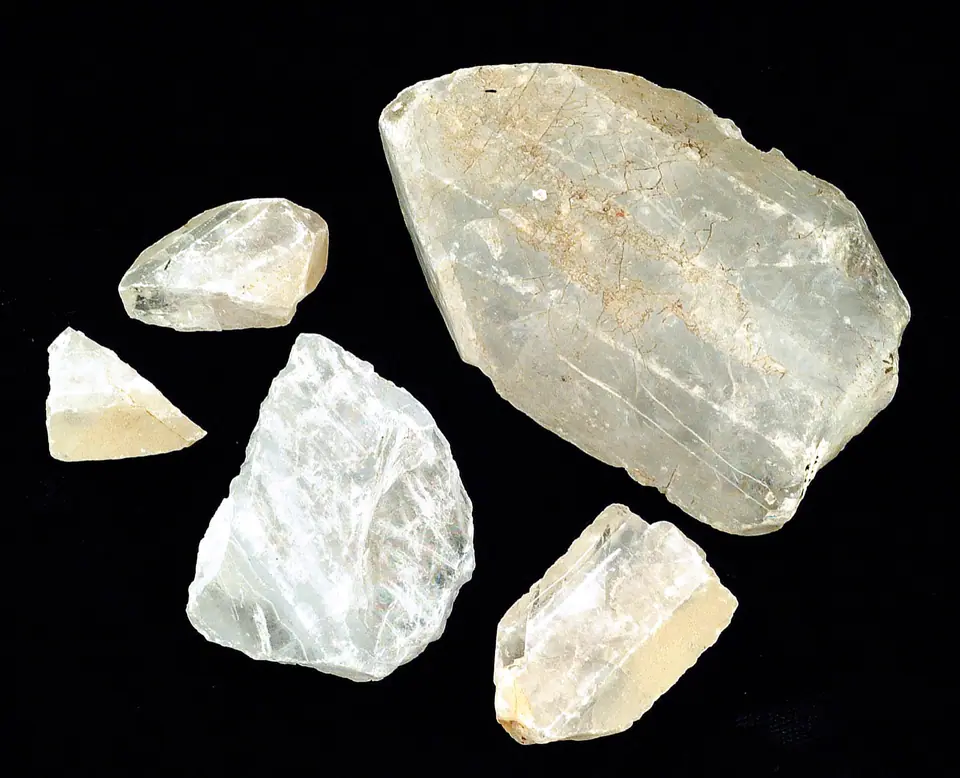

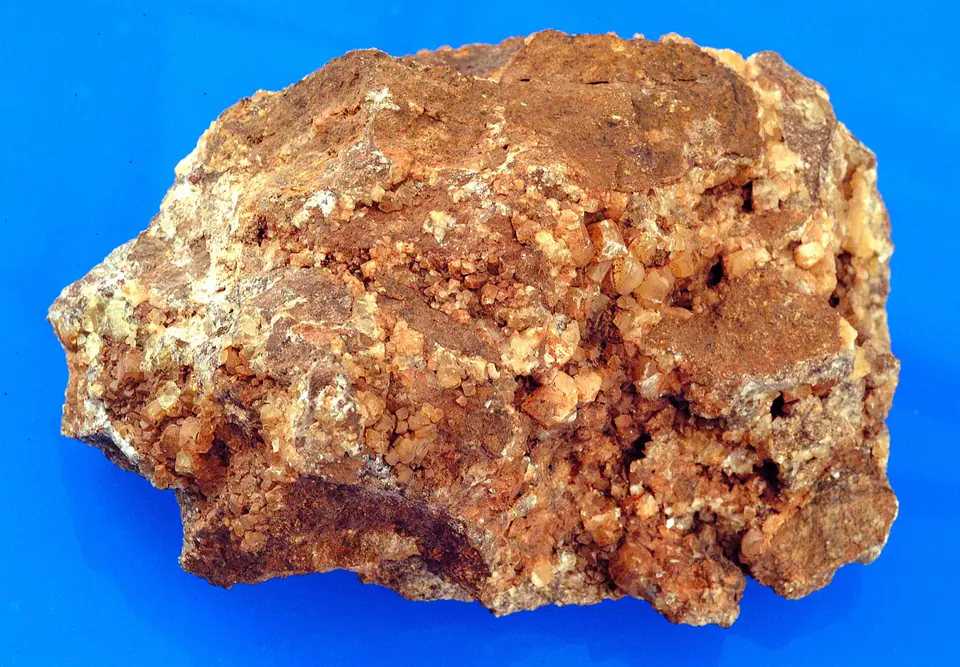

The most useful distinction
Do not use blue color alone. Measure density carefully: barite is commonly near 4.5, celestite near 4.0, with natural solid solution and attached matrix capable of blurring the result.
Celestite and Barite comparison table
| Property | Celestite | Barite | How to use it |
|---|---|---|---|
| Composition | Strontium sulfate, SrSO₄ | Barium sulfate, BaSO₄ | Chemistry defines the minerals. |
| Density | High, commonly near 4.0 | Very high, commonly near 4.5 | The best nondestructive field-to-lab distinction when measured accurately. |
| Color | Often pale blue but also colorless, white, yellow, or reddish | Often white or colorless but also blue, yellow, brown, or reddish | Color overlaps extensively and is unreliable. |
| Hardness and habit | Mohs 3 to 3.5; tabular, bladed, prismatic, or fibrous | Mohs 3 to 3.5; tabular, bladed, rosette, granular, or massive | These common properties rarely separate the pair. |
A practical identification sequence
- 1
Document crystal habit and host rock without relying on color.
- 2
Remove no matrix from a valuable specimen.
- 3
Measure mass and water-displacement volume if the specimen can be wetted safely.
- 4
Use chemical or spectroscopic testing when the result matters.
Where the distinction gets difficult
- Porosity, attached matrix, and trapped air distort density measurements.
- Barium–strontium solid solution can produce intermediate properties.
- Do not use improvised flame or chemical tests.
Use several independent observations. This comparison supports preliminary field identification, not laboratory confirmation, appraisal, proof of origin, or collecting permission.
Celestite vs. barite FAQ
Is every blue sulfate celestite?
No. Barite can be blue, and celestite can be colorless or white.
Which mineral is heavier?
Barite is usually denser, but the difference is modest enough that accurate measurement is preferable to hand heft.
Can celestite and barite occur together?
Yes. They can occur in similar sedimentary and hydrothermal settings and can form compositional mixtures.
Authoritative sources
LithoMap wrote this comparison in original language from the physical properties and geological concepts supported by these public scientific references.
- Strontium Statistics and Information U.S. Geological Survey
- Minerals and their physical properties U.S. National Park Service
- Mohs Hardness Scale U.S. National Park Service
- Natural Gemstones: Mineral Gemstones U.S. Geological Survey
- Barite Statistics and Information U.S. Geological Survey
Editorial review: September 17, 2026.