
.jpg)

The most useful distinction
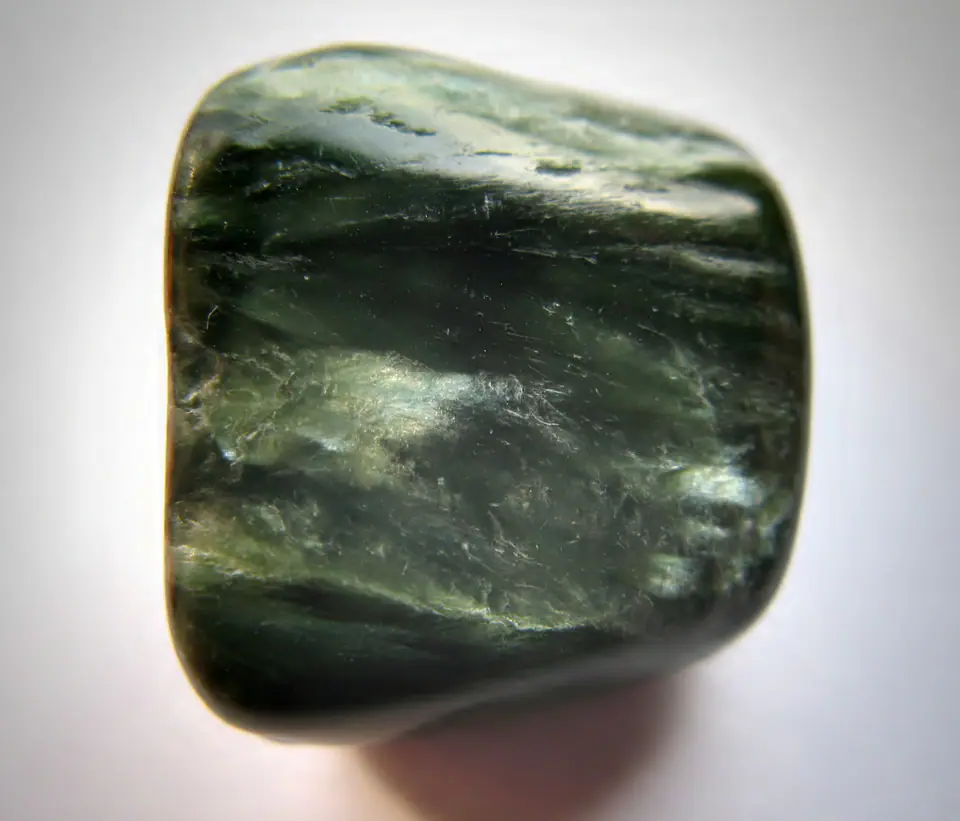
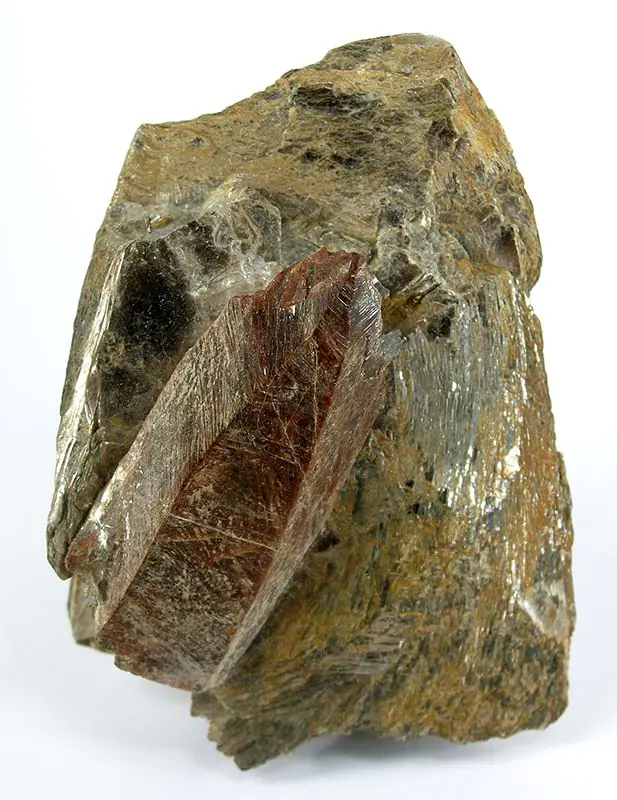
Test an already loose flake. Green, very soft material that bends without springing back favors chlorite; brown-black elastic sheets favor biotite.
Chlorite and Biotite comparison table
| Property | Chlorite | Biotite | How to use it |
|---|---|---|---|
| Color | Usually green to gray-green | Usually dark brown, black, or greenish-black | A useful first clue, though both can be greenish. |
| Hardness | Commonly Mohs 2 to 2.5 | Commonly Mohs 2.5 to 3 | Chlorite is typically softer, but the ranges overlap. |
| Flake behavior | Flexible but generally nonelastic | Flexible and elastic | Spring-back is one of the best distinctions on a loose flake. |
| Typical setting | Low-grade metamorphic and altered rocks | Igneous and medium- to high-grade metamorphic rocks | Setting supports the physical tests. |
A practical identification sequence
- 1
Observe color and luster on a fresh cleavage surface.
- 2
Use only an already detached flake.
- 3
Bend it gently and observe whether it springs back.
- 4
Use microscopy or chemistry when flakes are tiny or intergrown.
Where the distinction gets difficult
- Do not peel a display specimen to create a test flake.
- Weathered biotite can lose elasticity and turn greenish.
- Fine green alteration may contain several sheet silicates.
Use several independent observations. This comparison supports preliminary field identification, not laboratory confirmation, appraisal, proof of origin, or collecting permission.
Chlorite vs. biotite FAQ
Is chlorite a type of mica?
No. Chlorite is a separate sheet-silicate group, although it resembles mica in cleavage and platy habit.
Can biotite turn into chlorite?
Biotite commonly alters partly or extensively to chlorite, producing mixed or transitional grains.
Which mineral is elastic?
Fresh biotite sheets are characteristically elastic. Chlorite flakes are usually flexible but do not spring back as strongly.
Authoritative sources
LithoMap wrote this comparison in original language from the physical properties and geological concepts supported by these public scientific references.
- Minerals and their physical properties U.S. National Park Service
- Mohs Hardness Scale U.S. National Park Service
- Natural Gemstones: Mineral Gemstones U.S. Geological Survey
Editorial review: September 17, 2026.