
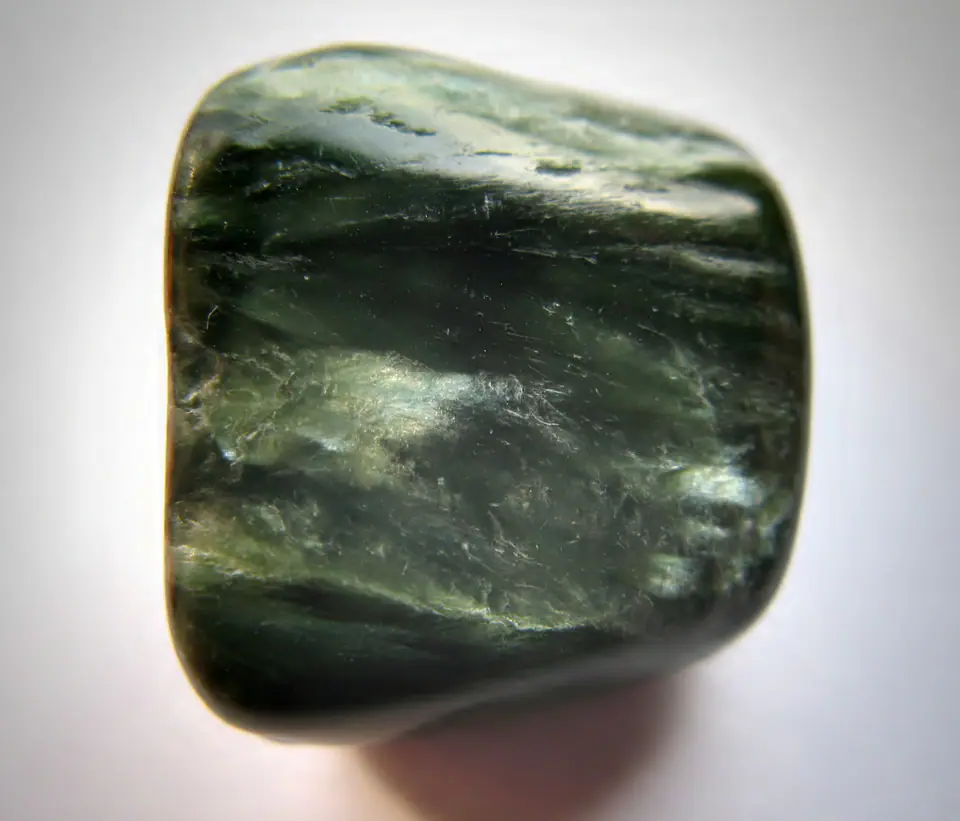
.jpg)
What is chlorite?
Chlorite-group minerals are hydrous magnesium, iron, and aluminum sheet silicates with substantial chemical variation. Species identification usually requires chemical or crystallographic data.
What does chlorite look like?
Chlorite occurs as platy crystals, fine scaly aggregates, green coatings, foliated masses, and microscopic grains. Luster ranges from pearly or vitreous on cleavage surfaces to dull in earthy material.
Color may be pale to dark green, gray, blackish, white, or brownish. Fine chlorite in rock can create an overall green color without visible individual flakes.
Identification tests
Begin with observation and use the least destructive test first. Results can change with weathering, mixtures, coatings, and grain size. Review the step-by-step field-test methods before altering an unfamiliar specimen.
Hardness
Commonly about 2 to 2.5Usually scratched by a fingernail or copper point.
Cleavage
Perfect basal cleavageProduces thin sheets like mica.
Tenacity
Flexible but generally not elasticSeparates typical chlorite from springy mica flakes.
Streak
White to pale greenSupporting evidence for green material.
Useful procedures: Mohs hardness test · Cleavage versus fracture · Mineral streak test
Common lookalikes
Biotite
Usually brown to black, more elastic in thin sheets, and commonly harder.
Muscovite
Usually colorless or silvery and elastic in thin sheets.
Serpentine
Often waxy or massive and lacks the same consistent mica-like basal sheets.
How does it form?
Chlorite forms during low- to moderate-grade metamorphism and through hydrothermal or weathering alteration of iron- and magnesium-bearing minerals.
It is common in greenschist, phyllite, slate, altered basalt, veins, and fault zones, often with epidote, actinolite, albite, quartz, or calcite.
Geologic setting and occurrence
Chlorite is widespread in low-grade metamorphic rocks and altered igneous rocks. Its presence can help describe metamorphic grade and fluid alteration.
A green platy mineral should be called chlorite-group material cautiously because color and simple field properties do not establish species.
Uses and significance
Chlorite has little direct commodity use but is important in petrology, alteration mapping, ceramics, and understanding metamorphic conditions and fluid-rock interaction.
Field notes
- Test flexibility only on an already loose expendable flake.
- Avoid creating dust from altered rock or fault material.
- Use multiple properties because many green sheet silicates overlap.
This guide supports preliminary field identification, not a laboratory determination, appraisal, hazard assessment, or statement of ownership or collecting permission. Verify land status and local rules before handling or collecting material.
Authoritative sources
LithoMap wrote this guide in original language using the scientific concepts and physical-property standards supported by these sources.
- Minerals and their physical properties U.S. National Park Service
- Mohs Hardness Scale U.S. National Park Service
- Natural Gemstones: Mineral Gemstones U.S. Geological Survey
Editorial review: September 17, 2026.