
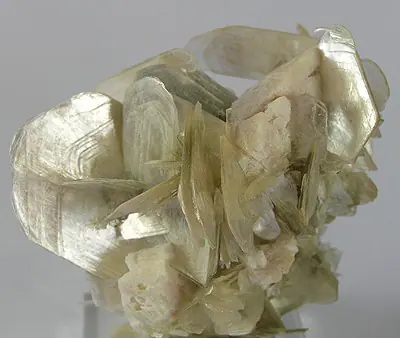

What is muscovite?
Muscovite is a potassium aluminum sheet silicate containing hydroxyl and sometimes fluorine. Substitution and inclusions can produce green, brown, pink, or other pale tones.
What does muscovite look like?
Books of muscovite consist of stacked sheets that peel apart along one perfect cleavage. Thin sheets transmit light and spring back after gentle bending.
In rocks, muscovite may appear as glittering flakes aligned in schist or scattered through granite and pegmatite.
Identification tests
Begin with observation and use the least destructive test first. Results can change with weathering, mixtures, coatings, and grain size. Review the step-by-step field-test methods before altering an unfamiliar specimen.
Hardness
2 to 2.5Scratched by a fingernail or copper coin.
Streak
WhiteUsually not necessary when sheet habit is clear.
Cleavage
Perfect in one directionProduces thin, elastic sheets.
Transparency
Thin flakes are transparent to translucentHelps separate muscovite from darker biotite.
Useful procedures: Mohs hardness test · Mineral streak test · Cleavage versus fracture
Common lookalikes
How does it form?
Muscovite crystallizes in granitic magmas and pegmatites, forms during metamorphism of clay-rich rocks, and develops through hydrothermal alteration.
Its platy structure reflects strongly between sheets and controls its exceptional cleavage.
Geologic setting and occurrence
Muscovite is common in granite, pegmatite, schist, gneiss, and altered rocks. Durable flakes may accumulate in sand and sparkle in stream sediment.
A glittering surface is not evidence of gold. Mica reflects light strongly but forms flakes rather than dense metallic grains.
Uses and significance
Muscovite is used as an electrical and thermal insulator, filler, pigment extender, drilling additive, and decorative sparkle in manufactured products.
Field notes
- Test elasticity gently; old specimens may be brittle or weathered.
- Fine mica dust can irritate lungs and eyes.
- Do not confuse reflective flakes in sand with metallic ore.
This guide supports preliminary field identification, not a laboratory determination, appraisal, hazard assessment, or statement of ownership or collecting permission. Verify land status and local rules before handling or collecting material.
Authoritative sources
LithoMap wrote this guide in original language using the scientific concepts and physical-property standards supported by these sources.
- Minerals and their physical properties U.S. National Park Service
- Mohs Hardness Scale U.S. National Park Service
- Natural Gemstones: Mineral Gemstones U.S. Geological Survey
Editorial review: September 17, 2026.