

What is talc?
Talc is a hydrous magnesium sheet silicate. Iron, nickel, or other substitutions and intergrowths can change color and density. Natural talc rock may contain carbonate, chlorite, serpentine, amphibole, or other minerals.
What does talc look like?
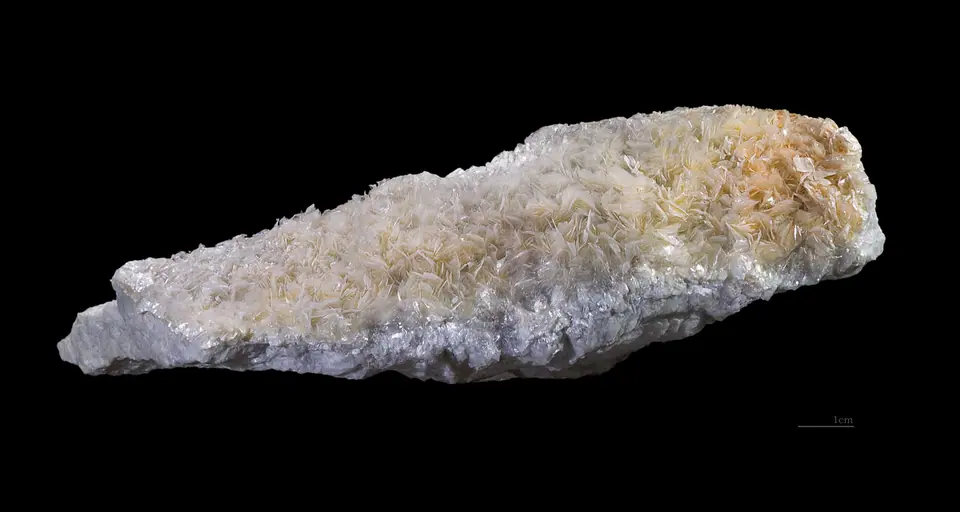
Talc occurs as foliated flakes, compact masses, fine-grained soapstone, or scaly aggregates. Thin plates have pearly surfaces and perfect basal cleavage but are not elastic like mica.
Massive talc-rich rock can feel slick and may be carved easily. Weathering, polishing, or fine grain size can hide the individual platy crystals.
Identification tests
Begin with observation and use the least destructive test first. Results can change with weathering, mixtures, coatings, and grain size. Review the step-by-step field-test methods before altering an unfamiliar specimen.
Hardness
1The defining clue; even a fingernail scratches it very easily.
Streak
WhiteConsistent but shared by many pale minerals.
Feel
Commonly greasy or soapyUseful supporting evidence on a clean massive surface.
Cleavage
Perfect in one basal directionPlaty fragments bend but are not elastically springy like mica.
Useful procedures: Mohs hardness test · Mineral streak test · Cleavage versus fracture
Common lookalikes
How does it form?
Talc commonly forms when magnesium-rich rocks react with silica-bearing fluids during metamorphism or hydrothermal alteration.
It occurs in altered ultramafic rocks, metamorphosed magnesium carbonate rocks, shear zones, and some contact-metamorphic settings.
Geologic setting and occurrence
Talc occurs in metamorphic and altered magnesium-rich rocks, sometimes in bodies large enough to mine. Talc-rich soapstone also contains varying proportions of other minerals.
Hand identification cannot evaluate purity or detect all fibrous contaminants. Industrial suitability and health assessment require analytical testing.
Uses and significance
Talc is used in ceramics, paint, plastics, paper, roofing, rubber, and other manufactured materials; high-purity grades have additional specialized uses.
Field notes
- Do not create or inhale dust from talc-rich or altered ultramafic rock.
- Some deposits can occur near fibrous amphibole or serpentine minerals; visual inspection cannot certify safety.
- A soft carved object may be soapstone, not pure talc.
This guide supports preliminary field identification, not a laboratory determination, appraisal, hazard assessment, or statement of ownership or collecting permission. Verify land status and local rules before handling or collecting material.
Authoritative sources
LithoMap wrote this guide in original language using the scientific concepts and physical-property standards supported by these sources.
- Talc and Pyrophyllite Statistics and Information U.S. Geological Survey
- Minerals and their physical properties U.S. National Park Service
- Mohs Hardness Scale U.S. National Park Service
- Natural Gemstones: Mineral Gemstones U.S. Geological Survey
Editorial review: September 17, 2026.