
.jpg)
What is kaolinite?
Kaolinite is a hydrous aluminum silicate clay mineral. Natural kaolin deposits commonly contain quartz, mica, iron oxides, other clay minerals, and organic matter, so a field sample may not be pure kaolinite.
What does kaolinite look like?
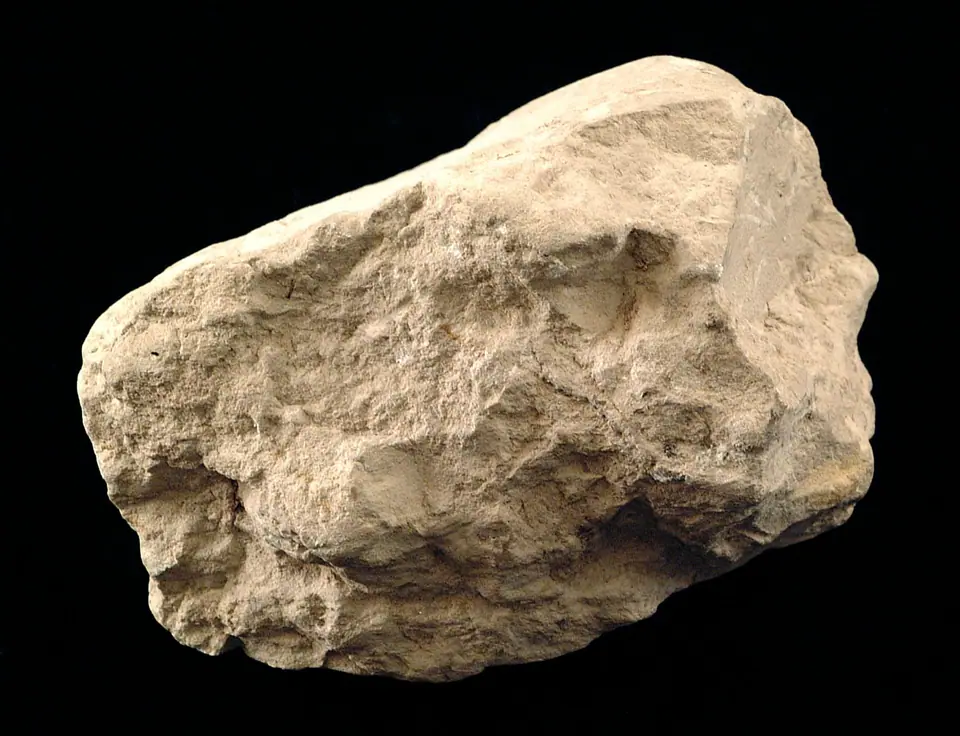
Kaolinite occurs as soft earthy masses, compact claystone, coatings, and microscopic platy crystals. Pure material is commonly white, while iron oxides create yellow, orange, red, or brown staining.
Dry material can look chalky or floury and may become plastic with water. These behaviors overlap other clays and are not sufficient for a species-level identification.
Identification tests
Begin with observation and use the least destructive test first. Results can change with weathering, mixtures, coatings, and grain size. Review the step-by-step field-test methods before altering an unfamiliar specimen.
Hardness
About 2 to 2.5Soft enough to scratch easily but often harder-feeling than talc-rich material.
Streak
WhiteExpected but shared by many clay minerals.
Luster and feel
Earthy to dull; may feel smooth but not characteristically greasyHelps separate typical kaolinite from talc, though mixtures overlap.
Certainty limit
Field properties rarely prove kaoliniteX-ray diffraction or other laboratory analysis is commonly required.
Useful procedures: Mohs hardness test · Mineral streak test
Common lookalikes
Talc
Softer near Mohs 1 with a characteristically greasy or soapy feel.
Gypsum
Commonly forms visible crystals or cleavage fragments and has different hydration and crystal structure.
Other clay minerals
Illite, smectite, halloysite, and mixtures can be nearly indistinguishable without laboratory testing.
How does it form?
Kaolinite forms through intense chemical weathering or hydrothermal alteration of aluminum-bearing silicate minerals such as feldspar.
It accumulates in residual soils, altered igneous rocks, sedimentary clay deposits, and transported kaolin beds.
Geologic setting and occurrence
Kaolinite is widespread in deeply weathered terrains, hydrothermal alteration zones, soils, and economic kaolin deposits, especially in parts of the southeastern United States.
A pale earthy deposit should be described as clay or kaolin-like until mineralogy is confirmed.
Uses and significance
Kaolin is used in ceramics, paper coating and filling, paint, rubber, plastics, refractories, and other products. Industrial suitability depends on brightness, particle size, impurities, and processing behavior.
Field notes
- Do not taste clay or deliberately inhale powder.
- Use “kaolinite-bearing clay” cautiously unless laboratory data are available.
- Clay pits and wet banks can collapse without warning.
This guide supports preliminary field identification, not a laboratory determination, appraisal, hazard assessment, or statement of ownership or collecting permission. Verify land status and local rules before handling or collecting material.
Authoritative sources
LithoMap wrote this guide in original language using the scientific concepts and physical-property standards supported by these sources.
- Clay Statistics and Information U.S. Geological Survey
- Minerals and their physical properties U.S. National Park Service
- Mohs Hardness Scale U.S. National Park Service
- Natural Gemstones: Mineral Gemstones U.S. Geological Survey
Editorial review: September 17, 2026.