
.jpg)
What is apatite?
Apatite-group minerals contain calcium phosphate with fluorine, chlorine, or hydroxyl in related end-member compositions. Natural specimens may contain substitutions and inclusions, so color does not identify the exact apatite species.
What does apatite look like?
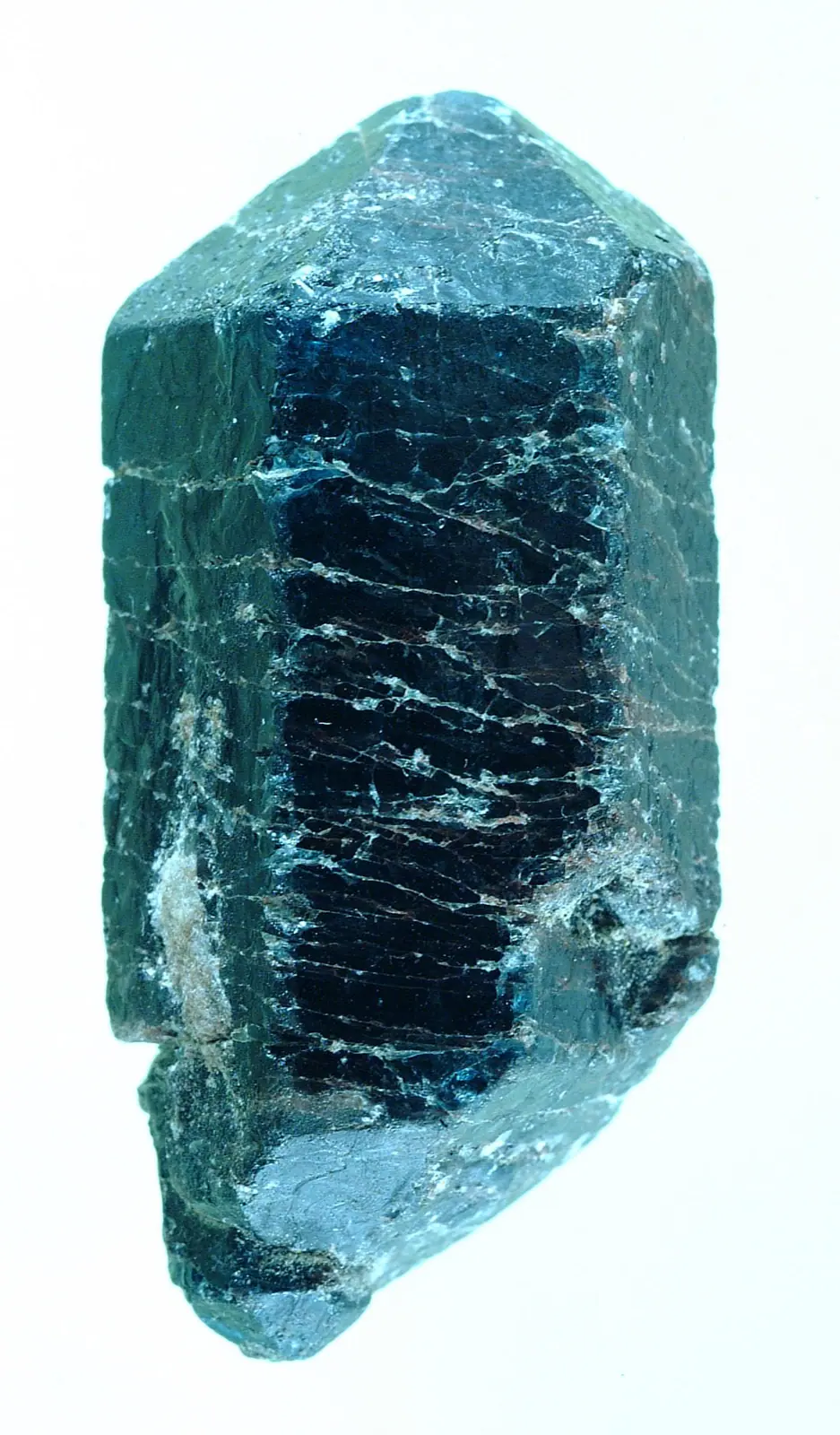
Apatite forms short to long six-sided prisms, tabular crystals, granular masses, nodules, and fine disseminated grains. Crystal ends may be flat, pyramidal, or modified by several faces.
Colors include green, blue, yellow, brown, violet, pink, gray, and colorless. Weathered or massive apatite can be dull and difficult to distinguish from other pale minerals.
Identification tests
Begin with observation and use the least destructive test first. Results can change with weathering, mixtures, coatings, and grain size. Review the step-by-step field-test methods before altering an unfamiliar specimen.
Hardness
5Scratches fluorite but is scratched by feldspar and ordinary steel files.
Cleavage
Poor to indistinctBroken pieces usually do not show repeated perfect cleavage like fluorite.
Crystal habit
Hexagonal prisms or tabular crystalsUseful on intact crystals but shared with beryl and some quartz forms.
Streak
WhiteConsistent but not distinctive among pale nonmetallic minerals.
Useful procedures: Mohs hardness test · Cleavage versus fracture · Mineral streak test
Common lookalikes
How does it form?
Apatite is an accessory mineral in many igneous and metamorphic rocks and can become concentrated in pegmatites, hydrothermal systems, and phosphate-rich sedimentary deposits.
Biological hard tissues also contain apatite-related calcium phosphate material, but fossil or bone identification requires context beyond a phosphate mineral test.
Geologic setting and occurrence
Apatite is widespread as small accessory grains and occurs in economically important phosphate deposits, including sedimentary phosphorites and igneous phosphate bodies.
A visible apatite crystal does not demonstrate fertilizer-grade phosphate resources, gem quality, or a fossil-bearing unit.
Uses and significance
Phosphate rock supplies phosphorus for fertilizer and chemical products. Transparent, well-colored apatite may be cut as a collector gemstone, but its moderate hardness limits wear durability.
Field notes
- Use several hardness references because weathered surfaces can mislead.
- Do not use color to infer gem value or exact chemical end member.
- Avoid dust from phosphate rock and mine waste.
This guide supports preliminary field identification, not a laboratory determination, appraisal, hazard assessment, or statement of ownership or collecting permission. Verify land status and local rules before handling or collecting material.
Authoritative sources
LithoMap wrote this guide in original language using the scientific concepts and physical-property standards supported by these sources.
- Phosphate Rock Statistics and Information U.S. Geological Survey
- Minerals and their physical properties U.S. National Park Service
- Mohs Hardness Scale U.S. National Park Service
- Natural Gemstones: Mineral Gemstones U.S. Geological Survey
Editorial review: September 17, 2026.