
.jpg)
What is beryl?
Beryl consists of beryllium, aluminum, silicon, and oxygen in a ring-silicate structure. Trace elements produce gem colors, including chromium or vanadium in emerald and iron in many aquamarines; color alone does not prove a variety.
What does beryl look like?
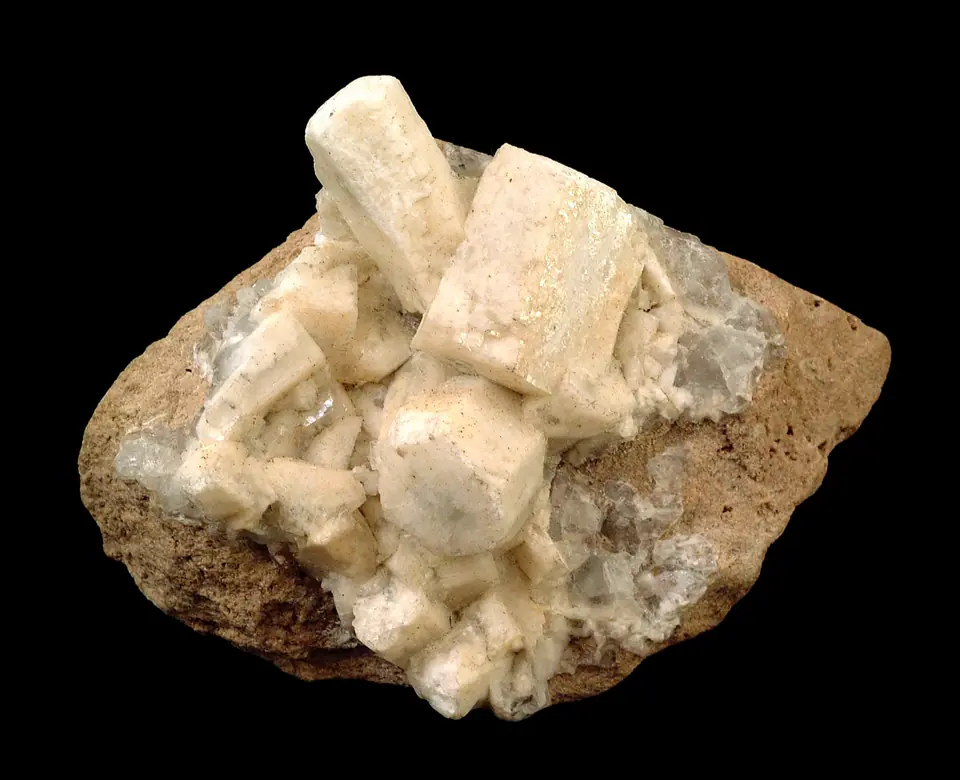
Crystals are commonly long or stout six-sided prisms with flat basal terminations and lengthwise striations. Massive beryl may lack obvious faces and resemble quartz or feldspar.
Many specimens are opaque and pale green, white, tan, or gray. Transparent gem-quality zones can occur within otherwise ordinary crystals.
Identification tests
Begin with observation and use the least destructive test first. Results can change with weathering, mixtures, coatings, and grain size. Review the step-by-step field-test methods before altering an unfamiliar specimen.
Hardness
7.5 to 8Harder than quartz and feldspar, though destructive testing is inappropriate for gemmy crystals.
Cleavage
Poor to indistinct basal cleavageSeparates it from strongly cleaved feldspar and topaz.
Habit
Hexagonal prism, often flat-endedA strong clue when natural faces are preserved.
Streak
WhiteConsistent but not distinctive.
Useful procedures: Mohs hardness test · Cleavage versus fracture · Mineral streak test
Common lookalikes
Quartz
Usually slightly softer, commonly has pyramidal terminations, and lacks beryl’s typical flat-ended hexagonal prism.
Apatite
Much softer at Mohs 5 and commonly shorter or more tabular.
Tourmaline
Often shows strongly striated triangular or rounded-triangular cross sections rather than a true hexagonal prism.
How does it form?
Beryl most commonly crystallizes in granitic pegmatites and some hydrothermal or metamorphic environments where beryllium becomes sufficiently concentrated.
Associated minerals may include quartz, feldspar, mica, tourmaline, topaz, and spodumene, but association alone does not identify beryl.
Geologic setting and occurrence
Beryl occurs in pegmatite districts and selected metamorphic or hydrothermal settings across the United States. Crystals may be sparse even within a favorable pegmatite.
Field appearance cannot establish emerald, aquamarine, treatment, synthetic origin, or monetary value.
Uses and significance
Beryl is a source of beryllium and a gemstone family that includes emerald, aquamarine, morganite, heliodor, and goshenite. Industrial and gem evaluation require composition and quality testing.
Field notes
- Do not grind or inhale dust from beryllium-bearing minerals.
- Avoid scratch testing transparent crystals.
- Pegmatite quarries, claims, and underground workings require permission and hazard awareness.
This guide supports preliminary field identification, not a laboratory determination, appraisal, hazard assessment, or statement of ownership or collecting permission. Verify land status and local rules before handling or collecting material.
Authoritative sources
LithoMap wrote this guide in original language using the scientific concepts and physical-property standards supported by these sources.
- Minerals and their physical properties U.S. National Park Service
- Mohs Hardness Scale U.S. National Park Service
- Natural Gemstones: Mineral Gemstones U.S. Geological Survey
Editorial review: September 17, 2026.