
.jpg)
What is topaz?
Topaz contains aluminum, silicon, oxygen, fluorine, and hydroxyl in variable proportions. Natural color can be modified by irradiation and heat treatment, so color does not establish origin or treatment history.
What does topaz look like?
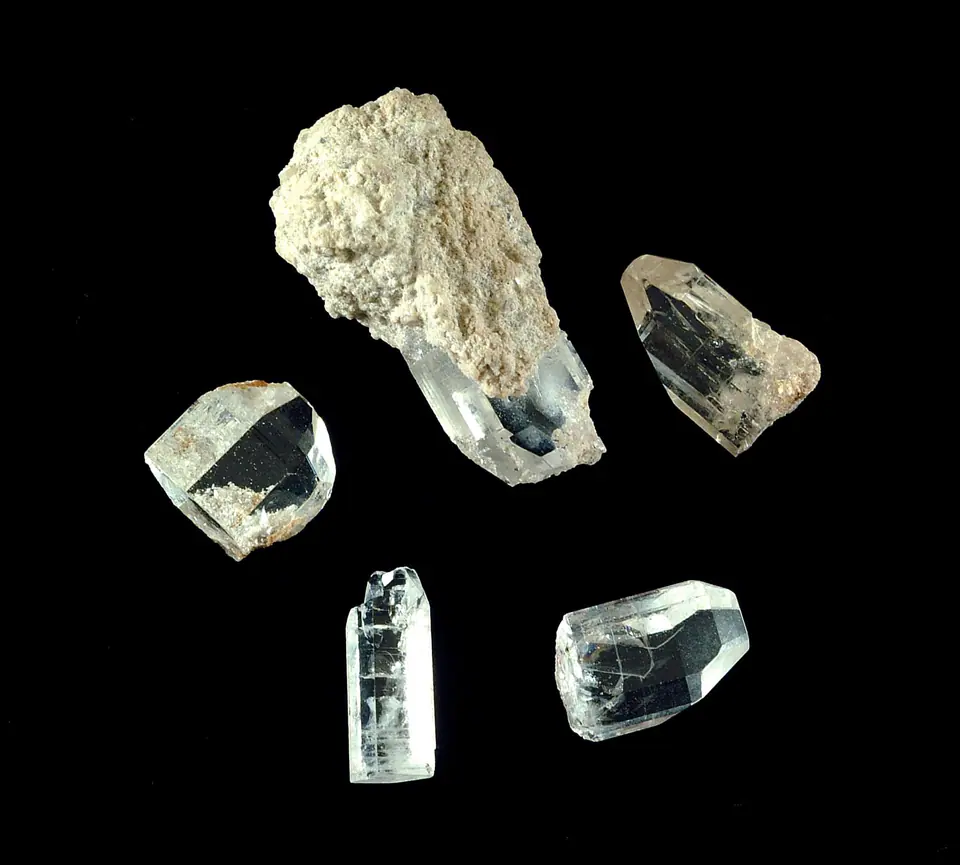
Topaz commonly forms stout to elongated prismatic crystals with lengthwise striations and complex terminations. It also occurs granular or massive.
Fresh cleavage faces are smooth and reflective. Transparent crystals can resemble quartz, beryl, spodumene, or manufactured glass, especially when broken or cut.
Identification tests
Begin with observation and use the least destructive test first. Results can change with weathering, mixtures, coatings, and grain size. Review the step-by-step field-test methods before altering an unfamiliar specimen.
Hardness
8Scratches quartz readily but can be scratched by corundum.
Cleavage
Perfect in one basal directionA critical distinction from quartz, which has no cleavage.
Crystal system and habit
Orthorhombic prismsCross sections and terminations differ from six-sided quartz and beryl.
Streak
WhiteExpected but not diagnostic.
Useful procedures: Mohs hardness test · Cleavage versus fracture · Mineral streak test
Common lookalikes
How does it form?
Topaz crystallizes in fluorine-rich felsic igneous and hydrothermal environments, including granitic pegmatites, rhyolitic cavities, greisens, and veins.
Its durability allows resistant crystals to survive into stream sediment near suitable source rocks.
Geologic setting and occurrence
Topaz occurs in specialized granitic and volcanic settings, including pegmatites and cavities in silica-rich volcanic rock. Notable U.S. occurrences exist in parts of Utah, Colorado, Texas, and several other states.
A transparent hard crystal requires professional testing before any gemstone identity, treatment, quality, or value claim.
Uses and significance
Topaz is used principally as a gemstone and collector mineral. Cleavage makes even hard topaz vulnerable to sharp blows and affects cutting and wear.
Field notes
- Do not perform scratch or cleavage tests on a transparent or potentially valuable crystal.
- Hardness 8 does not make topaz immune to breakage.
- Confirm gem material with nondestructive optical and density tests by a qualified gemologist.
This guide supports preliminary field identification, not a laboratory determination, appraisal, hazard assessment, or statement of ownership or collecting permission. Verify land status and local rules before handling or collecting material.
Authoritative sources
LithoMap wrote this guide in original language using the scientific concepts and physical-property standards supported by these sources.
- Minerals and their physical properties U.S. National Park Service
- Mohs Hardness Scale U.S. National Park Service
- Natural Gemstones: Mineral Gemstones U.S. Geological Survey
Editorial review: September 17, 2026.