
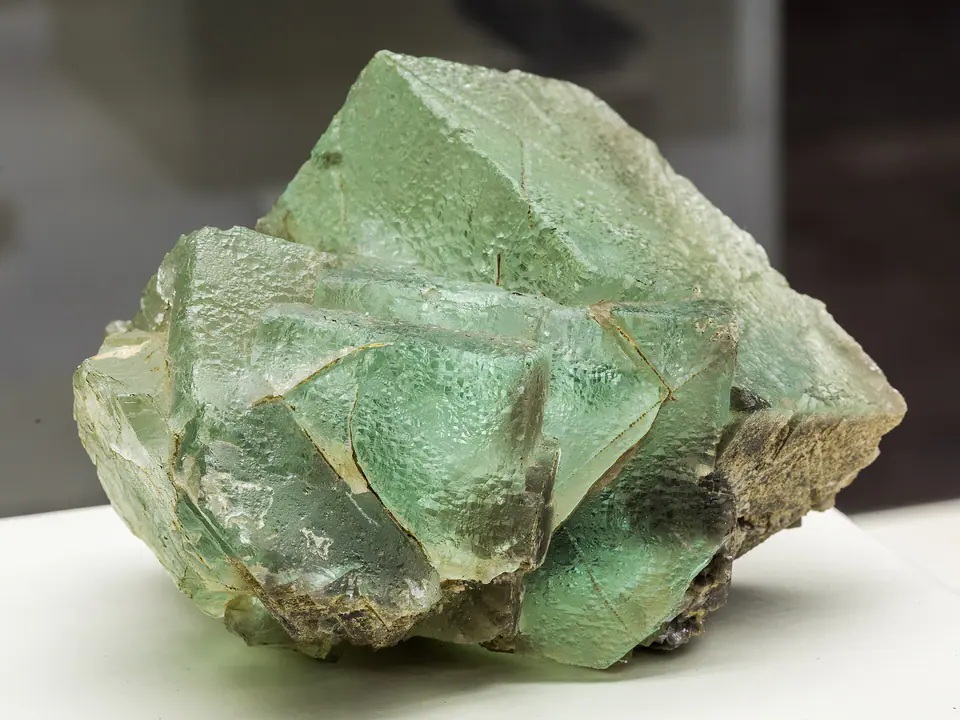

What is fluorite?
Fluorite is calcium fluoride. Trace impurities and radiation-related defects create its wide range of colors; color zoning is common.
What does fluorite look like?
Well-formed crystals are often cubes, sometimes modified by octahedral faces. Broken pieces tend toward triangular faces and octahedral forms because of cleavage.
Many specimens fluoresce under ultraviolet light, but the response varies in color and intensity and may be absent. Fluorescence is supportive, not required.
Identification tests
Begin with observation and use the least destructive test first. Results can change with weathering, mixtures, coatings, and grain size. Review the step-by-step field-test methods before altering an unfamiliar specimen.
Hardness
4Harder than calcite but softer than a steel knife or glass.
Streak
WhiteWorks across different body colors.
Cleavage
Perfect in four directionsProduces octahedral fragments rather than cubic cleavage.
UV response
May fluoresce; variableUseful only as a secondary clue.
Useful procedures: Mohs hardness test · Mineral streak test · Cleavage versus fracture
Common lookalikes
How does it form?
Fluorite forms in hydrothermal veins, carbonate replacement deposits, granitic pegmatites, and some sedimentary environments.
It commonly occurs with calcite, quartz, barite, sulfides, or other vein minerals. Association alone does not establish an ore deposit.
Geologic setting and occurrence
Fluorite occurs in many hydrothermal districts and carbonate-hosted deposits. Loose colorful cubes are also widely sold, so provenance should not be inferred from appearance.
Weathering can dull faces or separate cleavage chips from larger masses.
Uses and significance
Fluorite is the principal source of fluorine and is used in metallurgical fluxes, chemical manufacturing, ceramics, optics, and lapidary work.
Field notes
- Cleavage makes crystals fragile; test only an inconspicuous chip.
- Do not heat fluorite or perform chemical tests outside a proper laboratory.
- Mine dumps and underground workings may contain unstable ground and hazardous metals.
This guide supports preliminary field identification, not a laboratory determination, appraisal, hazard assessment, or statement of ownership or collecting permission. Verify land status and local rules before handling or collecting material.
Authoritative sources
LithoMap wrote this guide in original language using the scientific concepts and physical-property standards supported by these sources.
- Minerals and their physical properties U.S. National Park Service
- Mohs Hardness Scale U.S. National Park Service
- Natural Gemstones: Mineral Gemstones U.S. Geological Survey
Editorial review: September 17, 2026.