
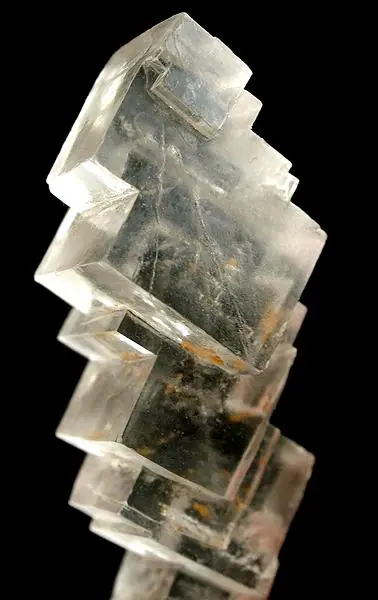

What is halite?
Halite is sodium chloride. Clay, iron oxides, organic matter, radiation defects, or fluid inclusions can produce gray, pink, red, blue, purple, or other colors.
What does halite look like?
Fresh halite has a glassy luster and breaks into cubes because it cleaves perfectly in three directions at 90 degrees.
Moisture can round edges, etch surfaces, or dissolve specimens. Massive bedded salt may look cloudy rather than crystal clear.
Identification tests
Begin with observation and use the least destructive test first. Results can change with weathering, mixtures, coatings, and grain size. Review the step-by-step field-test methods before altering an unfamiliar specimen.
Hardness
2 to 2.5Scratched by a fingernail with moderate ease.
Streak
WhiteNot unique but consistent.
Cleavage
Perfect cubic cleavageProduces repeated right-angle corners.
Solubility
Readily soluble in waterUse only a tiny loose chip; do not damage specimens or exposures.
Useful procedures: Mohs hardness test · Mineral streak test · Cleavage versus fracture
Common lookalikes
How does it form?
Halite precipitates when saline water becomes concentrated enough through evaporation or freezing. Thick deposits commonly record restricted marine basins or saline lakes.
Salt can flow plastically under burial, forming domes and other structures. Near the surface it dissolves quickly and can contribute to subsidence.
Geologic setting and occurrence
Halite occurs in evaporite basins, salt flats, brines, and subsurface salt structures. Surface specimens persist best in arid settings.
Because road salt and industrial salt are common, cultural context matters when judging a loose fragment.
Uses and significance
Halite is used for food and chemical production, water conditioning, and deicing. Subsurface salt formations may also host storage caverns.
Field notes
- Never taste a field specimen; it may be contaminated or misidentified.
- Keep specimens dry and separate from moisture-sensitive collections.
- Salt mines, brine pits, and collapse terrain are hazardous and often restricted.
This guide supports preliminary field identification, not a laboratory determination, appraisal, hazard assessment, or statement of ownership or collecting permission. Verify land status and local rules before handling or collecting material.
Authoritative sources
LithoMap wrote this guide in original language using the scientific concepts and physical-property standards supported by these sources.
- Minerals and their physical properties U.S. National Park Service
- Mohs Hardness Scale U.S. National Park Service
- Natural Gemstones: Mineral Gemstones U.S. Geological Survey
Editorial review: September 17, 2026.