
.jpg)

The most useful distinction
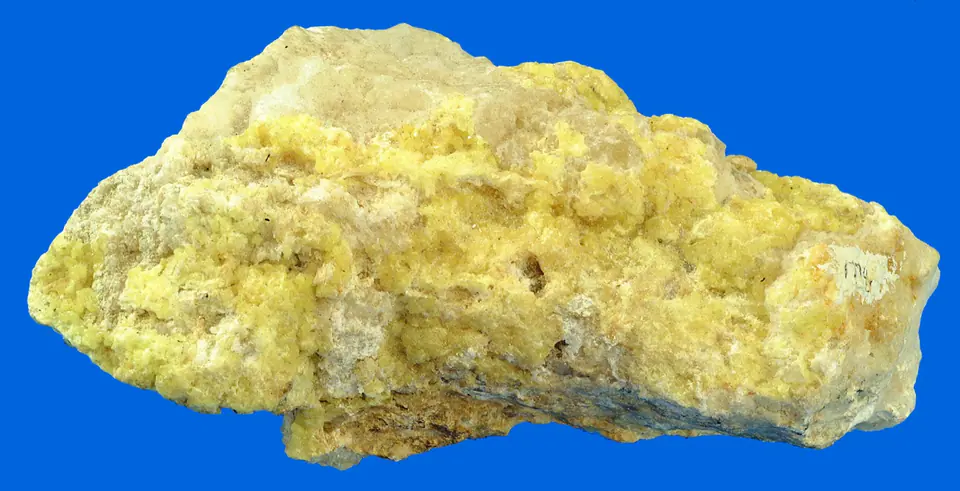
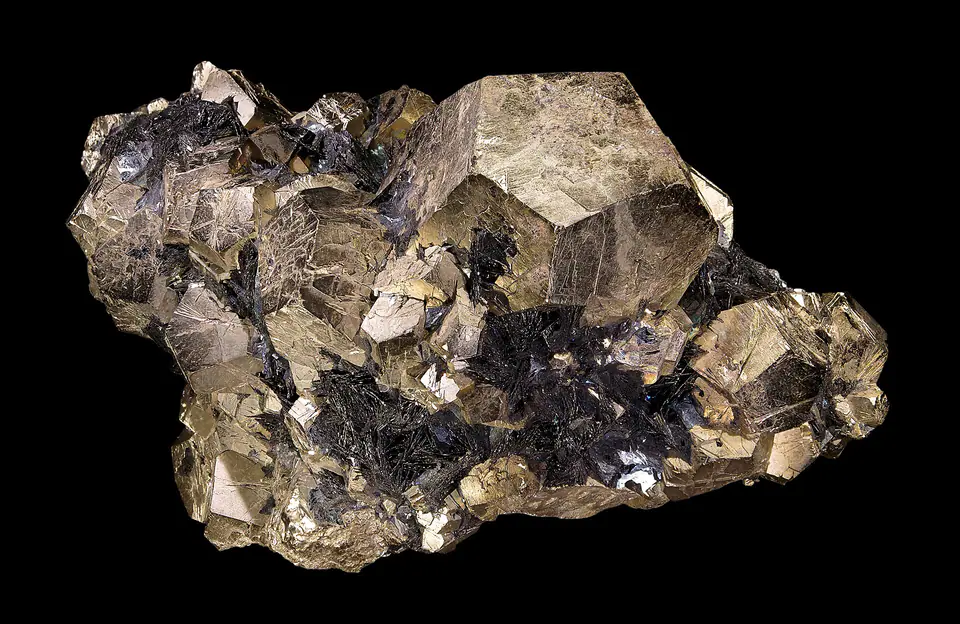
Check luster and hardness, not odor. Soft resinous yellow material favors sulfur; flashing metallic grains that scratch glass and leave a dark streak favor pyrite.
Sulfur and Pyrite comparison table
| Property | Sulfur | Pyrite | How to use it |
|---|---|---|---|
| Luster and color | Bright yellow with resinous, greasy, or earthy nonmetallic luster | Pale brass-yellow with metallic luster | Metallic reflection usually separates pyrite immediately. |
| Hardness | Mohs about 1.5 to 2.5; often scratched by a fingernail | Mohs 6 to 6.5; scratches glass | The large hardness gap is decisive. |
| Streak | White to pale yellow | Greenish- to brownish-black | Powder colors are sharply different. |
| Density and habit | Lightweight; crystals, crusts, coatings, or earthy masses | Much denser; cubes, pyritohedra, nodules, grains, or masses | Heft and geometric metallic crystals support the tests. |
A practical identification sequence
- 1
Observe whether the surface is metallic or resinous in diffuse light.
- 2
Try a gentle fingernail scratch on an expendable fresh edge.
- 3
Use streak only if necessary and safe.
- 4
Use volcanic, evaporite, or sulfide-deposit context as supporting evidence.
Where the distinction gets difficult
- Never burn sulfur or strike unknown sulfides to identify them.
- Do not intentionally smell fumaroles, mine gases, or mineral powders.
- Yellow arsenic sulfides are hazardous lookalikes and should not be handled or tested casually.
Use several independent observations. This comparison supports preliminary field identification, not laboratory confirmation, appraisal, proof of origin, or collecting permission.
Sulfur vs. pyrite FAQ
Does native sulfur smell like rotten eggs?
Pure sulfur has little odor. Rotten-egg odor indicates hydrogen sulfide gas, which is toxic and must never be used as a close-range field test.
Can sulfur scratch glass?
No. Native sulfur is very soft, while pyrite commonly scratches glass.
Is pyrite made of sulfur?
Pyrite is iron disulfide, so sulfur is part of its composition, but pyrite is a distinct compound with very different properties from native sulfur.
Authoritative sources
LithoMap wrote this comparison in original language from the physical properties and geological concepts supported by these public scientific references.
- Sulfur Statistics and Information U.S. Geological Survey
- Minerals and their physical properties U.S. National Park Service
- Mohs Hardness Scale U.S. National Park Service
- Natural Gemstones: Mineral Gemstones U.S. Geological Survey
Editorial review: September 17, 2026.