
.jpg)
What is sulfur?
Native sulfur is elemental S, commonly occurring as molecular sulfur in the orthorhombic crystal system at ordinary surface conditions. Impurities, coatings, and mixed sediment can produce orange, brown, greenish, or gray material.
What does sulfur look like?
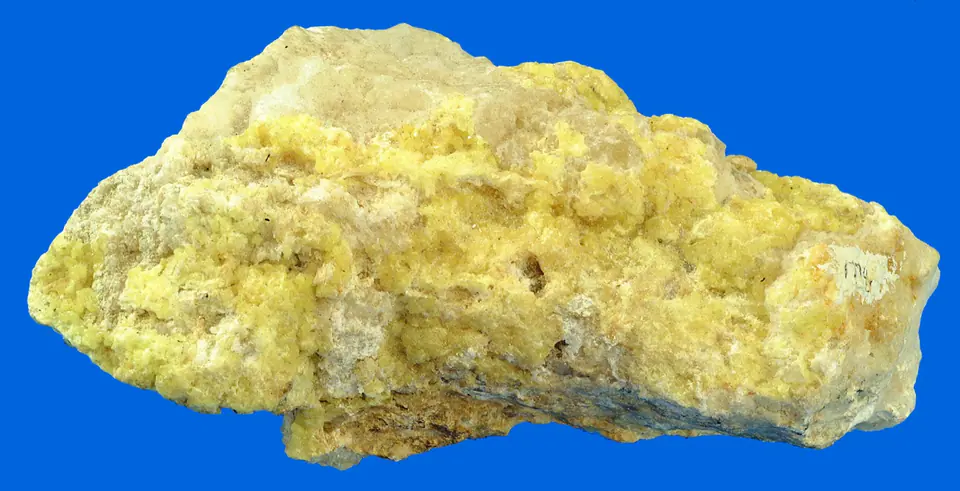
Sulfur forms yellow crystals, crusts, powdery coatings, earthy masses, and granular aggregates. Well-formed crystals may be blocky or pyramidal with a strong resinous luster.
Color is memorable but not exclusive. Yellow iron oxides, arsenic sulfides, industrial chemicals, lichens, and staining can imitate part of its appearance.
Identification tests
Begin with observation and use the least destructive test first. Results can change with weathering, mixtures, coatings, and grain size. Review the step-by-step field-test methods before altering an unfamiliar specimen.
Hardness
About 1.5 to 2.5Scratched by a fingernail in many specimens.
Streak
White to pale yellowSeparates sulfur from dark-streaking metallic sulfides.
Density
Low; specific gravity near 2Feels light compared with pyrite and most ore minerals.
Luster
Resinous to greasy, nonmetallicDistinct from the flashing metallic luster of pyrite.
Useful procedures: Mohs hardness test · Mineral streak test · Specific gravity and density test
Common lookalikes
Pyrite
Metallic brass-yellow, much harder, denser, and dark-streaked.
Orpiment
Typically orange-yellow and platy; arsenic-bearing and hazardous to handle or test.
Yellow staining
May be powdery iron oxide, biological growth, or manufactured residue without sulfur’s consistent properties.
How does it form?
Native sulfur precipitates around volcanic vents and fumaroles, forms through oxidation or biological alteration of sulfide and sulfate compounds, and occurs in evaporite and salt-dome environments.
It may be associated with gypsum, anhydrite, calcite, celestite, sulfides, bitumen, and volcanic alteration minerals.
Geologic setting and occurrence
Native sulfur occurs in active and extinct volcanic areas, evaporite basins, salt domes, sedimentary sulfur deposits, and oxidizing sulfide deposits.
A sulfur odor is not a reliable mineral test: pure native sulfur has little odor, while hydrogen sulfide and sulfur dioxide are hazardous gases.
Uses and significance
Most industrial sulfur is recovered from petroleum and natural gas processing and is used primarily to make sulfuric acid, fertilizers, chemicals, rubber products, and many manufactured materials.
Field notes
- Never burn or heat sulfur to identify it; irritating sulfur-oxide gases can form.
- Leave active fumaroles and gas-emitting ground undisturbed and obey closures.
- Do not intentionally smell unknown gases or minerals.
This guide supports preliminary field identification, not a laboratory determination, appraisal, hazard assessment, or statement of ownership or collecting permission. Verify land status and local rules before handling or collecting material.
Authoritative sources
LithoMap wrote this guide in original language using the scientific concepts and physical-property standards supported by these sources.
- Sulfur Statistics and Information U.S. Geological Survey
- Minerals and their physical properties U.S. National Park Service
- Mohs Hardness Scale U.S. National Park Service
- Natural Gemstones: Mineral Gemstones U.S. Geological Survey
Editorial review: September 17, 2026.