

.jpg)
The most useful distinction
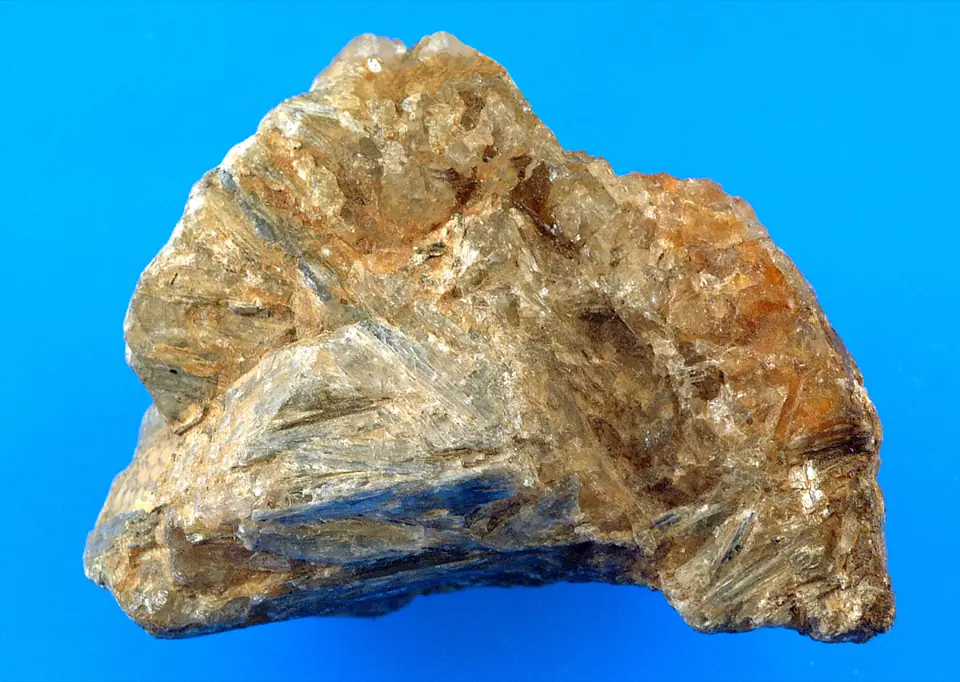
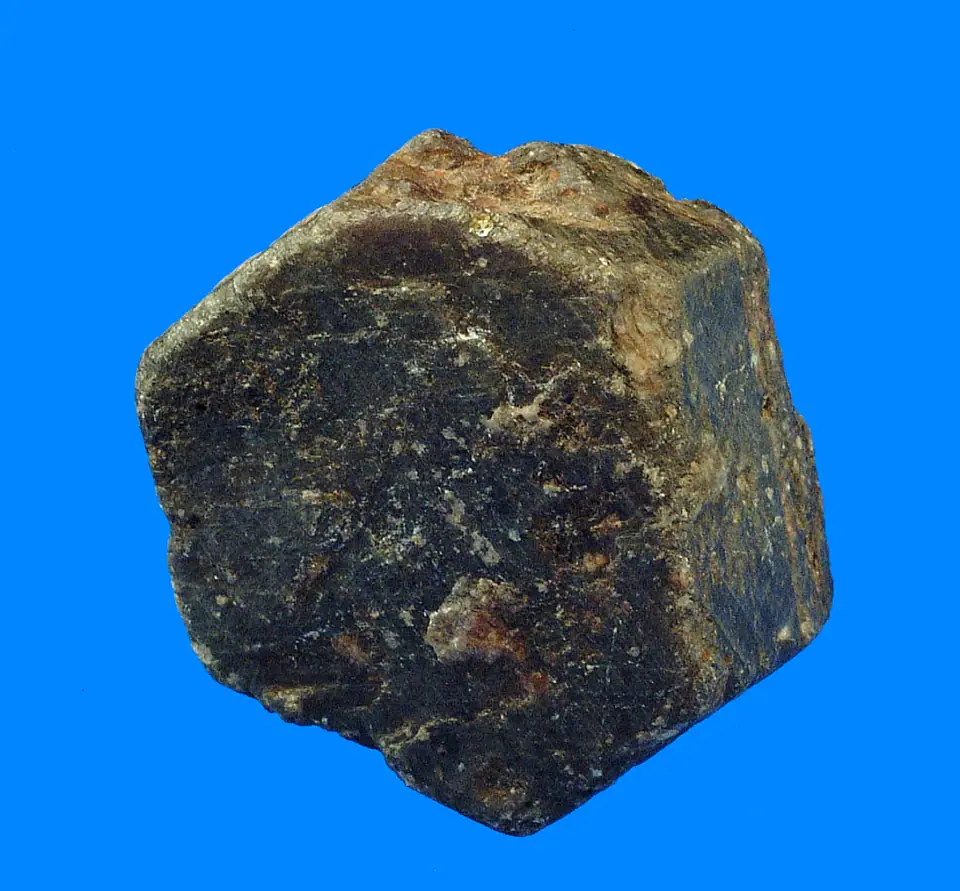
Use habit and existing breakage. Flat cleavable blades favor kyanite; compact crystals with extreme uniform hardness and no cleavage favor corundum.
Kyanite and Corundum comparison table
| Property | Kyanite | Corundum | How to use it |
|---|---|---|---|
| Hardness | Directional: roughly 4.5 to 5 along the blade and 6.5 to 7 across it | Mohs 9 in all ordinary directions | Corundum is far harder, while kyanite has unusual anisotropy. |
| Habit | Elongated flattened blades | Barrel-shaped, tabular, bipyramidal, or massive | Crystal shape usually separates intact specimens. |
| Cleavage | Perfect in one direction and good in another | No true cleavage; parting may occur | Repeated blade-parallel breaks favor kyanite. |
| Density | Commonly around 3.5 to 3.7 | Commonly around 4.0 | Supporting evidence through careful nondestructive measurement. |
A practical identification sequence
- 1
Inspect crystal shape and existing cleavage without breaking it.
- 2
Look for blade-parallel striations and flat cleavage surfaces.
- 3
Avoid scratch testing transparent material.
- 4
Use refractive index, density, or laboratory confirmation for gemmy specimens.
Where the distinction gets difficult
- Blue color does not prove sapphire or kyanite.
- Corundum may show parting that can be mistaken for cleavage.
- Do not damage potential gem material with hardness tests.
Use several independent observations. This comparison supports preliminary field identification, not laboratory confirmation, appraisal, proof of origin, or collecting permission.
Kyanite vs. corundum FAQ
Is blue corundum sapphire?
Gem-quality blue corundum may be called sapphire, but color alone does not establish natural origin, treatment, or gem quality.
Why does kyanite have two hardness values?
Its resistance to scratching changes with crystallographic direction, especially along versus across the long blade.
Can kyanite scratch glass?
Across the blade it may scratch glass, while along the blade it can be much softer. Direction matters.
Authoritative sources
LithoMap wrote this comparison in original language from the physical properties and geological concepts supported by these public scientific references.
- Kyanite and Related Minerals Statistics and Information U.S. Geological Survey
- Minerals and their physical properties U.S. National Park Service
- Mohs Hardness Scale U.S. National Park Service
- Natural Gemstones: Mineral Gemstones U.S. Geological Survey
- Corundum and Its Occurrence and Distribution in the United States U.S. Geological Survey
Editorial review: September 17, 2026.