
.jpg)
What is corundum?
Corundum is aluminum oxide, Al₂O₃. Trace chromium produces ruby red, while iron, titanium, and other elements contribute blue, yellow, green, pink, and additional sapphire colors. Color alone cannot establish natural origin, treatment, or gem variety.
What does corundum look like?
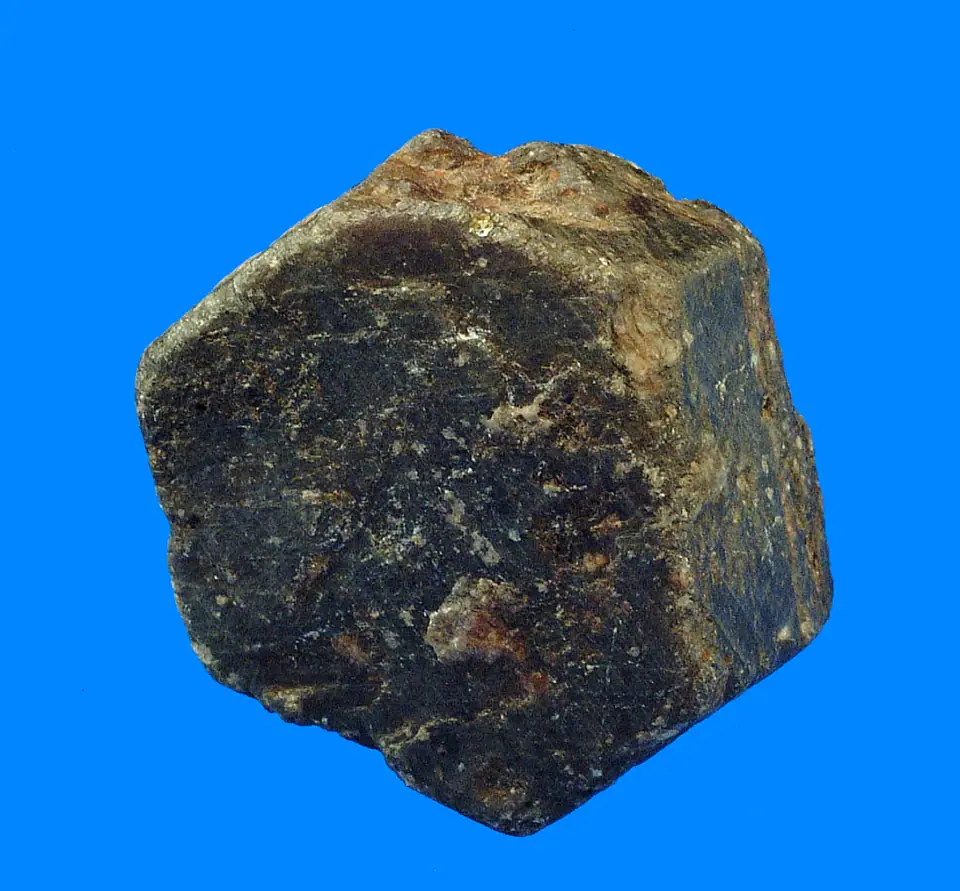
Corundum may form hexagonal barrel-shaped prisms, tabular crystals, rounded grains, or massive aggregates. Weathered crystals can look dull even though fresh surfaces are vitreous to adamantine.
Parting may create planar breaks that resemble cleavage, but true cleavage is absent. Some crystals display color zoning, silk-like inclusions, or a star effect when cut appropriately.
Identification tests
Begin with observation and use the least destructive test first. Results can change with weathering, mixtures, coatings, and grain size. Review the step-by-step field-test methods before altering an unfamiliar specimen.
Hardness
9Scratches quartz readily; only diamond is harder among standard Mohs minerals.
Streak
White or colorlessNot diagnostic by itself and destructive testing should be avoided on attractive material.
Cleavage
None; parting may occurRepeated true cleavage faces suggest another mineral.
Density
High; specific gravity near 4Heavier than quartz of equal size but requires careful comparison.
Useful procedures: Mohs hardness test · Mineral streak test · Cleavage versus fracture · Specific gravity and density test
Common lookalikes
Quartz
Much softer at Mohs 7 and commonly forms six-sided prisms with pyramidal terminations.
Garnet
Usually softer, commonly equant, and belongs to a mineral group with different crystal forms and density ranges.
Spinel
Typically forms octahedra and is softer; gem material often requires optical or laboratory testing.
How does it form?
Corundum forms in aluminum-rich, silica-poor metamorphic and igneous settings, including marbles, gneisses, schists, syenites, and some pegmatites.
Its hardness and chemical resistance allow crystals to survive weathering and accumulate in placer deposits with other dense minerals.
Geologic setting and occurrence
Corundum is uncommon because silica-rich conditions favor other aluminum minerals. It occurs in selected metamorphic and igneous terranes and in sediment derived from them.
Field tests cannot establish whether colored corundum is natural, synthetic, treated, gem quality, or valuable.
Uses and significance
Ruby and sapphire varieties are gemstones. Synthetic and natural corundum are also used as abrasives, refractories, bearings, watch windows, lasers, and durable optical components.
Field notes
- Do not scratch, strike, or streak a potentially valuable crystal.
- Use a qualified gemologist or laboratory for origin and treatment questions.
- Verify collecting permission; placer access and mineral rights can differ from surface access.
This guide supports preliminary field identification, not a laboratory determination, appraisal, hazard assessment, or statement of ownership or collecting permission. Verify land status and local rules before handling or collecting material.
Authoritative sources
LithoMap wrote this guide in original language using the scientific concepts and physical-property standards supported by these sources.
- Corundum and Its Occurrence and Distribution in the United States U.S. Geological Survey
- Minerals and their physical properties U.S. National Park Service
- Mohs Hardness Scale U.S. National Park Service
- Natural Gemstones: Mineral Gemstones U.S. Geological Survey
Editorial review: September 17, 2026.