
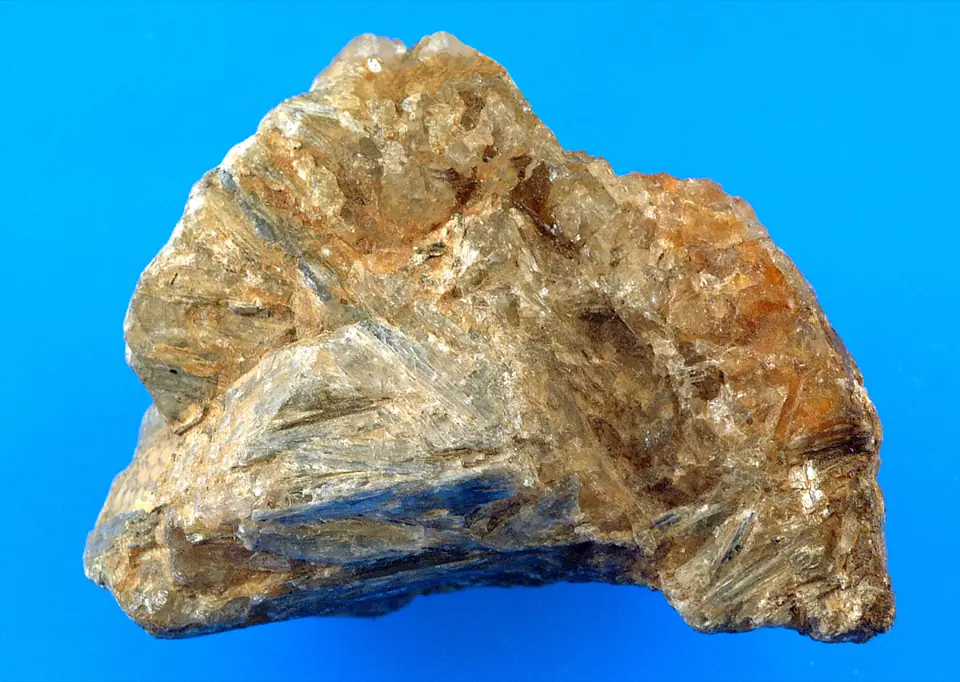

What is kyanite?
Kyanite is Al₂SiO₅, the same chemical composition as andalusite and sillimanite but with a different crystal structure stable under different pressure-temperature conditions.
What does kyanite look like?
Crystals are typically elongated, flattened blades with parallel striations and vitreous to pearly luster. Blue color may be patchy or concentrated along the crystal center.
Kyanite also occurs gray, white, green, blackish, or colorless and may form radiating aggregates or embedded blades in schist, gneiss, and quartz-rich rock.
Identification tests
Begin with observation and use the least destructive test first. Results can change with weathering, mixtures, coatings, and grain size. Review the step-by-step field-test methods before altering an unfamiliar specimen.
Directional hardness
About 4.5 to 5 parallel to length and 6.5 to 7 across the bladeThe unusual hardness anisotropy is a major clue on expendable material.
Cleavage
Perfect in one direction and good in anotherBlades split along flat surfaces and may be brittle.
Habit
Elongated flattened bladesSeparates it from equant corundum and many blue minerals.
Streak
WhiteExpected but not diagnostic.
Useful procedures: Mohs hardness test · Cleavage versus fracture · Mineral streak test
Common lookalikes
Corundum
Uniformly much harder at Mohs 9 and lacks kyanite’s bladed cleavage habit.
Blue tourmaline
Harder and commonly forms deeply striated trigonal prisms with poor cleavage.
Sillimanite
Commonly fibrous or slender-prismatic and does not show the same extreme directional hardness.
How does it form?
Kyanite forms during medium- to high-grade metamorphism of aluminum-rich sedimentary rocks, especially under relatively high pressure.
Its presence helps constrain metamorphic conditions when mineral assemblage and regional context are evaluated together.
Geologic setting and occurrence
Kyanite occurs in metamorphic belts, commonly in mica schist, gneiss, quartzite, and high-pressure metamorphic rocks.
Color alone cannot establish kyanite, and directional hardness should not be tested on valuable crystals.
Uses and significance
Kyanite and related aluminum silicates are used in heat-resistant refractories, ceramics, kiln furniture, foundry products, and other high-temperature applications.
Field notes
- Test hardness in two directions only on expendable material.
- Bladed crystals can split and form sharp edges.
- Do not infer metamorphic pressure from one loose specimen without field context.
This guide supports preliminary field identification, not a laboratory determination, appraisal, hazard assessment, or statement of ownership or collecting permission. Verify land status and local rules before handling or collecting material.
Authoritative sources
LithoMap wrote this guide in original language using the scientific concepts and physical-property standards supported by these sources.
- Kyanite and Related Minerals Statistics and Information U.S. Geological Survey
- Minerals and their physical properties U.S. National Park Service
- Mohs Hardness Scale U.S. National Park Service
- Natural Gemstones: Mineral Gemstones U.S. Geological Survey
Editorial review: September 17, 2026.