
.jpg)
.jpg)
The most useful distinction
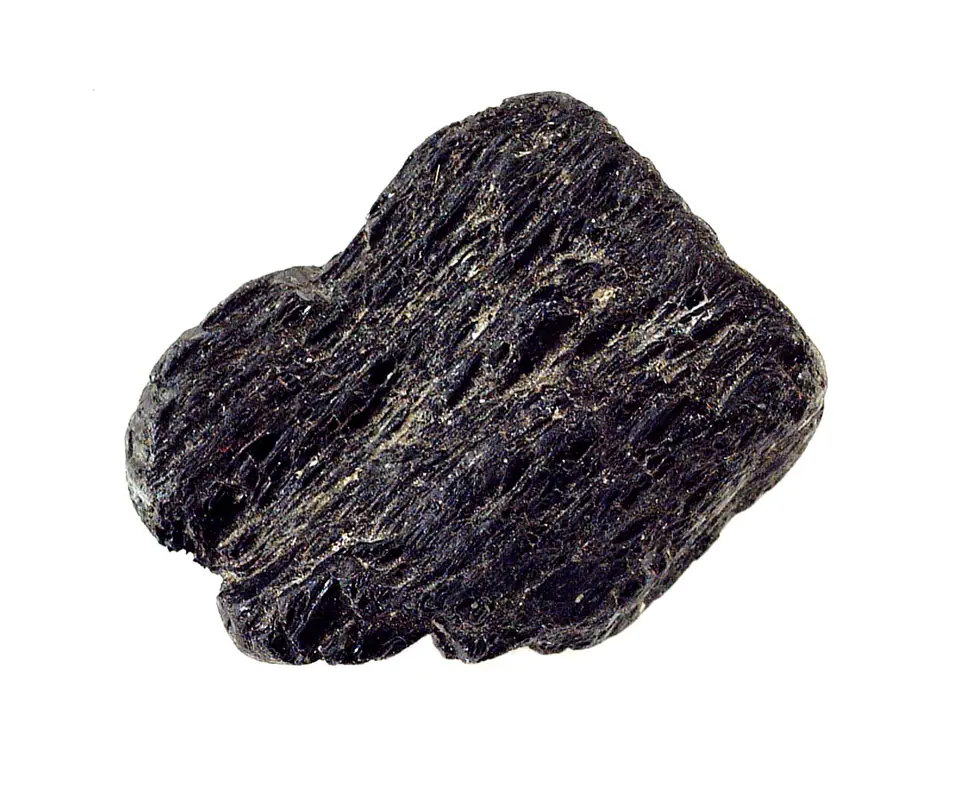
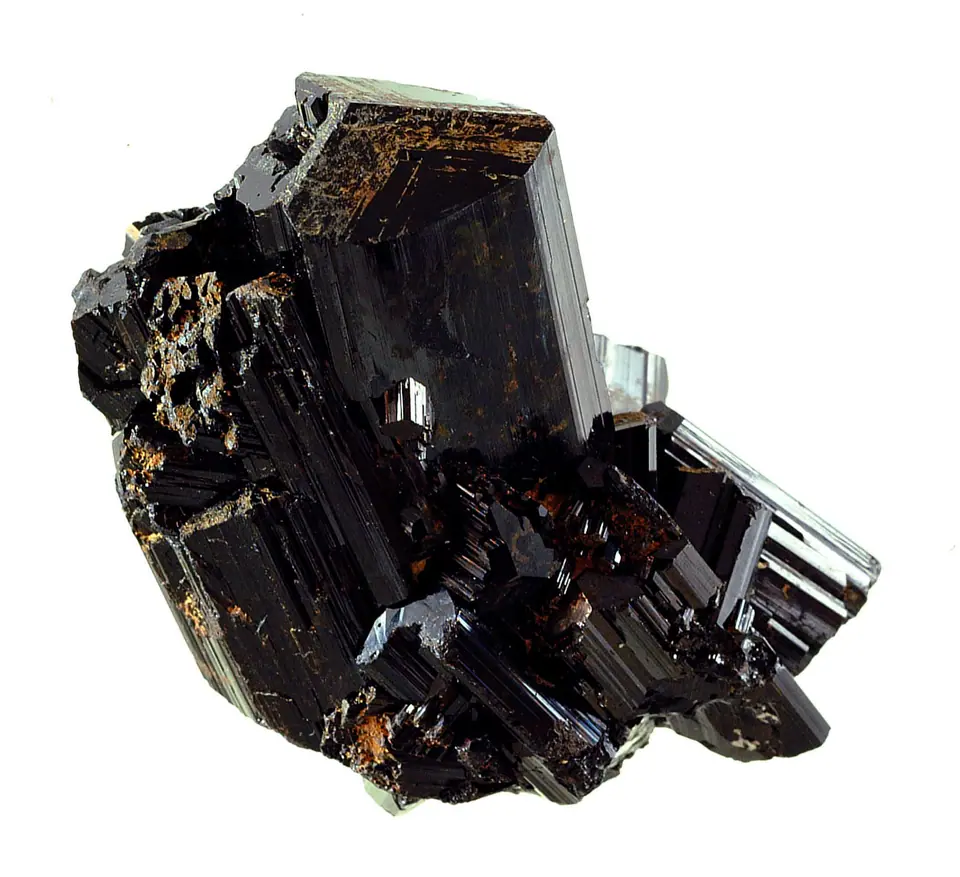
Check breakage and cross section. Repeated cleavage near 60 and 120 degrees favors hornblende; deep lengthwise grooves and a rounded-triangular section favor tourmaline.
Hornblende and Tourmaline comparison table
| Property | Hornblende | Tourmaline | How to use it |
|---|---|---|---|
| Cleavage | Two good directions near 56 and 124 degrees | Poor to indistinct | Cleavage geometry is the strongest distinction on broken grains. |
| Habit and cross section | Elongate or splintery prisms, often diamond-shaped | Strongly striated trigonal prisms with triangular to rounded-triangular sections | Natural crystal geometry can resolve intact specimens. |
| Hardness | Mohs about 5 to 6 | Mohs about 7 to 7.5 | Tourmaline commonly scratches quartz; hornblende generally does not. |
| Typical setting | Igneous and metamorphic rocks such as diorite and amphibolite | Pegmatites, metamorphic rocks, veins, and granitic settings | Context supports but cannot replace physical evidence. |
A practical identification sequence
- 1
Inspect natural faces and cross section with a hand lens.
- 2
Look for deep lengthwise grooves on a triangular prism.
- 3
Use existing breaks to find repeated oblique cleavage.
- 4
Reserve hardness testing for expendable material.
Where the distinction gets difficult
- Broken grains may lack recognizable crystal form.
- Dark color is shared and is not diagnostic.
- Do not scratch or break a potentially collectible tourmaline crystal.
Use several independent observations. This comparison supports preliminary field identification, not laboratory confirmation, appraisal, proof of origin, or collecting permission.
Hornblende vs. tourmaline FAQ
Is every black prismatic mineral tourmaline?
No. Hornblende, augite, staurolite, and other minerals can be dark and prismatic.
Which mineral has cleavage?
Hornblende has two good oblique cleavage directions. Tourmaline has poor or indistinct cleavage.
Can hornblende be triangular?
Its cross section can be angular or roughly six-sided, but the strongly striated rounded-triangular form is more characteristic of tourmaline.
Authoritative sources
LithoMap wrote this comparison in original language from the physical properties and geological concepts supported by these public scientific references.
- Minerals and their physical properties U.S. National Park Service
- Mohs Hardness Scale U.S. National Park Service
- Natural Gemstones: Mineral Gemstones U.S. Geological Survey
Editorial review: September 17, 2026.