
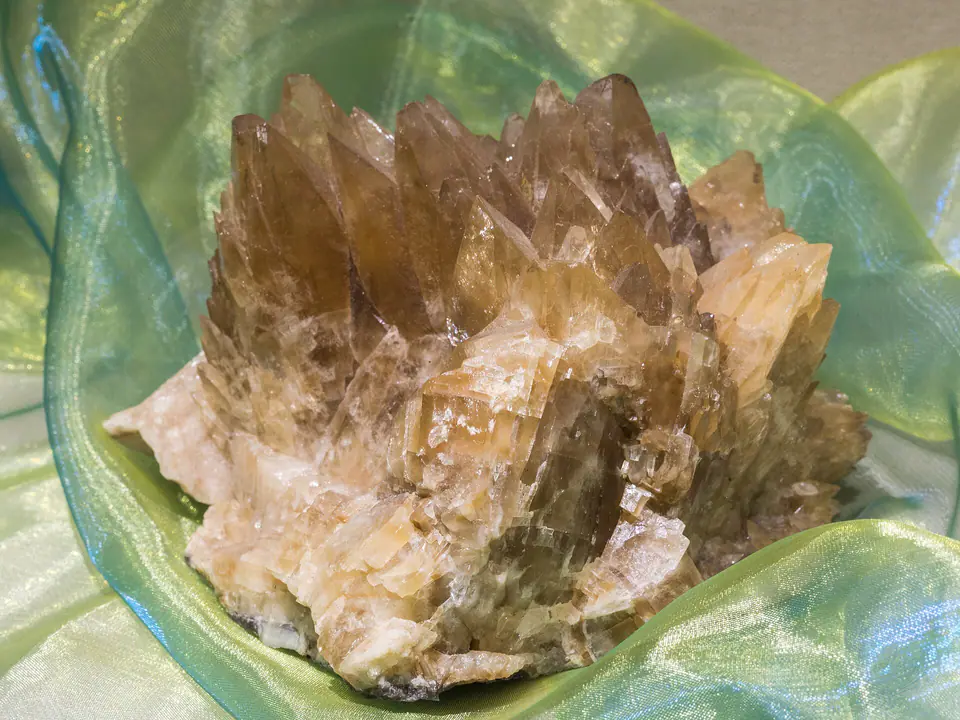

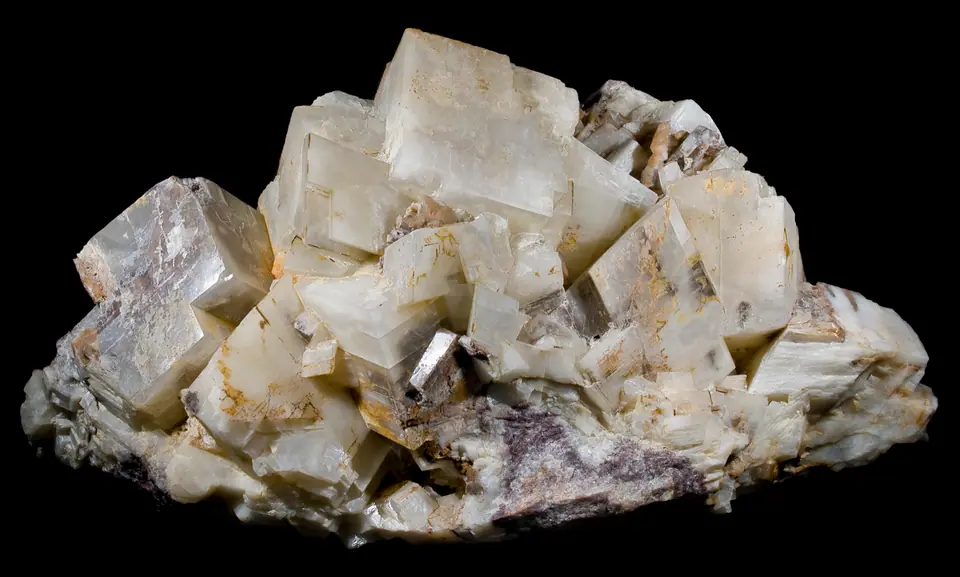

The most useful distinction
Use a controlled acid test on expendable material. A clean calcite surface effervesces immediately; dolomite usually needs powdering to produce an obvious cold-acid reaction.
Calcite and Dolomite comparison table
| Property | Calcite | Dolomite | How to use it |
|---|---|---|---|
| Hardness | Mohs 3; scratched by copper | Mohs 3.5 to 4; resists copper more strongly | Hardness supports the acid response when surfaces are fresh. |
| Acid response | Vigorous effervescence on a clean unpowdered surface | Weak or delayed on a clean surface; stronger when powdered | This is the standard practical separation under controlled conditions. |
| Cleavage | Three perfect directions forming rhombohedra | Three perfect directions forming rhombohedra | Cleavage confirms carbonate form but does not separate the pair. |
| Typical crystal appearance | Many habits including rhombohedra, scalenohedra, and transparent forms | Rhombohedra, sometimes with curved saddle-shaped faces; commonly pearly | Habit helps only when well-developed crystals are present. |
A practical identification sequence
- 1
Inspect a fresh uncoated surface and confirm rhombohedral cleavage if visible.
- 2
Compare resistance to a copper point on an inconspicuous edge.
- 3
Apply one drop of dilute acid to an expendable clean surface.
- 4
If reaction is weak, powder a tiny chip and retest before favoring dolomite.
Where the distinction gets difficult
- Calcite and dolomite commonly occur together and can produce mixed reactions.
- Temperature, acid strength, coatings, grain size, and weathering affect effervescence.
- Do not acid-test cave formations, fossils, monuments, finished stone, or valuable specimens.
Use several independent observations. This comparison supports preliminary field identification, not laboratory confirmation, appraisal, proof of origin, or collecting permission.
Calcite vs. dolomite FAQ
Does dolomite fizz in acid?
Dolomite commonly reacts weakly on a cold intact surface and much more clearly when powdered. Warm or stronger acid also increases reaction.
Can color separate calcite and dolomite?
No. Both can be white, gray, tan, pink, colorless, or stained by impurities.
Is dolomite a mineral or a rock?
Dolomite is a mineral. Dolostone is the preferred name for a sedimentary rock composed mostly of the mineral dolomite.
Authoritative sources
LithoMap wrote this comparison in original language from the physical properties and geological concepts supported by these public scientific references.
- Minerals and their physical properties U.S. National Park Service
- Mohs Hardness Scale U.S. National Park Service
- Natural Gemstones: Mineral Gemstones U.S. Geological Survey
- Dolomite Deposit Near Marble, Stevens County, Washington U.S. Geological Survey
Editorial review: September 17, 2026.