
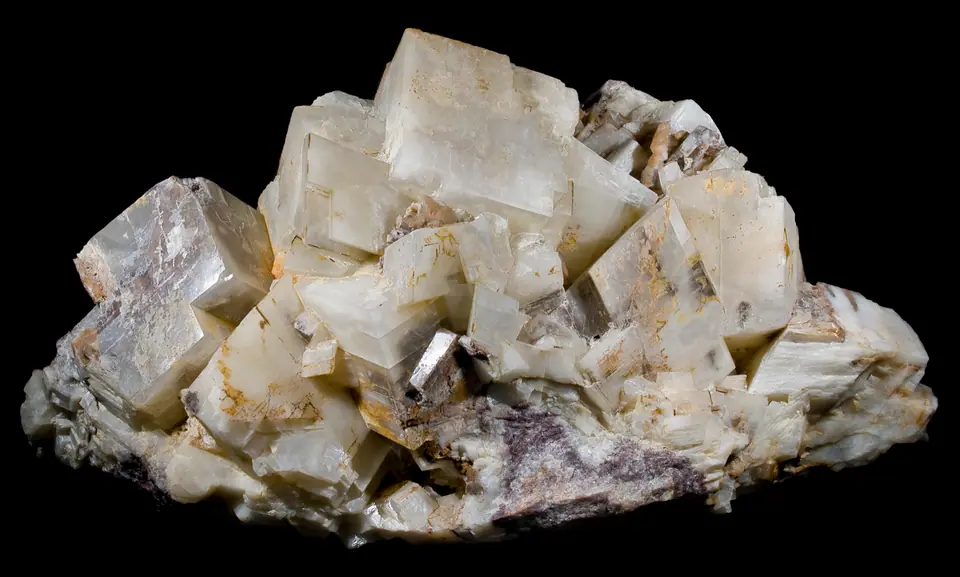

What is dolomite?
Dolomite contains calcium, magnesium, carbonate, and commonly minor iron or manganese. “Dolomite” names the mineral; “dolostone” is the preferred name for a sedimentary rock composed largely of dolomite.
What does dolomite look like?
Crystals are commonly rhombohedral and may have curved or saddle-shaped faces. Massive dolomite can be fine grained, sugary, porous, or difficult to distinguish visually from limestone.
Iron-bearing material weathers tan to brown. Pink hues may reflect manganese, while coatings and mixed calcite can change the apparent reaction and color.
Identification tests
Begin with observation and use the least destructive test first. Results can change with weathering, mixtures, coatings, and grain size. Review the step-by-step field-test methods before altering an unfamiliar specimen.
Hardness
3.5 to 4Harder than calcite and not scratched easily by copper.
Streak
WhiteConsistent but not diagnostic.
Cleavage
Perfect in three directions not at 90°Produces rhombohedral fragments similar to calcite.
Acid response
Weak on a cold fresh surface; stronger when powderedA controlled powdered test helps separate dolomite from readily effervescent calcite.
Useful procedures: Mohs hardness test · Mineral streak test · Cleavage versus fracture · Acid reaction test
Common lookalikes
Calcite
Softer and reacts vigorously with dilute acid on a clean unpowdered surface.
Magnesite
Similar carbonate with different composition; laboratory confirmation may be needed in fine-grained material.
Dolostone
A rock made mostly of dolomite rather than an individual mineral crystal.
How does it form?
Much sedimentary dolomite forms when magnesium-rich fluids alter earlier carbonate sediment or limestone during burial or fluid circulation.
Dolomite also forms in hydrothermal veins, metamorphic marble, evaporative settings, and some modern saline environments. Its origin can remain complex even where the mineral is easy to confirm.
Geologic setting and occurrence
Dolomite is widespread in carbonate sedimentary successions, hydrothermal veins, altered limestones, and metamorphic rocks. It may host groundwater, petroleum, and Mississippi Valley–type mineralization.
Acid response varies with grain size, temperature, coatings, porosity, and calcite impurities, so one ambiguous test should not carry the identification.
Uses and significance
Dolomite and dolostone are used as aggregate, dimension stone, soil amendment, refractory feedstock, and sources of magnesium-bearing material.
Field notes
- Use acid only on an expendable chip and wear eye protection.
- Do not acid-test monuments, cave formations, fossils, or protected outcrops.
- Keep the mineral name dolomite distinct from the rock name dolostone in field notes.
This guide supports preliminary field identification, not a laboratory determination, appraisal, hazard assessment, or statement of ownership or collecting permission. Verify land status and local rules before handling or collecting material.
Authoritative sources
LithoMap wrote this guide in original language using the scientific concepts and physical-property standards supported by these sources.
- Dolomite Deposit Near Marble, Stevens County, Washington U.S. Geological Survey
- Minerals and their physical properties U.S. National Park Service
- Mohs Hardness Scale U.S. National Park Service
- Natural Gemstones: Mineral Gemstones U.S. Geological Survey
Editorial review: September 17, 2026.