
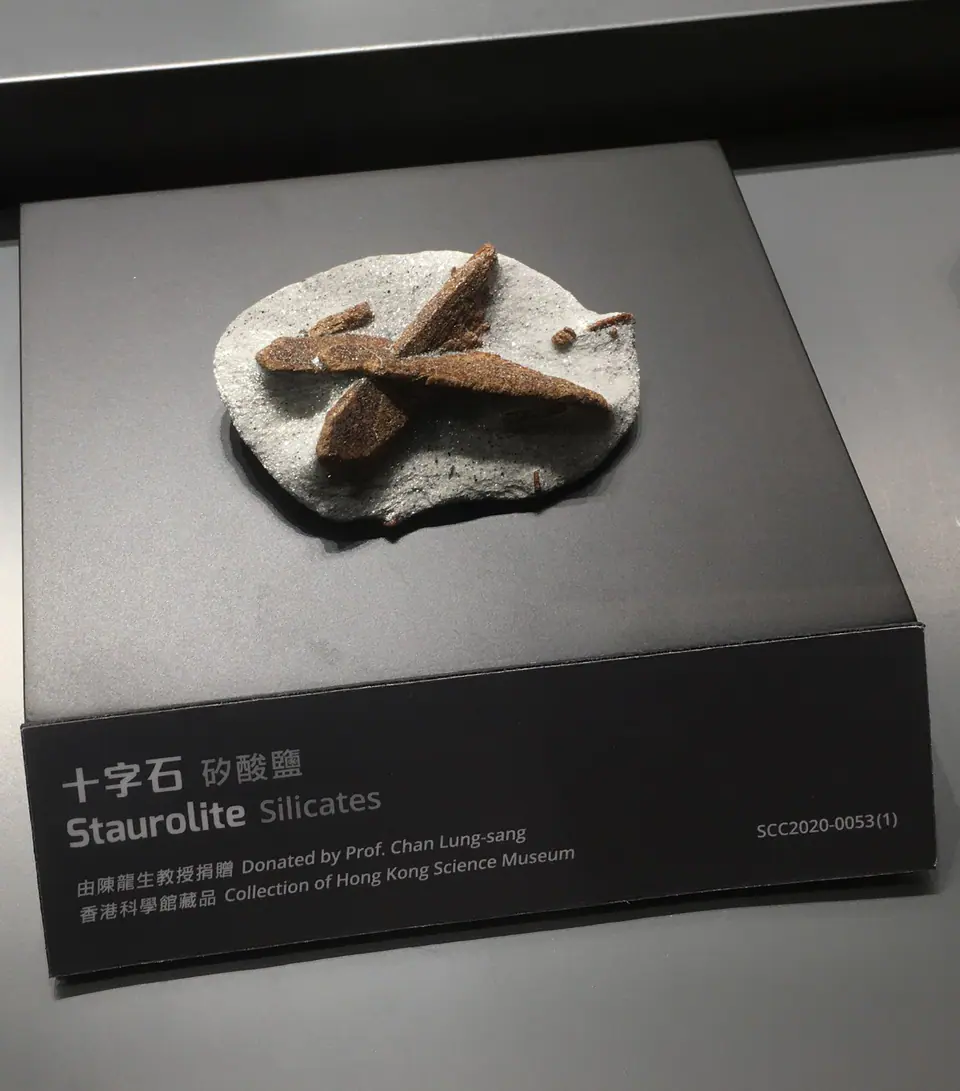

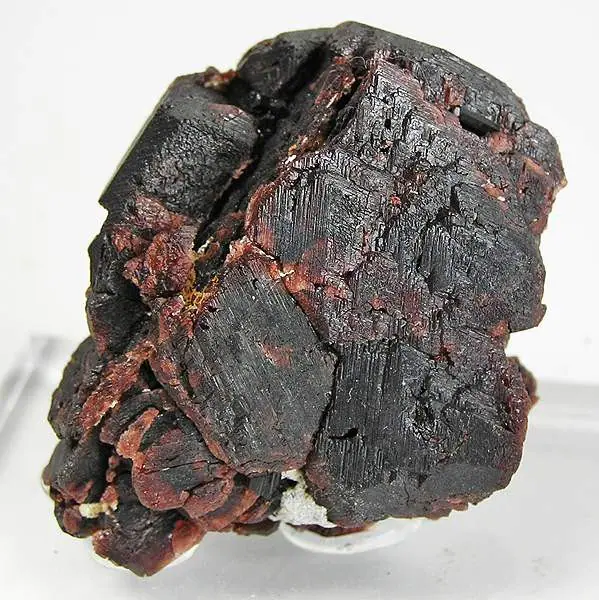

The most useful distinction
Use crystal geometry. Stout prisms or natural cross twins favor staurolite; compact many-faced or rounded crystals favor garnet.
Staurolite and Garnet comparison table
| Property | Staurolite | Garnet | How to use it |
|---|---|---|---|
| Habit | Prismatic, commonly penetration-twinned at about 60 or 90 degrees | Equant dodecahedra, trapezohedra, or rounded grains | The most decisive visible distinction. |
| Hardness | Mohs about 7 to 7.5 | Mohs about 6.5 to 7.5 depending on species | Strong overlap makes hardness a poor separator. |
| Cleavage | Poor | None | Both commonly fracture irregularly, so breakage is secondary. |
| Typical occurrence | Prismatic porphyroblasts in medium-grade mica-rich metamorphic rock | Equant porphyroblasts across a broad range of metamorphic rocks | Context supports the crystal-form evidence. |
A practical identification sequence
- 1
Observe complete crystal outlines where they meet the matrix.
- 2
Check for prismatic length or penetration twinning.
- 3
Compare with equant many-faced garnet forms.
- 4
Use microscopy or chemistry on broken grains lacking diagnostic shape.
Where the distinction gets difficult
- A cross shape must show natural crystal surfaces, not carving or mounting.
- Broken staurolite can appear equant and garnet can be irregular.
- Do not pry complete twins or garnets from protected outcrops.
Use several independent observations. This comparison supports preliminary field identification, not laboratory confirmation, appraisal, proof of origin, or collecting permission.
Staurolite vs. garnet FAQ
Can staurolite and garnet occur together?
Yes. Both are common metamorphic index minerals and can coexist in mica schist.
Does every staurolite make a cross?
No. Untwinned prismatic crystals are common, and some twins are incomplete or embedded.
Which one is redder?
Color overlaps and varies. Crystal form is much more reliable than red or brown tone.
Authoritative sources
LithoMap wrote this comparison in original language from the physical properties and geological concepts supported by these public scientific references.
- Minerals and their physical properties U.S. National Park Service
- Mohs Hardness Scale U.S. National Park Service
- Natural Gemstones: Mineral Gemstones U.S. Geological Survey
Editorial review: September 17, 2026.