
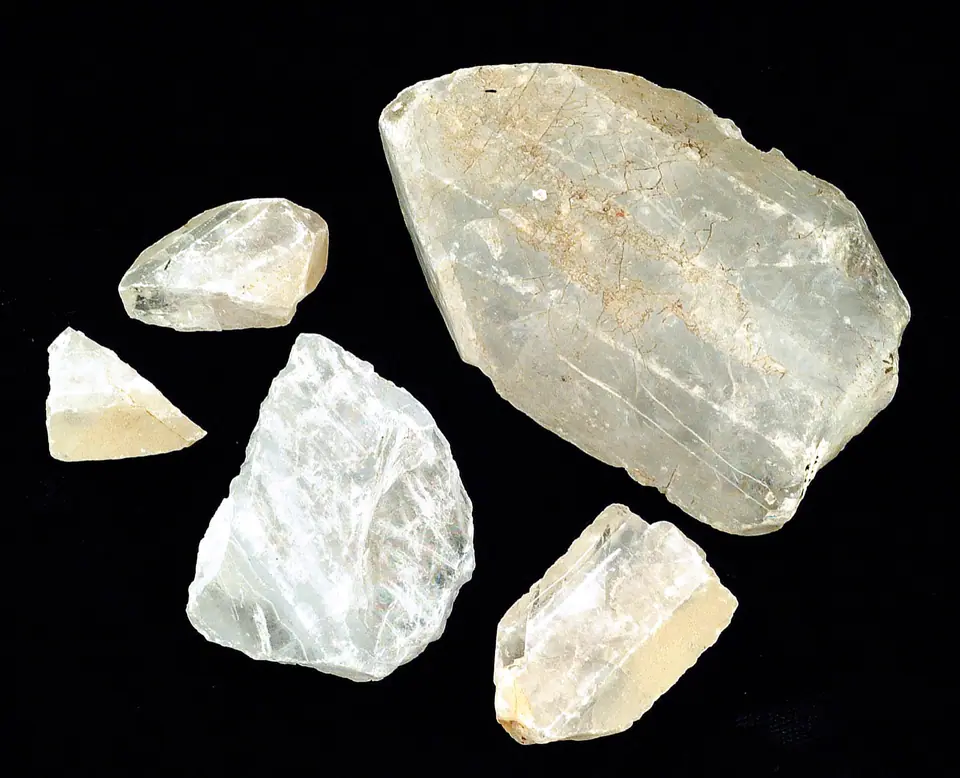

What is celestite?
Celestite is strontium sulfate and forms a solid-solution relationship with barite in some natural materials. Color may come from defects or impurities and is not a reliable measure of composition.
What does celestite look like?
Crystals commonly form transparent to translucent tablets, blades, or prisms with vitreous to pearly luster. It also occurs fibrous, granular, or massive.
Although pale blue is memorable, many specimens are white, gray, yellowish, reddish, or colorless and can resemble barite, calcite, or gypsum.
Identification tests
Begin with observation and use the least destructive test first. Results can change with weathering, mixtures, coatings, and grain size. Review the step-by-step field-test methods before altering an unfamiliar specimen.
Density
High; specific gravity commonly near 4Heavier than calcite or gypsum but often slightly lighter than barite.
Hardness
About 3 to 3.5Scratched by steel and overlaps barite and calcite.
Cleavage
Good to perfect in more than one directionProduces flat reflective breaks but is not decisive against barite.
Streak
WhiteConsistent but shared by many pale minerals.
Useful procedures: Specific gravity and density test · Mohs hardness test · Cleavage versus fracture · Mineral streak test
Common lookalikes
How does it form?
Celestite forms in sedimentary evaporite and carbonate environments, in cavities and geodes, and through low-temperature hydrothermal processes.
It may occur with gypsum, anhydrite, calcite, sulfur, halite, fluorite, or barite.
Geologic setting and occurrence
Celestite occurs in sedimentary basins, evaporite sequences, carbonate cavities, and some geodes, with important deposits in several parts of the world and scattered U.S. occurrences.
Blue color alone does not establish celestite, and a hand specimen may require specific-gravity or analytical confirmation.
Uses and significance
Celestite is the principal mineral source of strontium, used in ceramics, glass, ferrite magnets, pyrotechnics, metallurgy, and other chemical applications.
Field notes
- Do not perform flame tests outside a controlled laboratory.
- Compare measured volume and mass rather than subjective heft when possible.
- Avoid dust and do not ingest unknown sulfate minerals.
This guide supports preliminary field identification, not a laboratory determination, appraisal, hazard assessment, or statement of ownership or collecting permission. Verify land status and local rules before handling or collecting material.
Authoritative sources
LithoMap wrote this guide in original language using the scientific concepts and physical-property standards supported by these sources.
- Strontium Statistics and Information U.S. Geological Survey
- Minerals and their physical properties U.S. National Park Service
- Mohs Hardness Scale U.S. National Park Service
- Natural Gemstones: Mineral Gemstones U.S. Geological Survey
Editorial review: September 17, 2026.