
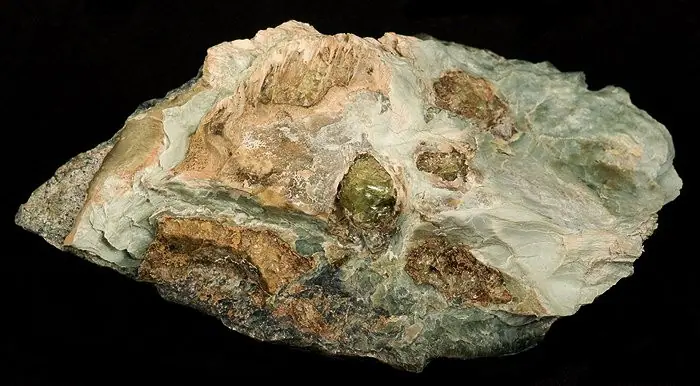

What is olivine?
Olivine is a solid-solution group between magnesium-rich forsterite and iron-rich fayalite. Most common rock-forming grains lie between those end members.
What does olivine look like?
Olivine often occurs as small glassy green grains scattered through dark basalt or concentrated in coarse ultramafic rock.
Weathering and hydrothermal alteration can replace it with reddish-brown iron oxides, clay, carbonate, or green serpentine minerals. Fresh surfaces are important.
Identification tests
Begin with observation and use the least destructive test first. Results can change with weathering, mixtures, coatings, and grain size. Review the step-by-step field-test methods before altering an unfamiliar specimen.
Hardness
6.5 to 7Fresh grains scratch glass.
Streak
WhiteOften difficult to obtain because grains are hard.
Cleavage
Poor or indistinctBreaks unevenly rather than into repeated flat sheets.
Luster
VitreousBest seen on fresh green grains.
Useful procedures: Mohs hardness test · Mineral streak test · Cleavage versus fracture
Common lookalikes
Epidote
Often pistachio green with one good cleavage and commonly more elongate crystals.
Serpentine
Usually softer, waxier, and may be fibrous or massive rather than hard glassy grains.
Green garnet
Garnet lacks cleavage too but commonly forms more equant crystal shapes and can be denser.
How does it form?
Olivine crystallizes early from many mafic and ultramafic magmas and is a major mineral in Earth’s upper mantle.
It reaches the surface in basalt, mantle xenoliths, and tectonically exposed ultramafic rocks. It weathers comparatively quickly under many surface conditions.
Geologic setting and occurrence
Olivine is common in basalt, gabbro, peridotite, and mantle xenoliths. Gem peridot requires unusual clarity, color, and crystal size.
Loose green grains in volcanic sand may include olivine, pyroxene, glass, or several minerals; magnification and testing improve confidence.
Uses and significance
Olivine is used as foundry sand, refractory material, slag conditioner, and gemstone. It is also studied for potential carbon-mineralization applications.
Field notes
- Avoid fibrous alteration products in unknown ultramafic rock; do not create dust.
- Color alone cannot distinguish olivine from other green silicates.
- Gem quality and value cannot be established from a field identification.
This guide supports preliminary field identification, not a laboratory determination, appraisal, hazard assessment, or statement of ownership or collecting permission. Verify land status and local rules before handling or collecting material.
Authoritative sources
LithoMap wrote this guide in original language using the scientific concepts and physical-property standards supported by these sources.
- Minerals and their physical properties U.S. National Park Service
- Mohs Hardness Scale U.S. National Park Service
- Natural Gemstones: Mineral Gemstones U.S. Geological Survey
Editorial review: September 17, 2026.