
.jpg)
What is epidote?
Epidote contains calcium, aluminum, iron, silicon, oxygen, and hydroxyl. Iron content strongly influences color and optical properties, and epidote belongs to a broader mineral group with related species.
What does epidote look like?
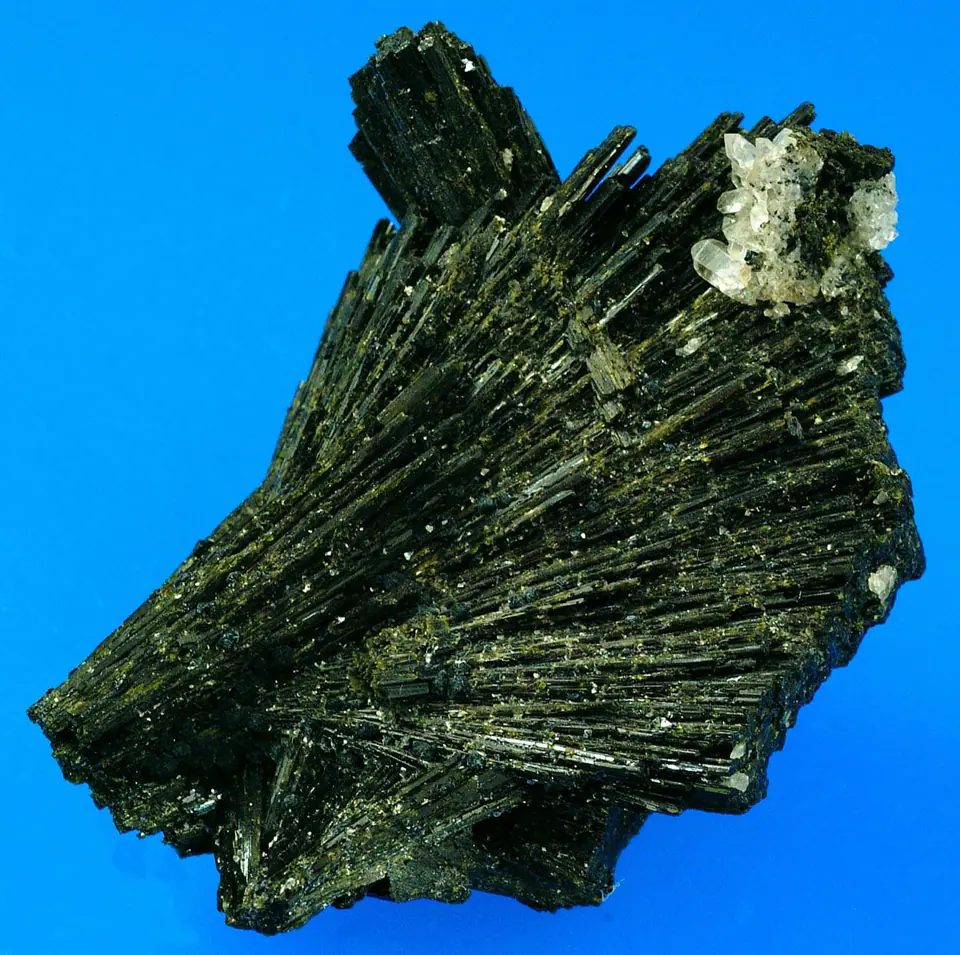
Crystals are commonly elongate, striated, or bladed with yellow-green to dark green color and vitreous luster. It also occurs as granular aggregates, vein fillings, coatings, or fine disseminations.
Massive epidote can give altered rock a distinctive pistachio-green cast. Dark specimens may resemble hornblende, tourmaline, or pyroxene without close inspection.
Identification tests
Begin with observation and use the least destructive test first. Results can change with weathering, mixtures, coatings, and grain size. Review the step-by-step field-test methods before altering an unfamiliar specimen.
Hardness
About 6 to 7Commonly scratches glass and is much harder than chlorite or serpentine.
Cleavage
One perfect directionMay produce flat reflective breaks along elongate crystals.
Streak
White to graySeparates it from green-streaking malachite.
Color
Characteristic pistachio to yellow-green in many samplesHelpful but not sufficient alone.
Useful procedures: Mohs hardness test · Cleavage versus fracture · Mineral streak test
Common lookalikes
Olivine
Usually granular with poor cleavage and occurs prominently in mafic or ultramafic igneous rocks.
Malachite
Much softer, leaves a green streak, and commonly forms banded or botryoidal carbonate material.
Tourmaline
Commonly triangular in cross section with strong lengthwise striations and poor cleavage.
How does it form?
Epidote forms during low- to moderate-grade metamorphism, hydrothermal alteration, and chemical replacement of plagioclase and other calcium-bearing minerals.
It is common in greenschist-facies rocks, skarns, veins, altered volcanic rocks, and around igneous contacts, often with chlorite, actinolite, albite, quartz, or calcite.
Geologic setting and occurrence
Epidote is widespread in metamorphic belts and hydrothermally altered igneous rocks. It can occur as attractive crystals in veins or as abundant fine green alteration.
A green altered rock may contain epidote with chlorite and actinolite; the whole rock should not automatically be named for one color.
Uses and significance
Transparent epidote is occasionally faceted for collectors, and attractive crystals are collected. Its chief geological importance is as an indicator of metamorphism and hydrothermal alteration.
Field notes
- Confirm hardness before relying on green color.
- Do not scratch transparent or well-formed crystals.
- Altered slopes and mine workings may be fractured and unstable.
This guide supports preliminary field identification, not a laboratory determination, appraisal, hazard assessment, or statement of ownership or collecting permission. Verify land status and local rules before handling or collecting material.
Authoritative sources
LithoMap wrote this guide in original language using the scientific concepts and physical-property standards supported by these sources.
- Minerals and their physical properties U.S. National Park Service
- Mohs Hardness Scale U.S. National Park Service
- Natural Gemstones: Mineral Gemstones U.S. Geological Survey
Editorial review: September 17, 2026.